


Rated operational voltage, Ue, describes the voltage associated with a device's declared operating duty. Rated insulation voltage, Ui, is a reference for its insulation characteristics and related verification. Rated impulse withstand voltage, Uimp, addresses a different transient-voltage condition. These values answer different questions and must not be substituted for one another. A switch disconnector with a Ui marking above the supply voltage is not automatically approved to switch that supply at the required current and load category. This guide explains how panel buyers should read the three voltage fields and retain configuration-specific evidence for an HGL(ETGL) switch-disconnector inquiry.
Start with the duty the switch must perform
Before reviewing a nameplate, identify the circuit voltage, alternating or direct current, frequency, load characteristics and operating function. State whether the device will switch the load, provide isolation or perform both functions. Include the number of poles and the actual connection arrangement. A voltage value without this duty information is an incomplete selection criterion.
The operational rating belongs with the current, utilization category and other declared conditions. A product can have different operating ratings for different applications. Do not take the highest voltage number found anywhere in a brochure and treat it as the answer to every application question. Retain the row or declaration that covers the proposed duty, and identify the exact code to which it applies.
Understand Ue without turning it into a universal limit
Ue is the voltage used with the operational current and relevant conditions to describe the equipment's intended application. For a purchasing review, ask which declared Ue applies to the proposed circuit and what operating current and category accompany it. An AC operational rating does not, by itself, establish a DC operational rating. Similarly, a rating for one load category does not prove the same switching duty for another.
The IEC 60947-1 standard overview identifies the general rules, characteristics and verification framework for low-voltage switchgear. The applicable product standard and manufacturer's declaration determine the actual rating combination. A standard's overall voltage scope is not a declaration that every product within that scope can operate at the scope's upper boundary.
Understand Ui as an insulation-related characteristic
Ui is associated with insulation verification and creepage-distance considerations. It should be recorded separately from the operational rating. It is not a second load-switching approval, a field-test instruction or permission to increase the applied supply voltage. A large Ui figure can therefore coexist with a lower declared operating voltage without any contradiction.
The GSO preview of IEC 60947-1 distinguishes the symbols and the corresponding characteristic clauses. Use the complete applicable document and exact product information for engineering decisions. This article does not reproduce the standard's test tables or assign a test voltage to a SUTON product. Any dielectric test performed on equipment must follow the approved test method and take connected electronics and accessories into account.
Keep impulse withstand separate from continuous operation
Uimp describes a specified impulse withstand characteristic. It is not a continuous operating-voltage rating and should not be compared with a normal supply voltage as though the two represent the same condition. Record its unit and applicable conditions rather than copying a number without its symbol. Confusing volts and kilovolts can make a comparison appear impressive while answering the wrong question.
The installation's transient environment, insulation coordination and assembly design need their own review. The IEC 60664-1 overview describes its role in insulation coordination, including clearances, creepage and solid insulation. It does not establish the dimensions or approval of a particular assembled panel. Product evidence and assembly verification must be kept connected to the installation assumptions.
Compare the voltage fields in a controlled schedule
| Symbol | Purpose in review | Incorrect shortcut |
|---|---|---|
| Ue | Declared operational duty with current and category | Choosing a higher brochure number instead |
| Ui | Insulation-related reference characteristic | Treating it as an extra switching approval |
| Uimp | Specified impulse withstand condition | Treating kV impulse data as continuous service voltage |
| Accessory voltage | Separate control or contact duty | Applying the main-circuit value to every terminal |
| Document revision | Exact model and conditions | Copying a family-wide maximum to every size |
| System requirement | Approved application and assembly design | Approving from one voltage number alone |
The table is a qualitative reading aid, not a calculation method. Each entry in a purchase schedule should cite the actual supplier document and revision. Where a voltage symbol is missing or translated ambiguously, request clarification before approval. Do not resolve an unclear label by borrowing the meaning of a similar number from a different manufacturer's catalogue.
For related current and switching questions, the making and breaking capacity guide explains why the duty must remain attached to its conditions. Voltage-field interpretation complements that review; it does not establish current or fault suitability on its own.
Use the HGL(ETGL) product page without flattening its table
The SUTON HGL(ETGL) load-disconnector page publishes operational, insulation and impulse-related information across a range of sizes. It also describes distinctions within the range, including isolation-only applications for specified larger ratings. A buyer must preserve those distinctions when requesting a model-level response.
Tables copied into spreadsheets can lose merged headings, units or alignment. That is especially risky when a long product-range table is reduced to a single line. Obtain a clear datasheet for the exact offered code and ask the supplier to identify the applicable voltage and duty rows. Keep the original document with the schedule instead of treating a manually copied number as the sole evidence.
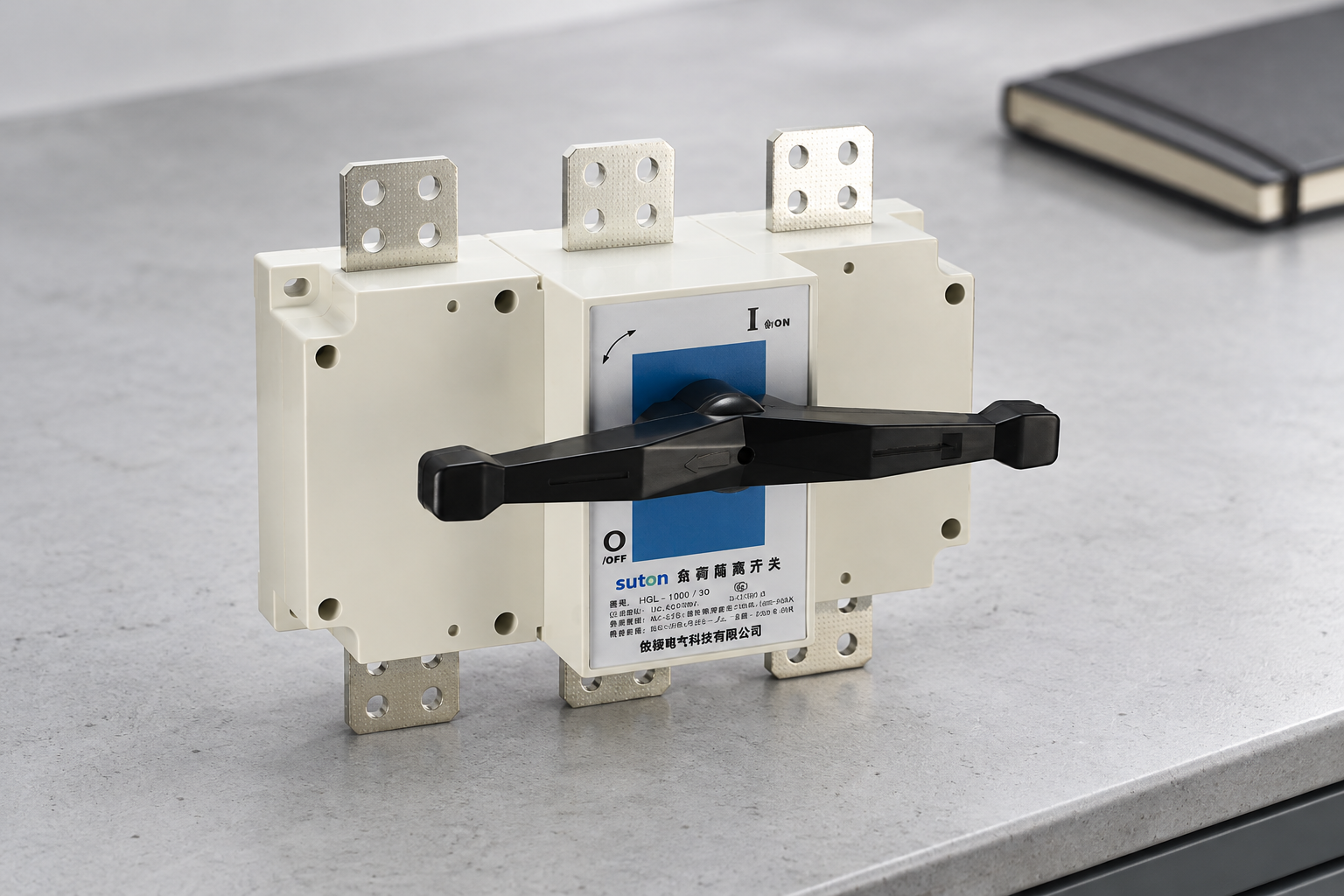
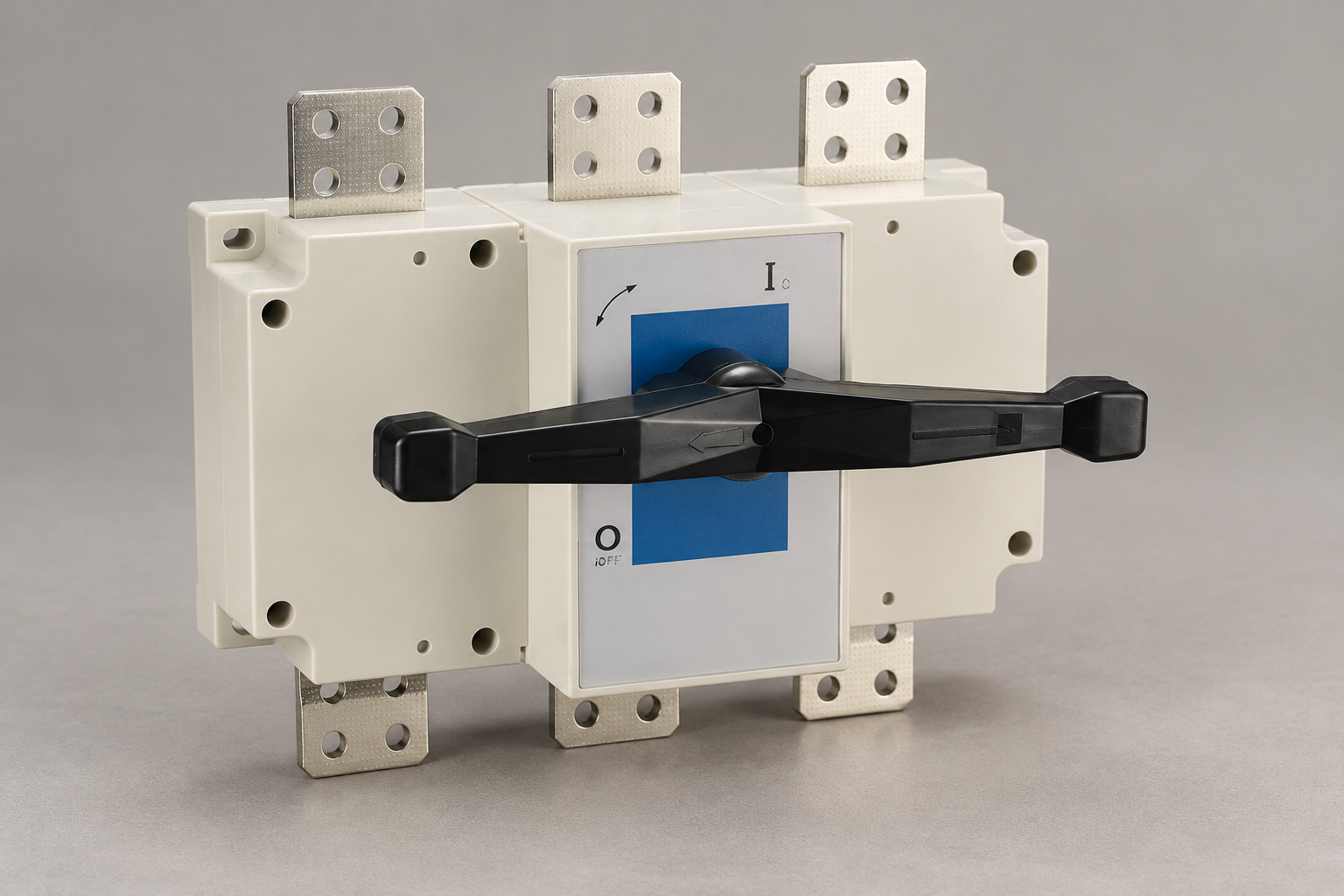
The product photograph is useful for identifying the family and its external arrangement. It cannot show the rated insulation characteristic or prove a switching performance. The image in this article is an exterior reference illustration and should be read alongside the documents, not as a substitute for them.
Review accessories and separate circuits
A main switch can include auxiliary contacts, indication components or an external operating arrangement. Those items may have their own electrical or environmental conditions. The main-circuit voltage does not automatically establish the voltage or load that an auxiliary contact can switch. Keep the main circuit, control supply and signal interface as separate schedule entries.
Ask for the exact accessory code and contact duty where remote indication is required. Confirm which circuit a terminal belongs to before comparing ratings. If an accessory changes during procurement, reopen the affected review rather than assuming that the original main-switch approval covers it. This prevents a correctly selected main circuit from being paired with an unsuitable control interface.
Avoid three common quotation shortcuts
The first shortcut is approving the product because Ui exceeds the supply voltage. That leaves Ue, current and utilization category unanswered. The second is treating Uimp as an operating voltage, which confuses a transient characteristic with a different service condition. The third is copying one family's most favorable rating into every size and construction offered under the same trade name.
A stronger review asks a supplier to answer each requirement against the exact configuration. Where a response uses only a generic brochure, mark the unresolved fields rather than filling them from memory. The switch-disconnector utilization category guide covers the load-category decision, and the isolator switch planning guide covers the installation role. Neither should be skipped because the voltage labels look familiar.
Use examples as reading exercises rather than approvals
Suppose a hypothetical quotation lists an operating voltage in volts, a higher insulation reference in volts and an impulse withstand value in kilovolts. The correct first response is to place each figure under its own symbol and purpose. It is not to select the largest figure or convert every value into a single ranking score. The circuit's required operating duty must be matched to its declared operational rating, while the insulation and transient requirements are assessed separately.
No numerical product approval follows from that example. Even a proposal with apparently adequate voltage fields can fail on switching duty, fault conditions, environment, terminals or assembly integration. Conversely, a lower Ui than a competing offer does not automatically make a product unsuitable if its complete evidence satisfies the actual design requirements. Comparisons should be requirement-based rather than marketing-number based.
Preserve evidence through handover and changes
Retain the exact order code, pole arrangement, voltage fields, current and category, short-circuit evidence, accessories, installation conditions and document revision. Link those records to the equipment tag. A later substitution should be compared against the same requirement sheet. If the supply or load changes, review the operational duty again rather than relying on an old insulation value.
Record acceptance questions and the supplier's written answers. If a requested duty is not covered, ask for a suitable configuration or an explicit limitation. That is a more useful outcome than an apparently complete table assembled from assumptions. It gives the panel builder a defensible equipment schedule and helps maintenance personnel understand which conditions were actually approved.
Frequently asked questions
Can Ui be used as the permitted switching voltage?
No. Ui is an insulation-related characteristic. Verify the declared operational voltage, current, utilization category and configuration for the actual switching duty.
Does an AC voltage rating establish a DC rating?
No. Obtain the applicable DC declaration and approved configuration where a DC application is proposed. An AC rating alone does not establish that duty.
Why keep Uimp separate from Ue and Ui?
It addresses a specified impulse withstand condition. Its purpose and units differ from continuous operation and insulation-reference fields, so it must be assessed under the appropriate conditions.
Educational video
Mod-01 Lec-16 Dielectric (Insulating) Solids by nptelhrd. This NPTEL university lecture explains solid dielectric principles. It supports the insulation discussion and does not assign voltage ratings or test procedures to a particular SUTON product.