

A fuse switch disconnector category must be read in two layers: the switching assembly's utilization category and the fitted fuse-link's declared characteristics. These layers answer different questions. The first concerns the supported switching duty at specified conditions; the second concerns the protective fuse and its application. A fuse's breaking capacity does not automatically become the switch's load-breaking rating, and a large frame current does not prove motor-switching suitability. Buyers should obtain the exact assembly declaration, approved fuse codes and coordination information together, then compare them with the actual load, voltage and installation conditions.
Identify the complete fuse-switch arrangement
A fuse-combination device joins switching or disconnecting functions with fuse-related components. Product terminology can describe different arrangements, including whether a fuse-link or carrier participates in the moving assembly. A catalogue title is therefore not enough to establish how a particular device operates. Obtain the selected model's instructions, operating function and component identification.
Record the switch body, fuse carrier, fuse-link type and any operating accessories as one proposed combination. State which items are supplied and which must be selected separately. If the quoted switch arrives without fuse-links, a final assembly has not yet been defined. Replacement fuse availability and identification should be addressed before the first purchase rather than after a protective operation.
The IEC 60947-3 product scope includes fuse-combination units and dedicated accessories. The applicable declaration must cover the actual equipment and conditions. This article explains the buying questions, not a new compliance claim for SUTON or a substitute for the complete standard and selected manufacturer's documents.
Read the switching category with its rated conditions
Utilization categories describe the supported type of switching duty. For common AC duties, AC-21 concerns resistive loads, AC-22 mixed resistive and inductive loads, and AC-23 motor or other highly inductive loads. Read the declaration at the actual operational voltage and current. The category is not an unconditional permission to switch any circuit that happens to fit the terminals.
The A and B suffixes distinguish frequent and infrequent operation categories. They do not provide a universal service life or justify an assumed maintenance interval. Obtain the relevant endurance and operating conditions for the exact assembly. Where the device is used for repeated motor control, review the manufacturer's supported application and any additional requirements with the responsible designer.
The AC-22A versus AC-23A guide covers the underlying load-duty comparison. This article adds the fuse-combination review: an accepted switch rating still needs the correct fuse-links and their supported relationship to the assembly. Do not apply an AC category to a DC application without a separate declared DC duty and configuration.
Keep fuse-link classification separate
A fuse-link's category and characteristics concern its protective role, application and operating behavior. A fuse label such as gG or aM is not an AC-22 or AC-23 switching category. Obtain the exact fuse manufacturer's application documentation, time-current information and any required complementary protection. Never infer protection coverage from physical interchangeability alone.
The IEC 60269-1 general fuse requirements form part of the relevant standards framework for low-voltage fuse-links. That scope does not confirm that any fuse carrying an IEC reference is suitable for every carrier or circuit. Verify the applicable product details, dimensions, voltage rating and supported use in the chosen assembly.
For procurement, preserve the fuse code rather than reducing the specification to amperes. Two fuse-links with the same nominal current may serve different applications or have different characteristics. Changing type can alter the accepted protection arrangement. Treat substitutions as a review requiring documentation, especially where downstream equipment protection or selectivity was assessed using a particular fuse.
Compare the four rating questions
| Rating question | Evidence required | Do not substitute |
|---|---|---|
| Load switching | Operational voltage/current and utilization category | Fuse breaking capacity |
| Current carrying | Actual assembly and thermal conditions | Unqualified family frame current |
| Fuse protection | Exact fuse code and application data | Switch utilization category |
| Fault coordination | Supported switch/fuse combination and conditions | Unrelated fuse catalogue number |
| Isolation | Declared isolation and assembly arrangement | OFF appearance alone |
| Replacement | Approved fuse and accessory codes | Physical fit or label current alone |
This qualitative table separates switching, carrying and protection evidence. It does not publish unverified SUTON ratings, test results or coordination limits. Use the selected model's documents to fill the evidence column. A blank or conditional response remains a review item; it should not be converted into a pass using a more attractive number from another part of the catalogue.
For a practical comparison, imagine two proposed assemblies with the same nominal current. One has a documented mixed-load duty at the required voltage; the other only provides a frame carrying current. Their quotations cannot be judged equivalent until the second supplier supplies the missing operational evidence. Likewise, a fuse's high fault-interruption capability does not fill that information gap.
Review fault coordination as an assembly question
The circuit's available fault assessment and protective arrangement must be compatible with the declared switch and fuse combination. Request the exact supported fuse-link code, rating and relevant conditions. If a conditional short-circuit rating is quoted, retain the protective-device and installation conditions alongside it. Removing those conditions from a comparison table can make an incomplete offer appear stronger.
Read the switch-disconnector making and breaking capacity explanation for the distinction between load switching, making, withstand and conditional ratings. These terms must retain their individual meaning when a fuse is added. Do not transfer the fuse's interruption number onto the switch body or assume a different fuse preserves the accepted combination.
Coordination with downstream equipment also needs its own assessment. Ask the responsible designer which protective functions and operating relationships are required, then request manufacturer data for that review. A general claim that a fuse is fast or current-limiting is not a complete coordination study. Keep the accepted evidence with the circuit schedule and bill of materials.
Check thermal and mechanical compatibility
Verify the permitted fuse format, carrier, terminals and conductor preparation requirements. Ask which fuse power-loss or thermal limits apply to the assembly and enclosure. A fuse that fits physically can still fall outside the supported conditions. Enclosure temperature, grouping, mounting and conductor arrangement should be reviewed using the actual manufacturer's instructions.
Do not assume that the largest current printed on a switch family page applies to every fuse combination. Obtain operational and carrying ratings for the chosen configuration. Any relevant thermal adjustment must come from accepted documents, not a generic percentage. The purchase specification should identify the ambient and enclosure conditions used in the project assessment.
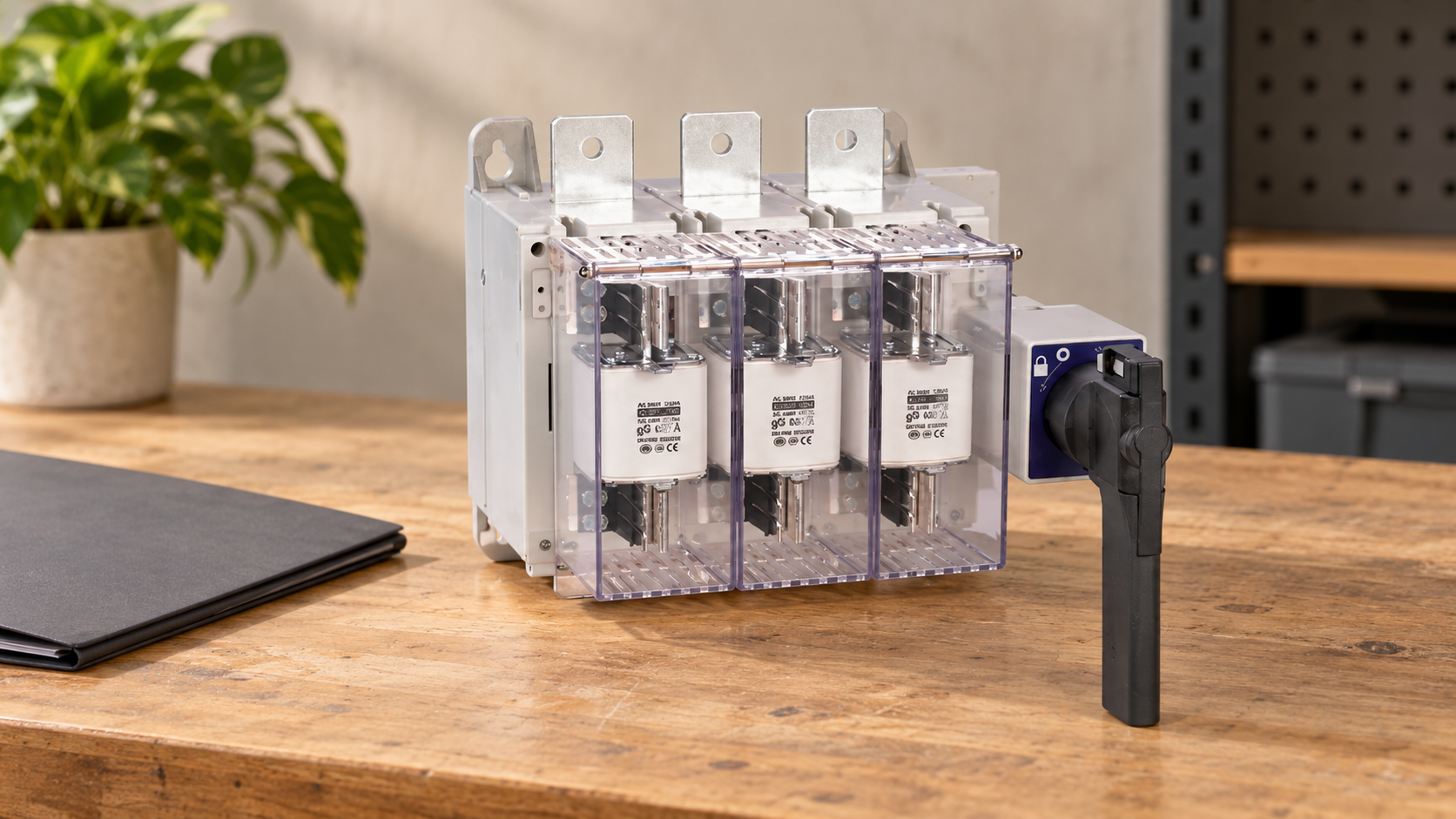
Mechanical operation requires similar care. Record whether the complete device is directly operated or uses a supported external mechanism, and what cover, barrier and access provisions are supplied. The appearance of transparent fuse covers does not establish finger protection, safe access or an interlock function. Ask for the declared arrangement rather than interpreting a product photograph as an inspection result.
Plan replacement and maintenance before commissioning
A protective operation requires investigation under the site's procedure. Restoring service by installing a larger fuse is not an acceptable selection method. Keep approved spare codes, the circuit identity and the accepted protective arrangement accessible to maintenance staff. Record how the cause of operation is assessed and who authorizes return to service.
Replacing fuse-links is electrical work. The required isolation boundary can include incoming terminals, alternative supplies and stored energy. The HSE guidance on secure isolation provides general principles; a fuse carrier or an OFF position alone is not a complete work procedure. This guide does not instruct users to remove fuse-links under load or access energized components.
Specify the documentation needed after replacement, including the installed code and any inspection findings. If a different fuse type is proposed because the original is unavailable, obtain an approved alternative before use. Maintaining a controlled spare list reduces the temptation to choose by size, label current or supplier availability alone and preserves the basis of the original selection.
Request exact SUTON ETGLR evidence
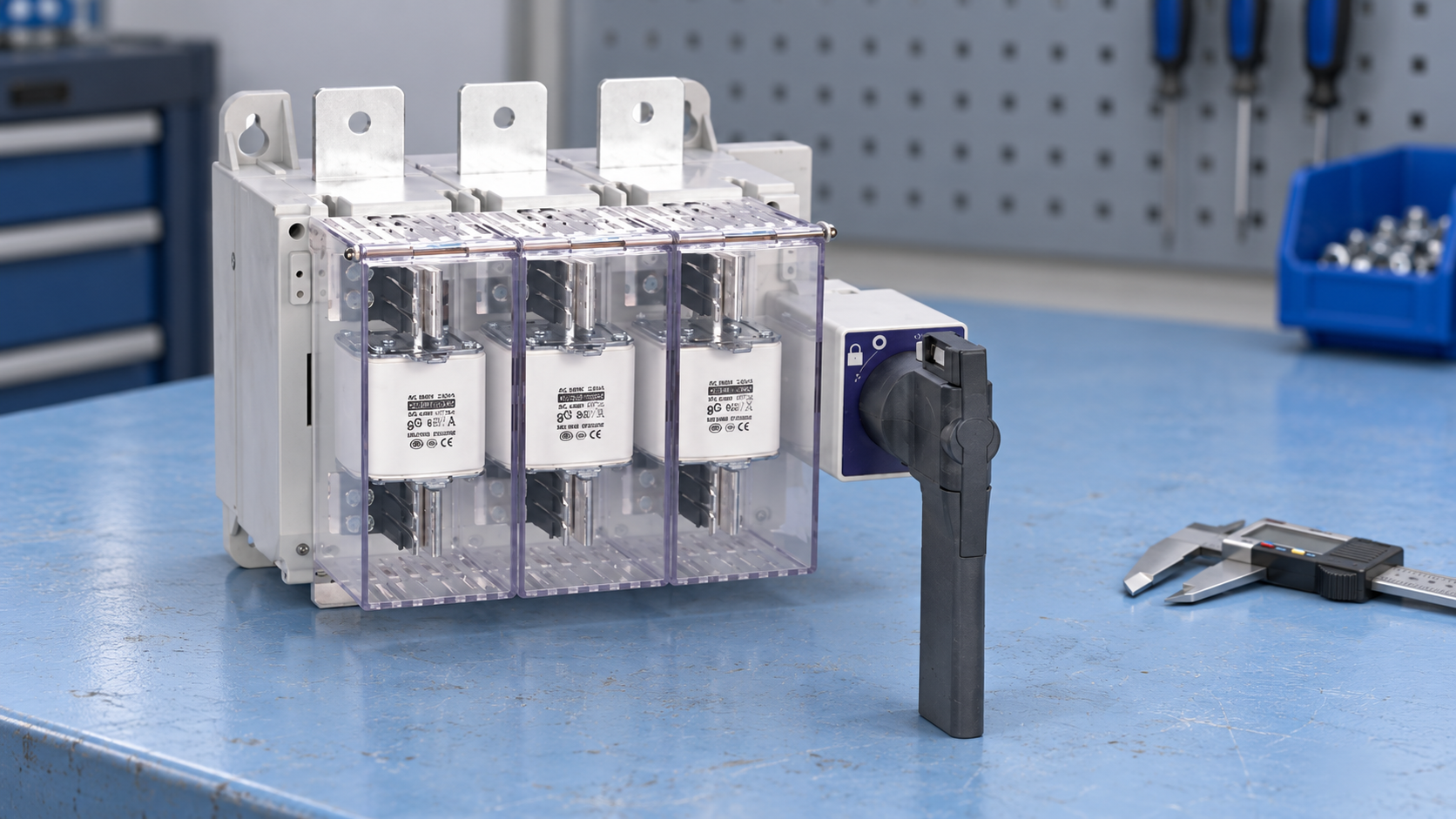
The SUTON ETGLR fuse switch-disconnector is the relevant product family for this enquiry. The reference-based illustrations show its exterior and fuse-cover arrangement. They do not certify a utilization category, contact condition, fuse compatibility or fault rating for a selected model. Obtain those details in the quotation and supporting documents.
Send the load description, actual voltage, operational current, switching frequency, pole arrangement, enclosure conditions and fault assessment. Identify whether the project already specifies fuse-links and include their complete codes. Ask SUTON to confirm the accepted assembly and explain which documents support each duty. Request accessory compatibility and replacement requirements at the same time.
The best response distinguishes confirmed information from conditions requiring additional project input. A quotation should not leave the buyer to combine unrelated ratings from a switch table and a fuse brochure. Contact SUTON with the circuit information and request a supported proposal. Retain the accepted model, fuse and accessory codes as one controlled purchase record.
Build an acceptance record for repeat orders
Use a single record containing the assembly identity, selected fuse-links, operational voltage and category, carrying conditions, coordination evidence and approved accessories. Add the source document revision and the reviewer who accepted the proposal. This prevents a later repeat order from quietly changing the technical basis while retaining the same commercial description.
When a project expands, compare the new circuit conditions rather than copying the previous current rating. Different loads, voltage, switching frequency or enclosures can require a fresh assessment. A successful installation provides useful experience, but it does not establish suitability for every future application. Repeat purchasing should preserve evidence, not replace it with familiarity.
For the overall equipment review, use the disconnect-switch guide for panel builders as the parent selection framework. Apply this article to its specific fuse-combination evidence requirements.
Frequently asked questions
Is a fuse-link category the same as a switch utilization category?
No. They describe different functions. The fuse-link classification concerns its protective application and characteristics; the switch utilization category concerns supported switching duty. Both need review in a fuse-combination assembly, together with voltage, current, installation and coordination conditions.
Can a higher-breaking-capacity fuse upgrade the switch rating?
Not automatically. The accepted assembly rating depends on the documented combination and its conditions. A different fuse may require a new coordination review. Do not relabel the switch's operational or fault capability using only a number printed on the replacement fuse.
What information is essential for an ETGLR quotation?
Provide the circuit voltage, load type, current, intended switching frequency, conductor arrangement, enclosure conditions and fault assessment. Include any specified fuse-link codes. Request exact model and accessory identification, declared switching duty, approved fuse compatibility and coordination evidence before accepting the offer.
Educational video
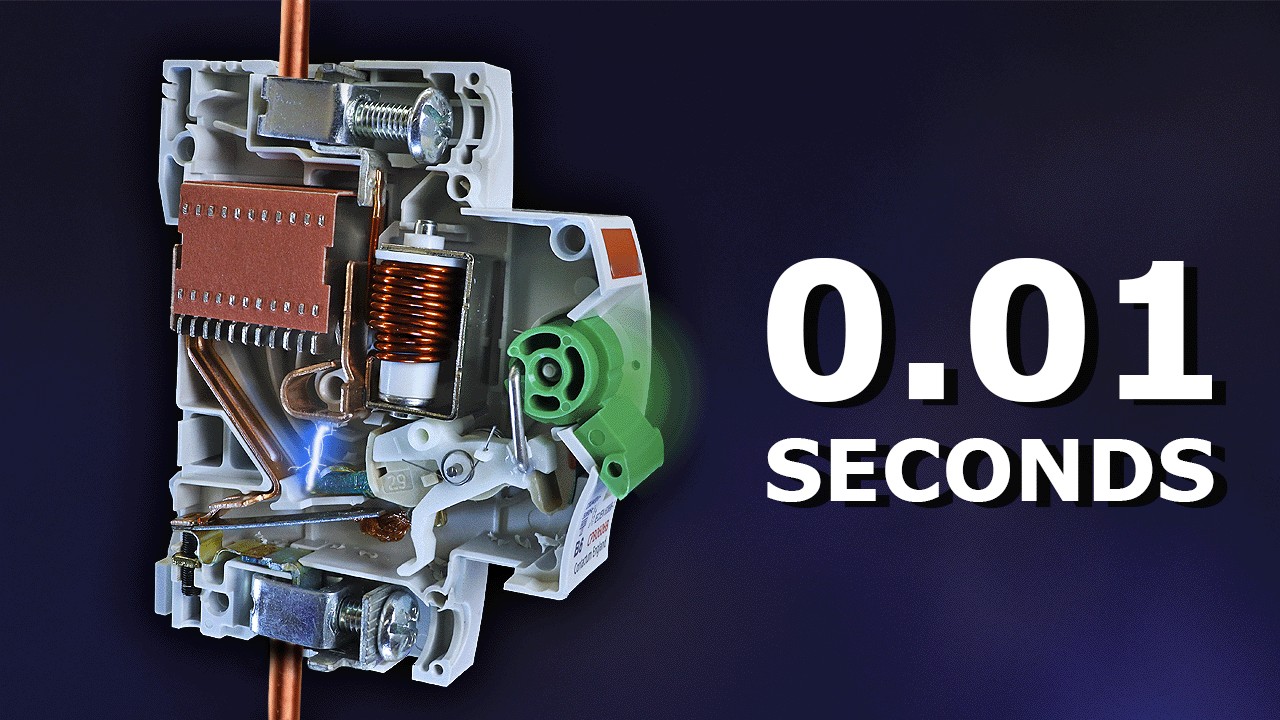
Why Circuit Breakers DON'T Protect People (electric shocks) by The Engineering Mindset. This video explains electrical-shock protection limits; it supports the safety-function distinction here, not an exact SUTON rating, PV connection, fuse selection or installation procedure.