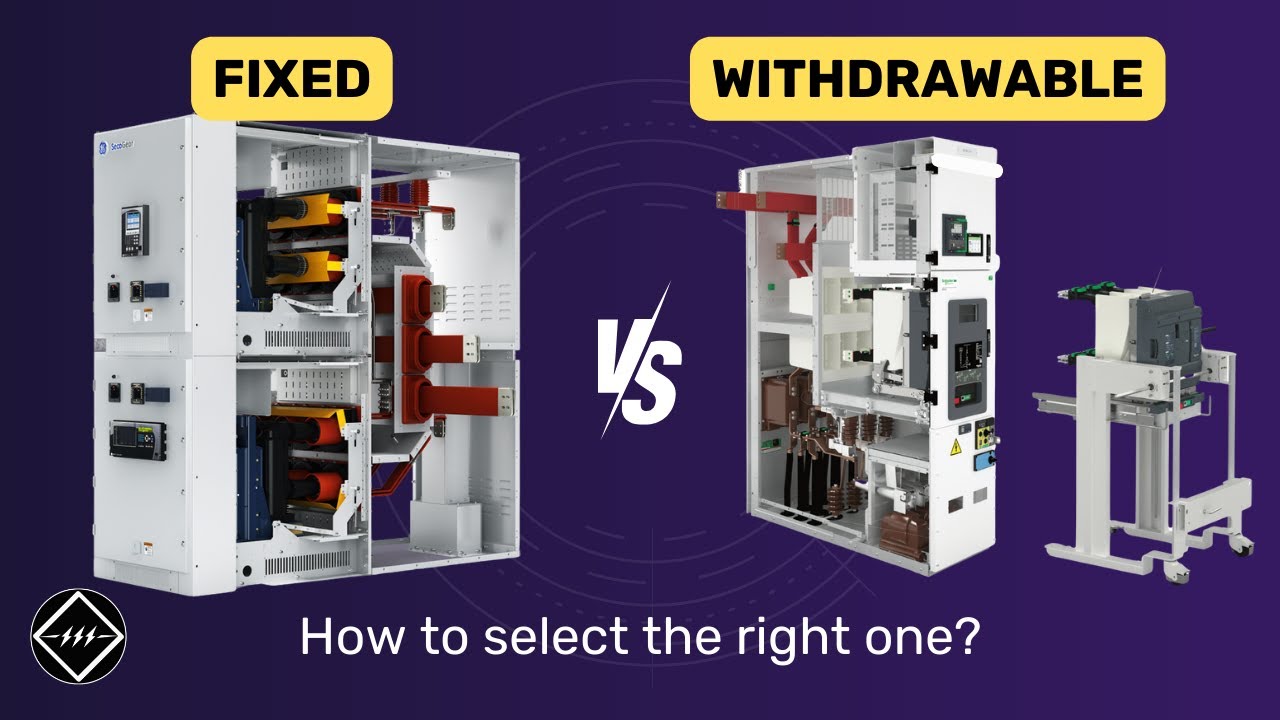


Fixed vs drawout ACB selection is mainly a switchboard service decision, not a change to the basic purpose of the breaker. Fixed units use direct mounting; drawout assemblies add a compatible cradle and controlled withdrawal interface. Compare the intended outage procedure, spare strategy, operator training, installation space and complete assembly cost. Both must independently meet the system voltage, current, fault and protection requirements. Never assume that a photographed breaker is supplied in either construction without the exact model documents.
Start with the maintenance task, not the breaker photograph
A fixed ACB is mechanically installed and connected at its final position. A drawout design uses a compatible cradle and mechanism that permits controlled movement of the breaker through positions defined by the manufacturer. The practical question is how the switchboard will be operated, inspected, tested and repaired during its life. An attractive removable mechanism has little value if there is no access, trained staff or spare breaker to use it.
Define the load, source arrangement, fault level, availability target and maintenance policy before asking for quotations. Record whether a replacement can be made during a planned shutdown and how much downtime the process can tolerate. For an essential incomer or bus-tie, the ability to exchange a compatible breaker may matter; for a simpler board with predictable shutdowns, fixed mounting can be sufficient. Neither arrangement substitutes for safe isolation and verification.
Compare the complete switchboard assembly
A drawout ACB is not merely a fixed breaker with wheels. The cradle, primary disconnects, secondary contacts, shutters, racking mechanism, position indication, interlocks and compartment structure must be designed as a system. The breaker and cradle must have a declared compatible code and rating. A fixed design has fewer moving interfaces but still requires sound busbar connections, access and the correct protective functions.
| Decision factor | Fixed ACB | Drawout ACB |
|---|---|---|
| Initial arrangement | Direct mounting and connections | Breaker plus compatible cradle and compartment |
| Removal | Usually requires disconnection under an approved outage | Designed for controlled withdrawal under stated conditions |
| Routine checks | Panel access and isolation plan required | Racking interfaces and position checks added |
| Spare strategy | Replacement may take longer to reconnect | Matched spare may reduce replacement time |
| Maintenance burden | Inspect fixed power/control connections | Also inspect cradle contacts, shutters and racking parts |
These are design tendencies, not guarantees. The exact model and complete switchboard instructions control operating sequences and permitted conditions.
Understand positions without assuming universal behavior
Drawout products often distinguish connected, test, disconnected and removed states, but names, electrical behavior and interlocks vary. A “test” position may power control circuits while separating primary power, yet that must be verified from the precise model drawing. A position indicator cannot replace a voltage check or site isolation procedure. Ask the supplier for the racking sequence, mechanical position proof, shutter behavior, padlocking points and emergency instructions.
Never rack a breaker simply to experiment with its position or clear a fault. Follow the manufacturer’s sequence, wear the specified protection and use the switchboard’s arc-risk assessment. The HSE electrical-safety guidance provides broader requirements for competent electrical work. The IET guide to protective, isolation and switching devices explains why switching, isolation and protection functions should not be conflated.
Specify the same electrical duty for either format
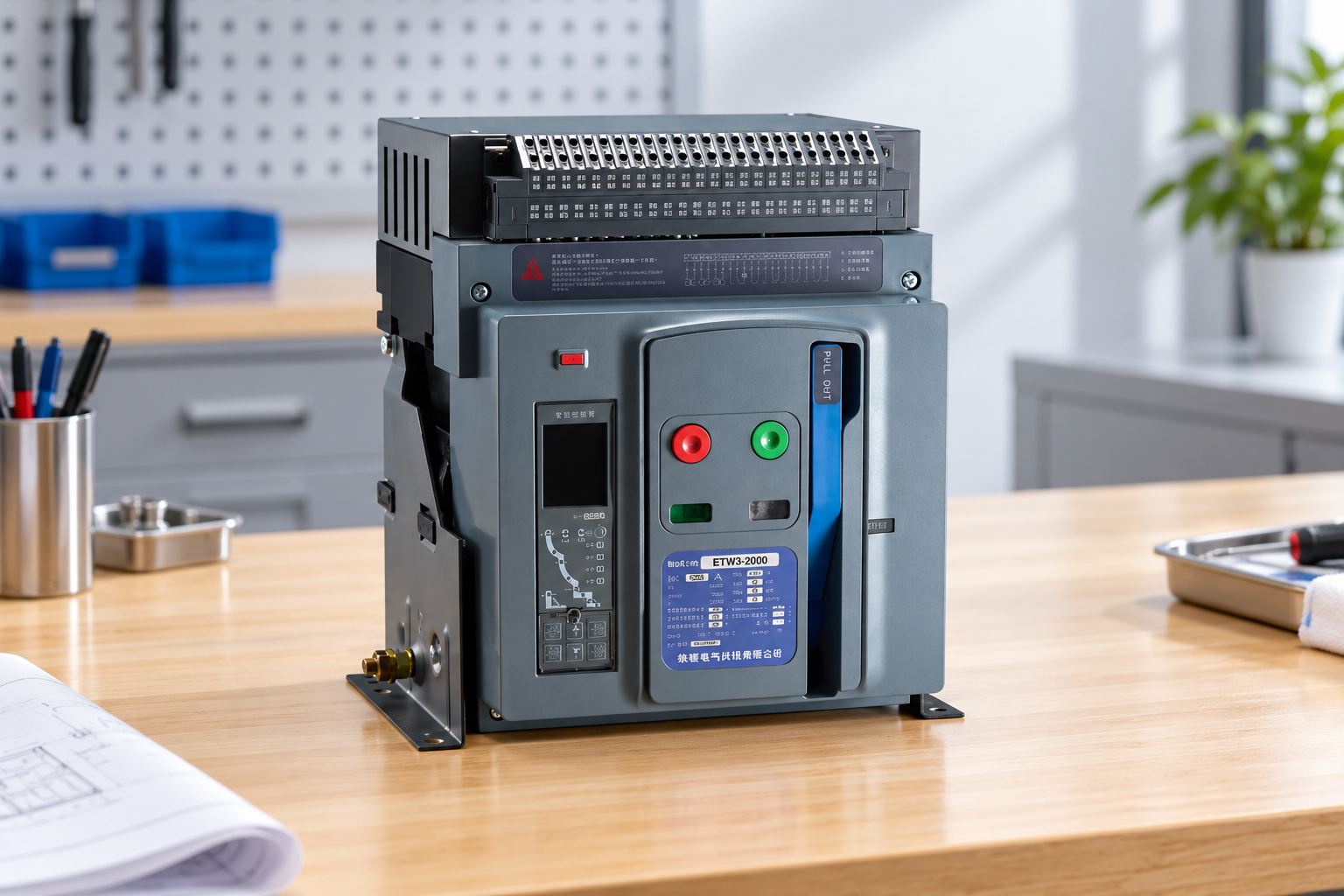
Mounting style is only one selection dimension. Check rated voltage and current, poles, breaking capacity, short-time withstand where applicable, trip-unit functions, neutral treatment, control voltage and accessories against the study. The prospective fault current at the installation point must remain within the exact breaker’s declared rating. IEC 60947-2 supplies the low-voltage circuit-breaker product-standard context; a project still needs its own calculations and approved device data.
Compare frame and sensor information separately. The ACB frame-versus-sensor guide explains why the physical class does not by itself determine pickup. A drawout cradle should not become a shortcut around coordination, cable sizing or source-mode checks. Include the effect of generator operation, bus-coupler states and transfer sequences where these change available fault current.
Plan access, space and enclosure effects
Measure front working space, door swing, lift path and extraction clearance. A heavy breaker can require a handling trolley and a defined storage surface. Verify that the open door and withdrawn breaker do not block an exit or adjacent operating device. The board builder must confirm compartment dimensions, busbar alignment, ventilation, IP protection, internal separation and the intended arc-management arrangement.
A fixed unit may save space or parts in some configurations, but a cramped board can make later termination inspection difficult. A drawout unit creates more service interfaces that need periodic attention. Compare the whole assembly drawing and maintenance method rather than only a catalogue front view. Do not infer dimensions or interchangeability from two visually similar products.
Design the maintenance and spare-parts policy
For a fixed ACB, document how the board will be de-energized, tested, disconnected, removed and re-commissioned. Estimate the outage time realistically, including authorization and post-work checks. For a drawout ACB, list racking checks, cradle-contact inspection, secondary-contact checks, shutter operation, lubrication only where instructed, and a matched spare’s storage and periodic test. Both require trained personnel and a documented safe system of work.
A spare breaker is useful only if its frame, trip unit, sensors, accessories, mechanical coding and firmware or configuration are approved for that cradle and application. Label the exact compatible assembly. Record as-left settings and functional test results after an exchange. If site staff cannot complete a safe exchange, include vendor response time in the availability calculation instead of claiming an instant replacement.
Compare cost against outage consequences
Evaluate equipment cost, panel construction, space, training, periodic maintenance, spares and the cost of a credible outage. A drawout arrangement commonly has a more involved assembly, but its potential value depends on whether the facility can exploit faster exchange and testing. A fixed arrangement may be simpler to own where shutdown windows are accessible. Ask bidders to price and describe both complete alternatives rather than substituting one mid-project without an engineering review.
For critical loads, consider the broader system: redundant feeds, bypass paths, source transfer and selective coordination may matter more to continuity than a removable breaker alone. A drawout device cannot make a single-source panel redundant. Equally, a fixed breaker need not imply unacceptable downtime if the plant has a planned isolation and spare strategy.
Use real product documentation in the RFQ
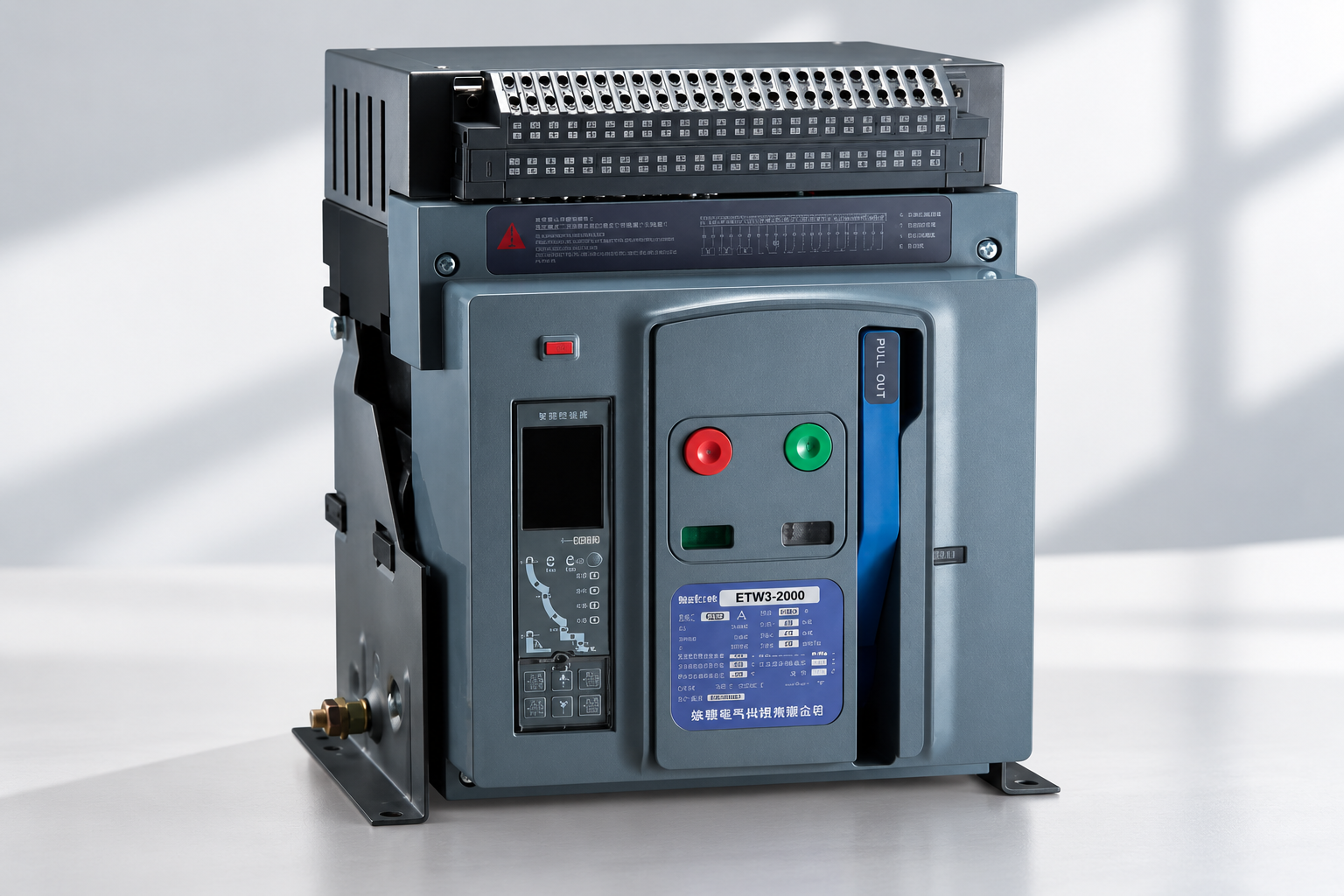
The SUTON ETW3 air circuit-breaker page is the starting point for physical product identification. Request an exact offered model code and written confirmation of fixed or drawout availability, the matching cradle code if any, dimensional drawing, accessory list, trip-unit documents, operating manual and test records. This article does not claim that every pictured ETW3 unit is drawout, or that different frames share a cradle. Those facts require model-specific evidence.
Include the circuit-breaker types guide when establishing the device’s role in the panel. If the supplier proposes an alternative, compare the complete bill of materials and switching/maintenance procedure as well as ratings. Keep the approved drawings and supplier response with the procurement record.
Commission and hand over the selected design
Before energization, verify nameplates, poles, power and control connections, protection settings, auxiliary circuits, interlocks and labels against approved drawings. On a drawout arrangement, additionally verify the declared positions, shutters, racking mechanism and cradle contacts under the manufacturer’s method. On fixed equipment, inspect the bolted interfaces and future removal access. Use specified tests and record instruments, results and corrective action.
Hand over an operating sequence, isolation and rescue procedure, maintenance intervals, spare policy, settings sheet and as-built drawings. When a breaker is later replaced, treat the new configuration as a change requiring compatibility and protection review. The best design is the one the facility can safely operate and maintain while meeting its actual electrical duty.
Train operators on the difference between an electrical trip, an intentional open command and a mechanical withdrawal operation. Give them an escalation path for a jammed mechanism or unexpected indication; forcing a handle is not a troubleshooting method. Include inspection intervals that match the supplier instructions and operating environment, with particular attention to dust, vibration, temperature and switching duty.
Finally, test the documentation itself during handover. Ask a qualified person who did not build the panel to identify the exact breaker, locate its approved settings, describe the safe isolation boundary and find the spare compatibility record. If those steps cannot be completed quickly, revise the labels and files. This practical check exposes gaps that a catalogue comparison cannot show.
Frequently asked questions
Is a drawout ACB safer than a fixed ACB?
Neither is inherently safe without the correct assembly, isolation procedure, training and maintenance.
Can any spare ACB fit the same drawout cradle?
No. Verify the manufacturer-approved frame, trip unit, accessories and mechanical coding.
Does drawout mounting change the interrupting rating?
Use the exact model and assembly data. Mounting style alone does not establish a breaking capacity.
Video explanation
Watch Fixed vs Withdrawable Switchgear | Which Should You Choose? by Gaurav J – TheElectricalGuy for visual context. Product configuration and safety steps must still follow the exact SUTON model documents.