


arc fault circuit interrupter vs ground fault circuit interrupter is a hazard comparison, not a label swap: an AFCI targets dangerous arcing linked to fire risk, while a GFCI targets ground-fault shock protection for people. The sections below separate those jobs, show when a circuit needs both, clarify dual-function versus combination-type wording, and turn the decision into panel RFQ inputs and modular DIN-rail inquiry paths.
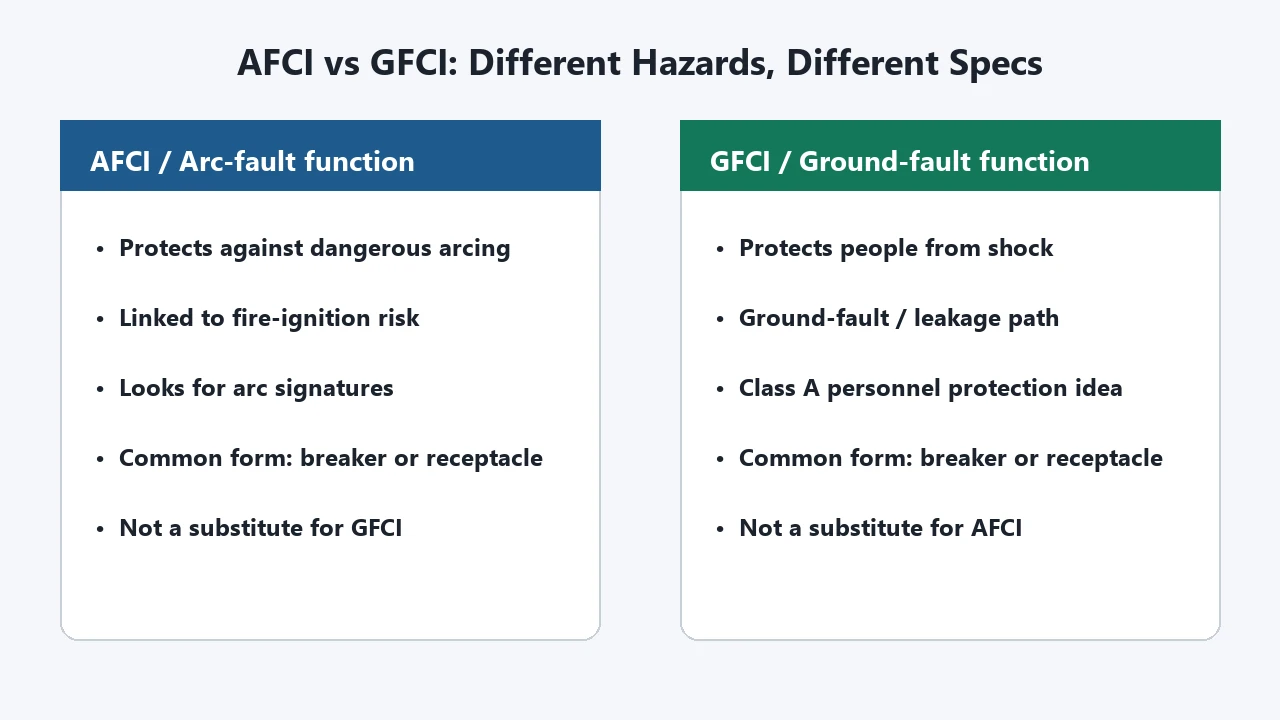
AFCI and GFCI Protect Against Different Hazards
An Arc fault circuit interrupter (AFCI) watches for arc-fault signatures and de-energizes to reduce fire risk from dangerous arcing; a Ground fault circuit interrupter (GFCI) watches for a ground-fault path that can shock a person and de-energizes for personnel protection.
UL Solutions describes an AFCI as a device that lessens the effects of arcing faults by de-energizing the circuit when an arc fault is detected, because continued arcing may pose a fire-ignition risk under certain conditions. The same organization describes a GFCI as a personal protection device against ground fault, using the familiar example of current leaving a damaged cord, passing through a person, and returning through ground.
In plain language, AFCI work is about dangerous sparking that can heat surroundings enough to start a fire. GFCI work is about unwanted current through a body or other unintended ground path. Overcurrent protection still belongs to the breaker or fuse role that the project assigns; neither AFCI nor GFCI language automatically replaces that role.
| Question | AFCI | GFCI |
|---|---|---|
| Primary hazard | Dangerous arcing with fire-ignition concern | Ground-fault shock to people |
| What the device looks for | Arc-fault signatures on the circuit | Imbalance / ground-fault current consistent with Class A personnel protection |
| Common evaluation framework named in UL education | UL 1699 | UL 943 |
| Typical form factors | Breaker or receptacle (and related listed constructions) | Breaker, receptacle, or portable constructions |
| Substitute for the other? | No | No |
That table is the selection baseline. If a drawing, specification, or adopted code names only one function, the other hazard remains outside the device’s intended job unless a second protection method is added.
Why AFCI and GFCI Are Not Interchangeable
Matching AFCI hardware to a GFCI requirement—or the reverse—leaves the uncovered hazard open, because the detection jobs are different.
A wet-location receptacle conversation often starts with shock risk. A GFCI-class answer addresses that personnel path. Putting an AFCI-only device there because “it is the newer safety breaker” does not complete the shock-protection job the buyer actually asked for. The opposite mistake appears on living-area branch circuits where arc-fault protection is the stated need: a GFCI receptacle can be excellent for shock risk and still leave the arc-fault requirement unanswered.
Important: Not every product phrase that contains “ground fault” is a Class A GFCI for personnel protection. UL’s ground-fault protective-device education separates Class A GFCI from other ground-fault equipment classes (UL ground-fault protective devices overview). On an RFQ, ask whether the buyer needs personnel GFCI, another ground-fault protective class, or an IEC residual-current device with a named sensitivity and standard.
Trade education also notes that AFCI and GFCI protection can each be provided in breaker or receptacle form. The form factor changes where the user resets the device and how much of the branch circuit is covered, but it does not turn one protective function into the other.
Readers who need the deeper single-axis AFCI strategy can use the AFCI protection guide and the arc-fault circuit breaker guide without turning this comparison into another device monograph. Ground-fault and earth-leakage wording belongs with the ground fault circuit breaker guide and the earth leakage circuit breaker guide.
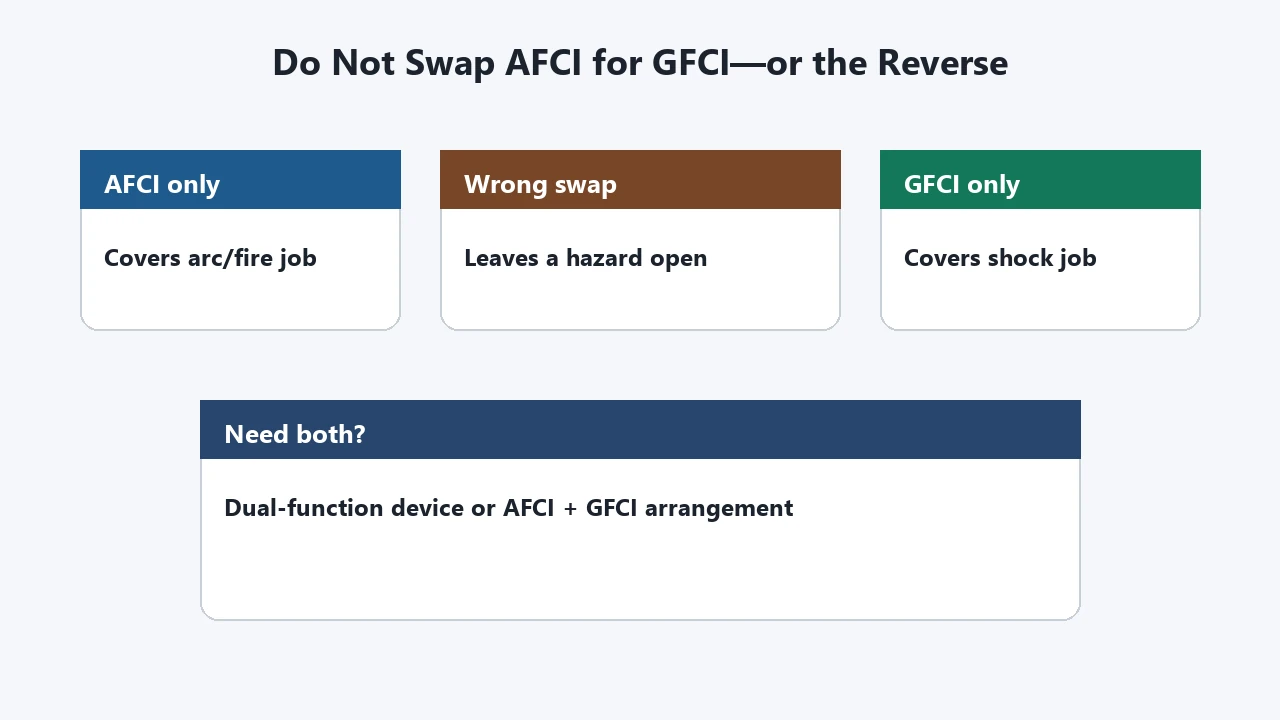
When a Circuit Needs Both Protections
When the governing design or adopted code requires both arc-fault and ground-fault personnel protection on the same circuit, specify both functions—through dual-function hardware or a coordinated AFCI-plus-GFCI arrangement.
US dwelling education sources commonly point to NEC 210.8 / 210.12 style section families for the two requirements. Location lists therefore overlap in some rooms and diverge in others. Kitchens and laundry areas are frequent examples in contractor discussions: both protections may apply, while bathrooms, garages, and outdoor receptacles often show strong GFCI expectations without the same AFCI room list. Those examples are teaching patterns, not a substitute for the code edition adopted on the project.
Mike Holt forum contractors describe the practical stocking question in plain terms: do we fill the panel with dual-function breakers, keep AFCI-only where GFCI is not required, or use a standard breaker with a GFCI receptacle where that reset point is better for the user? The useful lesson for a panel builder is that “both required” is a function statement first. Hardware form comes second.
A dual-function AFCI/GFCI breaker is one convenient way to satisfy both functions with a single pole device.
Tip: A dual-function AFCI/GFCI breaker is one convenient way to satisfy both functions with a single pole device — a point repeated in Mike Holt forum dual-coverage discussions. It is an option, not a universal rule that every overlap circuit must use that exact SKU.
Export and multi-market panels need an extra translation step. A US buyer may write “GFCI.” An IEC-facing bill of materials may answer with residual-current language, RCBO selection, or a different listing target. Record the required protective function and the named standard or listing expectation before equating catalog families.
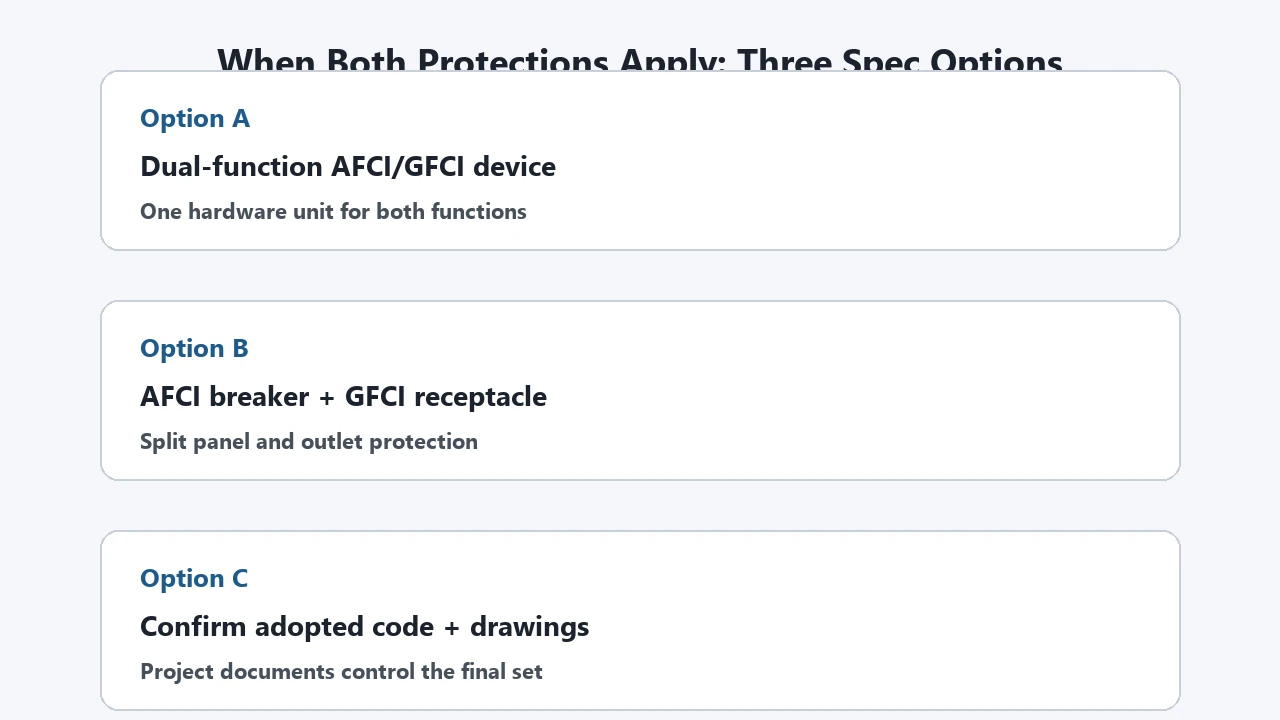
Choose Form Factor by Reset Access and Circuit Coverage
Choose Breaker form factor or Receptacle form factor after the protective function is fixed, because reset location and coverage boundaries change the field experience even when the hazard job is the same.
A panel-mounted AFCI or GFCI breaker typically protects from the breaker outward along the branch circuit. Reset happens at the panel. That arrangement can simplify homeowner troubleshooting when crews intentionally move protection to the panel, a practice discussed in contractor forums. A receptacle device protects the receptacle and, when load-side terminals are used correctly, can protect downstream outlets. Reset happens at the outlet, which can be preferable outdoors or in muddy-boot conditions where panel access is awkward.
EC&M’s code-basics education notes a practical preference pattern—AFCI often at the breaker, GFCI often at the receptacle—while also reminding readers to evaluate the application and consider dual-function options. Prefer that as engineering judgment language, not as a mandatory layout law.
Neutral handling matters for receptacle GFCIs that feed downstream loads: line and load terminations must stay correct, and the neutral must follow the intended path through the device. Wrong termination can look like a “nuisance” complaint when the real issue is installation sequence.
For modular DIN-rail assemblies outside North American load-center conventions, the same logic still applies. Decide whether protection sits in the distribution assembly, at a local outlet, or in a combination residual-current device, then confirm the interface drawings before the BOM freezes.
Dual-Function Is Not the Same as Combination-Type AFCI
“Combination-type AFCI” describes arc coverage (series and parallel), while “dual-function” describes AFCI plus GFCI in one device—so the two phrases must stay separate on drawings and quotes.
Manufacturer education pages for dual-function products make this vocabulary trap explicit because buyers repeatedly confuse the words. A combination-type AFCI can be the correct arc-fault device and still lack Class A GFCI personnel protection. A dual-function AFCI/GFCI device is the label that signals both jobs in one piece of hardware.
Write the RFQ with the function words first:
- arc-fault protection required: yes/no;
- ground-fault personnel protection required: yes/no;
- if both: dual-function device allowed, or AFCI device plus separate GFCI method required;
- if arc-fault only: do not accept “dual” wording as proof unless GFCI is also wanted.
That short checklist prevents a purchasing handoff where “combo breaker” means three different things to three different people.
Turn the Comparison into Panel RFQ Inputs
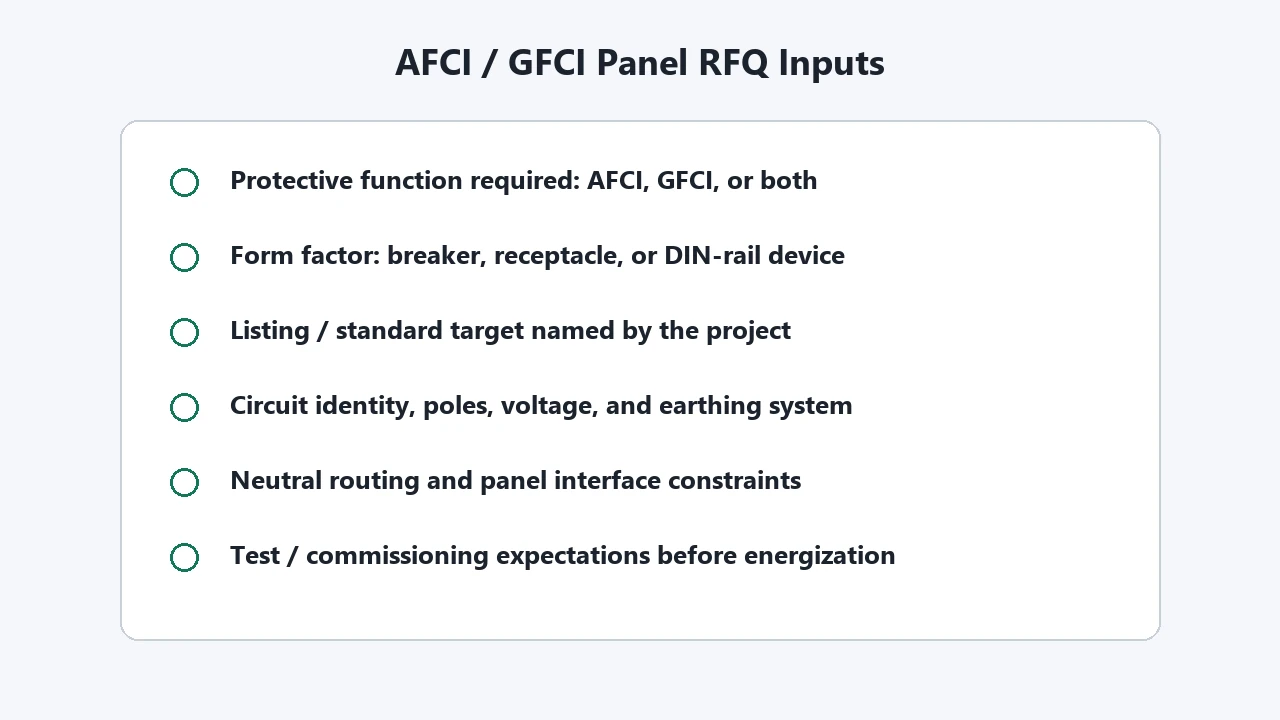
A usable AFCI vs GFCI RFQ names the protective function, form factor, listing or standard target, circuit identity, and verification expectations before anyone debates brand or price.
| RFQ field | What to send with the quote | Why it matters |
|---|---|---|
| Protective function | AFCI, GFCI/Class A personnel, both, or residual-current equivalent named by the project | Stops function swapping |
| Form factor | Breaker, receptacle, DIN-rail device, or dual-function construction | Aligns reset and coverage |
| Listing / standard target | Named project requirement (for example UL 1699 / UL 943 education targets, or the IEC family named on the drawing) | Prevents catalog false equivalents |
| Circuit identity | Panel ID, circuit ID, poles, voltage, earthing system | Ties the device to one line |
| Interface constraints | Neutral routing, bus type, enclosure, accessory needs | Avoids late mechanical rejects |
| Verification | Test button checks, commissioning notes, reconditioned-device prohibition if the adopted code bans them | Closes the loop before energization |
Reconditioned AFCI or GFCI devices are called out as prohibited in the NEC education article reviewed for this topic where that rule is adopted. Even when a project sits outside that rule set, treating interrupters as anonymous used parts is a poor specification habit: the buyer cannot defend unknown prior duty or unknown firmware/mechanical history.
Keep numbers honest. Class A education materials discuss trip behavior around a few milliamperes. Those education thresholds belong to the Class A GFCI conversation and the named standard; they are not free license to invent SUTON calibration data or universal trip times for every market device.
Route AFDD and Residual-Current Inquiries Through Modular DIN-Rail Paths
Use SUTON’s modular DIN-rail hub to route arc-fault detection and residual-current inquiries to the published AFDD and RCBO families, without inventing a dual-function UL AFCI/GFCI SKU that the catalog does not publish.
The modular DIN rail products category is the upward path for AFDD, RCBO, RCCB, and related modular devices. For arc-fault detection inquiry, the published ETB9LAF-63 arc fault detection device page is the first-party AFDD route. For residual-current with overcurrent inquiry adjacent to GFCI conversations, use the DZ47LE RCBO path and, where the form factor fits, the ETZBLE RCBO path.
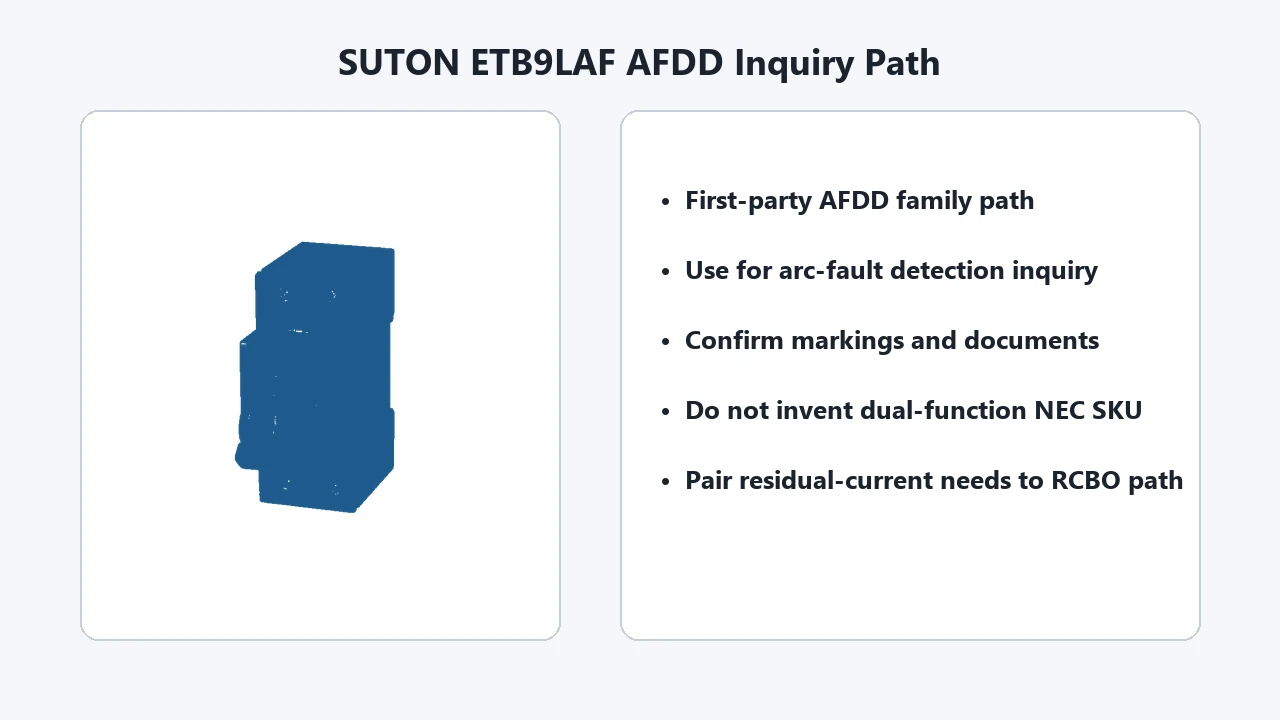
Those links are inquiry anchors, not certificate transfers. Do not read an undocumented AFCI listing or Class A GFCI listing into a page that does not publish that claim. Confirm markings, instructions, poles, sensitivity or settings, and panel interfaces against the project package before purchase or energization. When the comparison is settled and the documents are ready, contact SUTON with the RFQ fields above.
Owners inherit the trip story written into the schedule. If the note only says “special breaker,” service teams waste time guessing whether they are hunting an arc signature or a leakage path.
Keep AFCI vs GFCI decision notes beside the circuit ID so dual-function breaker orders and combination-type AFCI orders cannot silently swap meaning in purchasing.
FAQ
What is the difference between an AFCI and a GFCI?
An AFCI addresses dangerous arcing associated with fire risk. A GFCI addresses ground-fault shock protection for people. They answer different hazards and use different detection ideas.
Can an AFCI replace a GFCI?
No. An AFCI does not complete a personnel ground-fault protection requirement by itself. Specify GFCI or the project’s named residual-current equivalent when that hazard is in scope.
Does a GFCI protect against arc faults?
No. A GFCI is not the device class intended to recognize arc-fault signatures for the AFCI fire-protection job. Use AFCI/AFDD-class protection when that function is required.
When do I need both AFCI and GFCI?
When the adopted code, drawing, or specification requires both arc-fault and ground-fault personnel protection on the same circuit. Overlap rooms such as kitchens or laundry areas are common teaching examples, but the project documents control the final call.
Is a dual-function breaker the same as a combination-type AFCI?
No. Combination-type AFCI refers to series and parallel arc coverage. Dual-function means AFCI and GFCI functions together in one device.
What should a panel RFQ list for AFCI vs GFCI?
State the protective function, form factor, listing or standard target, circuit identity, interface constraints, and verification expectations. Add quantity and lead-time only after the function package is clear.
How does GFCI language relate to residual-current or RCBO products?
GFCI is the common US personnel-protection term tied to Class A education and the UL GFCI evaluation framework. Residual-current / RCBO language is the usual IEC-facing catalog path. Treat them as related inquiry families only after the project names the required function, sensitivity, and listing target; do not assume automatic equivalence.