


When procurement asks about breaker fuses, the task is deliberate role assignment in one low-voltage board — trip/reset branches, fuse-combination feeders, or studied hybrids — rather than stacking two protections because both words appear on a purchase order. Breakers interrupt by tripping a resettable mechanism; fuse links and fuse-combination units clear by sacrificing a rated element or carrying a fused switch role. The sections below map three protection paths, coordination and backup inputs, fuse-combination fit cases, breaker-led defaults, mixing boundaries, and a modular DIN-rail component route on cnsuton.com.
What Breaker Fuses Mean in Modern LV Panels
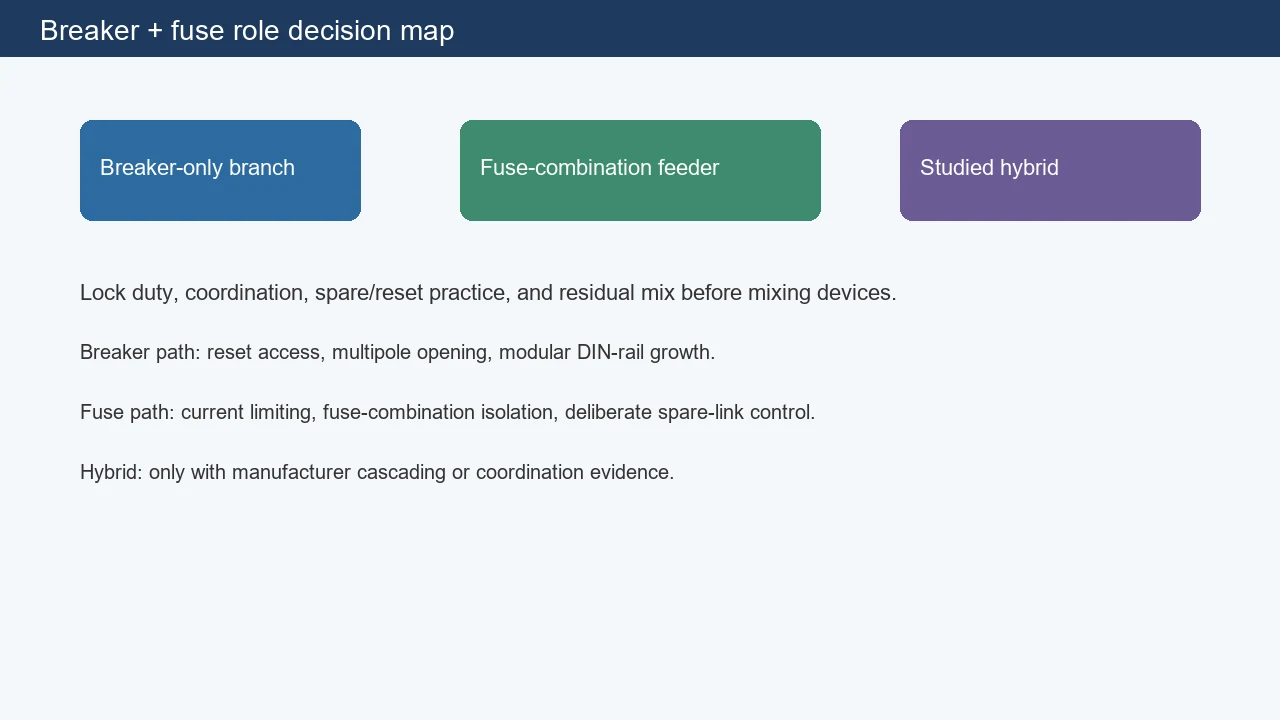
Breaker fuses means planned breaker and fuse roles in one panel — not blind doubling and not a single catalog SKU. Procurement readers often hear the phrase when someone wants fuses behind every breaker or when a retained fuse-combination feeder sits beside a modular MCB field. The engineering task is to name which role each device owns: overcurrent clearing, isolation, limiting, or a defined backup function.
That framing stays separate from the site’s electrical fuse box vs circuit breaker comparison, which decides fuse-gear versus breaker architecture at board level. It also stays separate from the circuit breaker types guide, which owns MCB/MCCB/ACB taxonomy. Assessment depth for legacy fuse boards stays in the fuse box guide for panel builders. This page owns role assignment inside one coordinated schedule.
A credible mixed design names four layers before anyone opens a device catalog:
- Role assignment: which circuits are breaker-led, fuse-combination, or hybrid.
- Coordination style: fuse-fuse grading, breaker time-current settings, or manufacturer cascading tables.
- Operations: spare-link discipline versus reset access and labeling.
- Architecture: modular DIN-rail growth versus stable fuse-combination feeders.
Breaker-Only, Fuse-Only, and Combined Protection Paths
Panels run breaker-only branches, fuse-only or fuse-combination feeders, or studied hybrids — rarely one technology on every circuit. Treating those as three paths prevents copying a feeder sketch onto every branch without asking what happens after a fault.
| Path | Typical device expression | After a fault | Operations emphasis |
|---|---|---|---|
| Breaker-only branch | MCB or larger breaker on DIN rail or fixed mount | Trip and investigate; reset when cleared | Reset access, labeling, no consumable per event |
| Fuse-only / fuse-combination feeder | Fuse link in carrier or fuse-combination unit | Open until the correct link is replaced | Exact spare links, stock control, indicator discipline |
| Studied hybrid | Upstream fuse limiting with downstream breakers, or mixed feeders in one board | Depends on the cleared role — replace link or reset breaker | Coordination evidence plus both spare and reset habits |
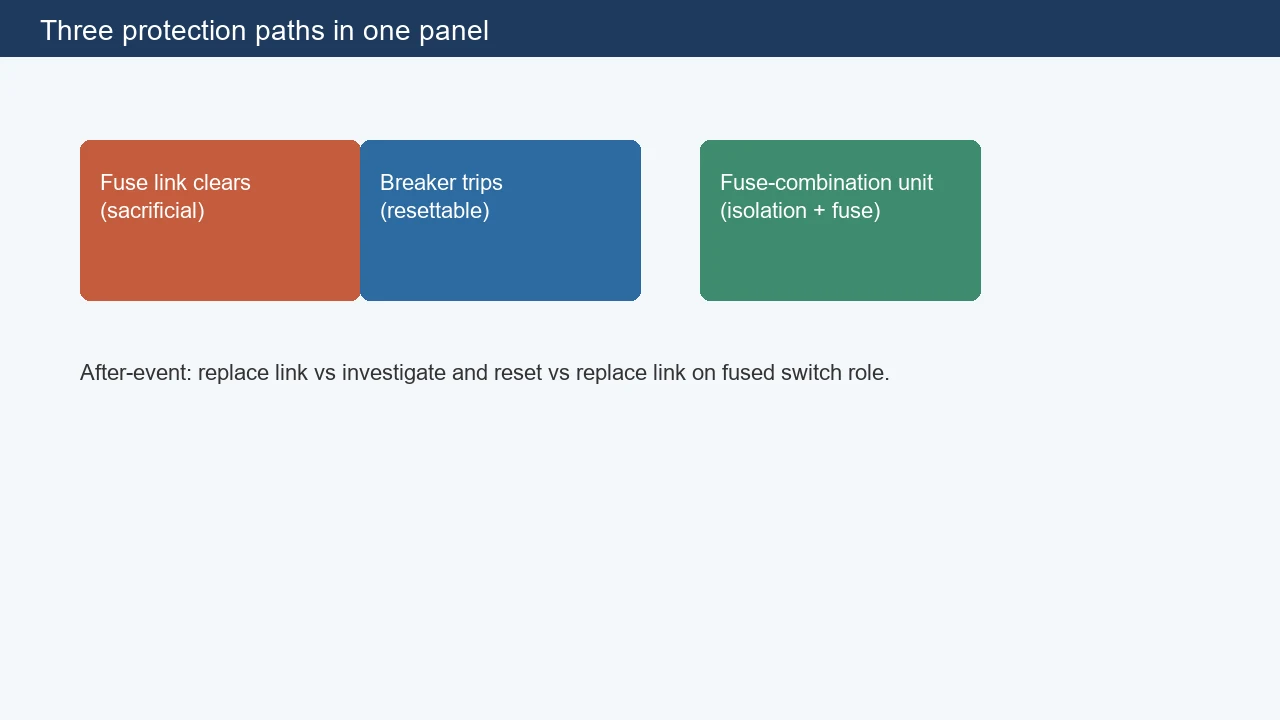
A warehouse with weekly conveyor nuisances usually keeps those branches on breakers for reset access. A compressor feeder that still specifies current limiting may retain fuse-combination gear even when the rest of the board is breaker-led. The mistake is choosing the path from habit instead of from the single-line diagram.
Important: Field threads on Electrician Talk still flag oversize links and improvised substitutes after a blown fuse — habits that defeat the rated protection. Hybrid boards only stay credible when spare-link practice is controlled and labeled.
Lock Coordination and Backup Inputs Before You Mix Devices
Confirm coordination method, backup intent, spare or reset logistics, and residual mix before adding another device family. “Backup fuse” language is meaningless without stating what the second element backs up — upstream limiting, isolation, or a documented selectivity pair.
| Input to lock | Why it changes the mix | Evidence to collect |
|---|---|---|
| Coordination method | Fuse-fuse grading differs from breaker setting work | Manufacturer tables or protection-study outputs |
| Backup intent | Redundancy is role-based, not automatic | Written protection philosophy per feeder/branch |
| Spare-link versus reset logistics | Fuse roles need exact links; breaker roles need access and procedure | Stock lists, lockout practice, remote-site constraints |
| Residual protection mix | Modular breaker families often package residual options | Required functions per circuit group |
| Installed technology identity | Mixed boards may already contain fuse-combination feeders | Photos, schedules, nameplate data |
| Expansion plan | DIN-rail breaker fields grow more easily than ad-hoc fuse maps | Spare ways and future circuit count |
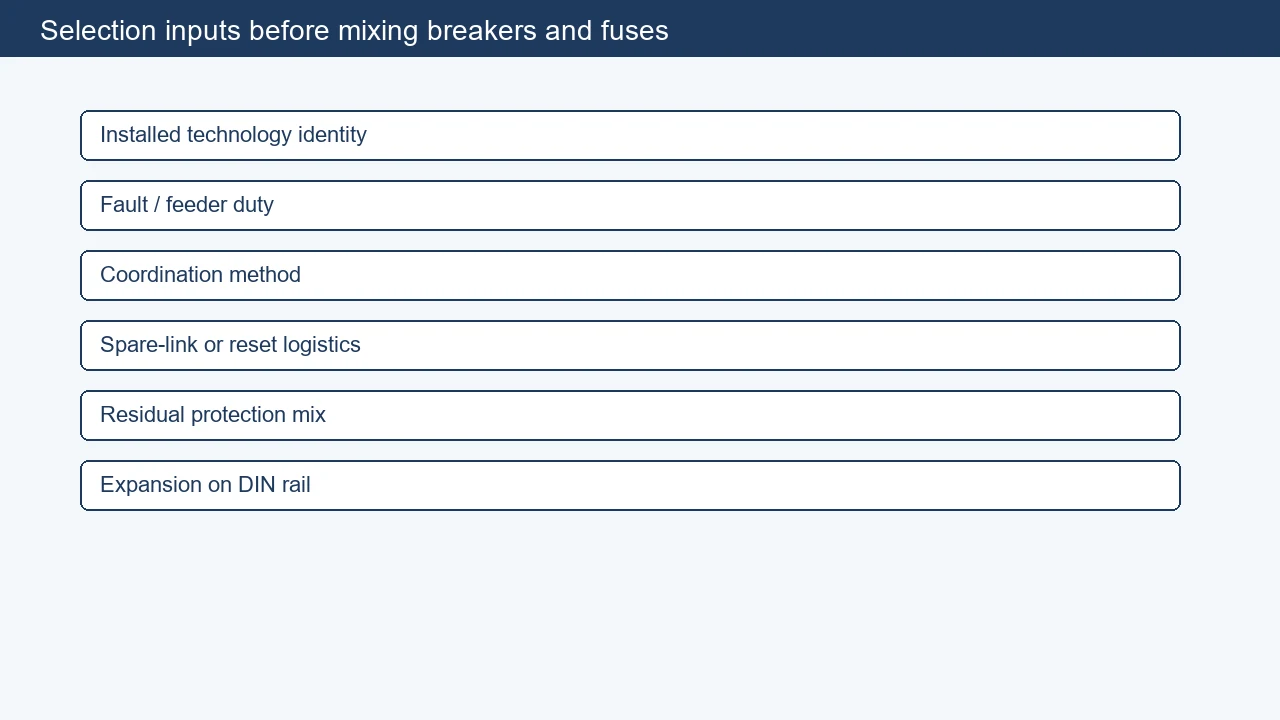
Procurement should receive these inputs as a package. A hybrid schedule without a diagram invites adapter folklore and improvised doubling. When the protection mix includes arc-fault or residual-current roles on breaker-led branches, cross-read the AFCI protection guide for panel builders for layout context — this page does not restate that strategy.
When Fuse-Combination Units Stay on the Bill of Materials
Keep fuse-combination units when limiting, fuse-fuse grading, or isolation-plus-fuse duties are deliberate design choices. IEC 60269-1 names the LV fuse link product-standard family in the public catalog, and IEC 60947-3 still lists fuse-combination units for distribution and motor circuits — not a legacy-only artifact.
Engineers on Electrician Talk return to the same niche for fuse-led roles: current-limiting fuses can restrain high-level fault current early in the event, while fuse-fuse coordination is often simpler than some breaker grading problems on defined feeders. That does not make every branch a fuse link; it keeps fuse-combination feeders on the bill of materials when the study says so.
Where a design retains that role, SUTON’s published ETGLR fuse switch disconnector page is a component route for the fuse-combination conversation — not proof that every board should standardize on fuse gear.
When Breakers Lead and Fuses Stay as Backup or Limiting Roles
Prefer breakers for branch reset access, multipole opening, residual packaging, and DIN-rail expansion; retain fuses only for named limiting or fuse-combination feeders. IEC 60947-2:2024 covers circuit-breakers intended for instructed or skilled persons, while IEC 60898-1 frames MCB-family devices for household and similar installations — two scopes that support breaker-led thinking without inventing a single global rating.
The same Electrician Talk discussion that defends fuse limiting also lists why teams standardize on breakers for everyday branches: three-phase devices can open together and reduce single-phasing risk from one spent fuse, no consumable is required after each trip, and trip units can add options a fixed link cannot. In modular assemblies, that usually means MCB or related DIN-rail devices as the default branch answer while a smaller set of fuse-combination feeders handles the exceptions.
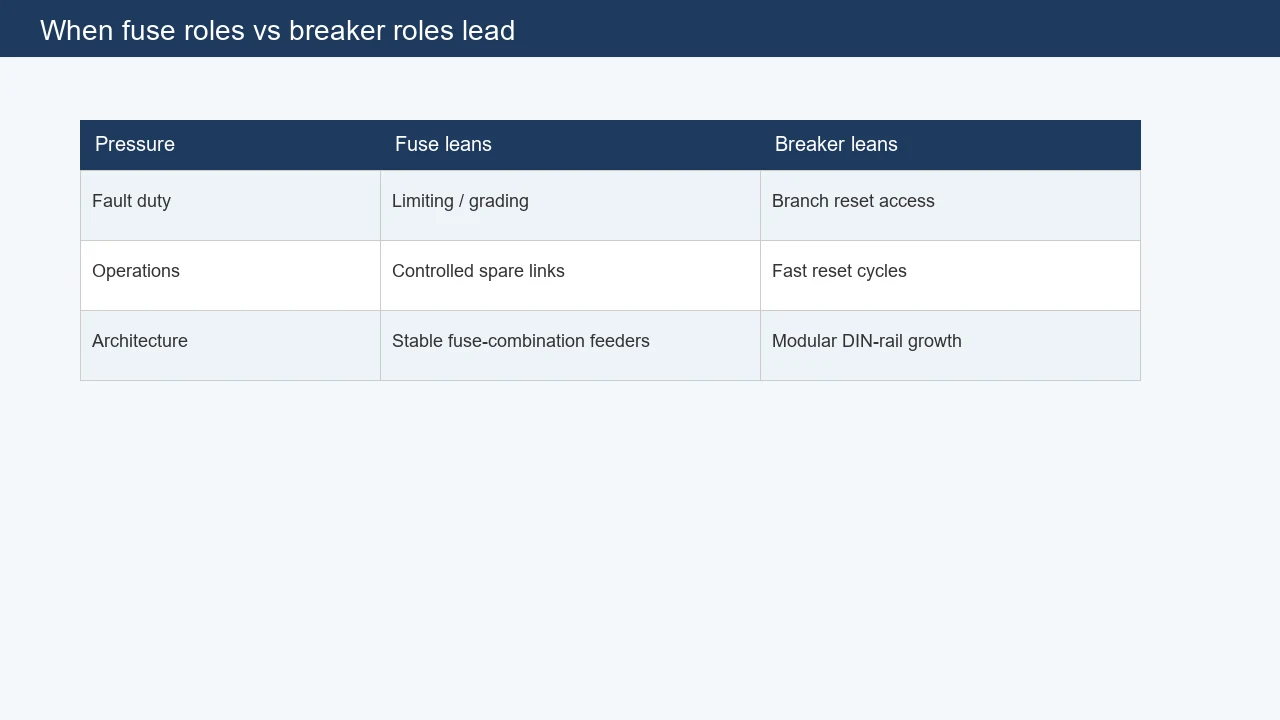
| Decision pressure | Fuse-led role still fits when… | Breaker-led role fits when… |
|---|---|---|
| Fault duty | Early current limiting is a stated need | Ordinary branch/feeder duties dominate |
| Operations | Exact links are controlled and stocked | Teams need fast, repeatable reset access |
| Three-phase integrity | Other measures handle open-phase risk | Multipole opening is required by default |
| Expansion | Fuse roles are stable and few | Ways and functions will grow on DIN rail |
| Protection mix | Residual devices are already planned separately | Integrated modular residual options matter |
Panel Boundaries That Block Casual Breaker-and-Fuse Mixing
Casual adapter swaps and unstudied doubling are not paths — coordination evidence and listing intent still govern what may share one enclosure. Contractor explainers reviewing upgrades stress that fuse gear and breaker gear differ in bus construction, mounting, and listing intent, so adapter shortcuts inside an unlisted enclosure are not an engineering path.
Legitimate hybrids still exist when manufacturer cascading or coordination data supports the pair. The keyword is studied. A bill of materials that merely doubles devices without let-through and discrimination evidence is only spare parts, not a protection strategy.
Assessment work for legacy fuse boards stays on the dedicated fuse box guide for panel builders. If the live installation is undocumented, overheated, mislabeled, or full of improvised links, resolve that evidence before debating whether the retained mix should include more breakers or more fuses.
Boundary checklist:
- do not treat adapter folklore as a listed conversion method;
- do not erase fuse-combination feeders the protection study still needs;
- do not reset breakers or replace fuses as a substitute for finding the fault cause;
- do not claim a complete assembled panel merely because modular devices are available on the hub.
Select Modular DIN-Rail Devices After the Protection Mix Is Clear
Use the modular DIN-rail hub and the DZ47 MCB family to specify breaker-led branch roles without claiming a complete panel. Once coordination inputs name a breaker-led branch field, component selection should stay inside published device pages rather than inventing an enclosure or switchgear package.
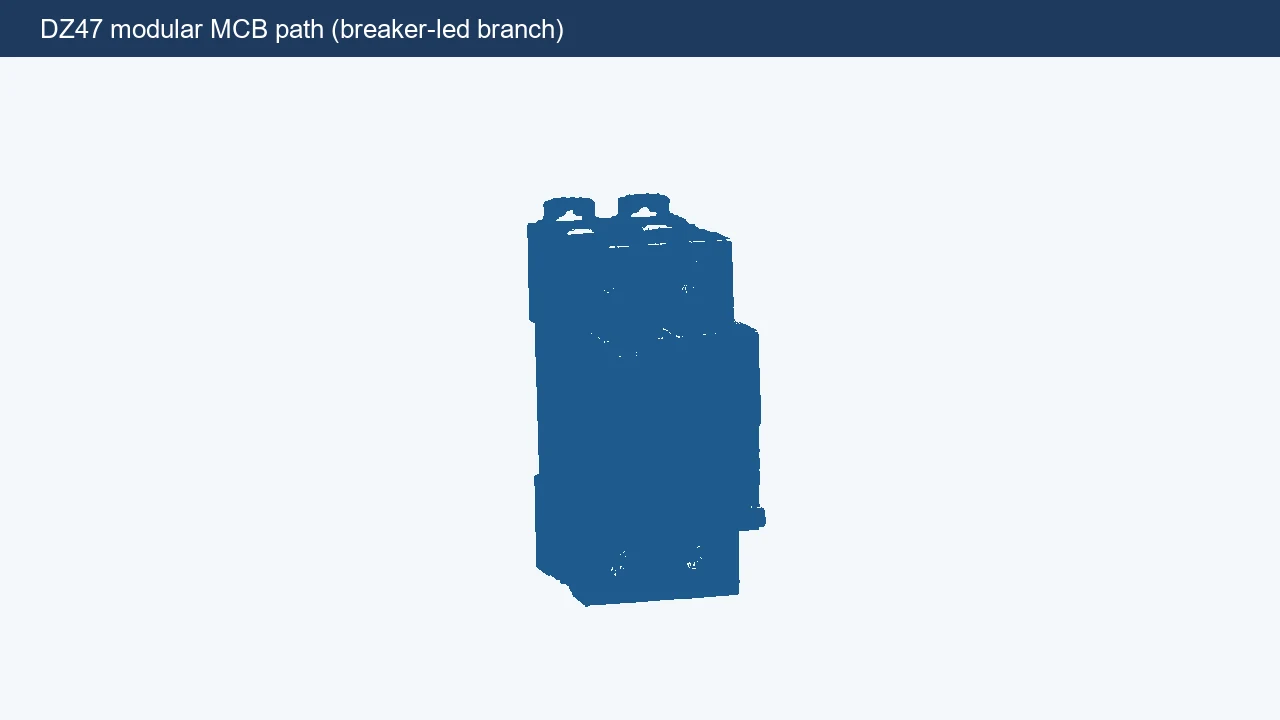
Open the published Modular DIN Rail Products category when the schedule locks breaker-led branches, then bind poles, curve, and ratings on the DZ47 series miniature circuit breaker page to the circuit list. Add adjacent hub devices only when their live pages match the required function.
When a fuse-combination feeder remains in the mix, route that role through the ETGLR product page instead of assigning every circuit to an MCB. Mixed bills of materials are allowed; unsupported complete-panel claims and improvised conversions are not.
When published ratings and documents need clarification for a live project, use Contact SUTON with the circuit schedule, coordination intent, and retained fuse roles. Public pages do not fix MOQ, lead time, certificate scope, or project approval.
FAQ
What are breaker fuses in a panel?
They are deliberately assigned breaker and fuse roles in one board — trip/reset branches, fuse-combination feeders, or studied hybrids — rather than a single product nickname.
Can fuses and breakers share one panel?
Yes, when roles and coordination are defined. Casual adapter swaps or unstudied doubling are not the same as a documented mixed design.
What is a fuse-combination unit?
It is a device class that combines switching or isolation intent with fuse protection, covered among switchgear device classes under the fuse-combination switching standard family.
Do breakers need fuse backup?
Not by default. A backup or limiting fuse only belongs when the protection study names that role and coordination evidence supports the pair.
When do fuses still lead in a mixed design?
When current limiting, fuse-fuse grading, or a retained fuse-combination feeder is a deliberate choice and spare links are controlled.
When should breakers lead the branch mix?
When reset access, multipole opening, modular expansion, and integrated residual options matter more than fuse limiting on the branches involved.
What is a fuse switch disconnector?
It is a modern fuse-combination style route that pairs switching or isolation intent with fuse protection; SUTON’s ETGLR page is a component path when that role is retained.
Where does fuse-box versus breaker comparison go?
Use the live electrical fuse box vs circuit breaker article for path comparison at board level; keep this page for combined-role selection inside a mixed strategy.
Where does fuse-box assessment go?
Use the live fuse box guide for panel builders for condition evidence and upgrade planning on legacy fuse-based boards.