

ACB frame rating vs sensor rating compares different parts of an air circuit breaker. The frame identifies a physical breaker family and current class, while the sensor or trip-unit reference determines how current is measured and used for protective settings. A separate rating module or programmed value may also apply, depending on the manufacturer. Confirm the exact model, installed sensor, trip unit and as-left settings before using any one number for cable protection, coordination or procurement. The frame label alone does not define the operating pickup.
Define the terms on the exact air circuit breaker
“Frame” can describe the physical breaker family, its maximum current class or a manufacturer catalogue size. “Sensor rating” can describe the current-measurement element or a reference value used by an electronic trip unit. A rating plug or programmed value may introduce another limit. These terms are not identical across all ACB designs. Before comparing numbers, obtain the legend for the exact model and trip unit and state which value each label represents.
The frame and contacts must carry and interrupt current within their declared duty. The sensor and trip unit measure current and apply protective settings. A lower sensor or programmed value does not turn a large frame into a physically smaller breaker; a high frame class does not mean the long-time pickup is automatically set at that class. The protection study must use the actual installed sensor, trip unit and settings.
| Item on the schedule | What it usually describes | Evidence to request |
|---|---|---|
| Frame designation | Physical breaker family and maximum construction class | Nameplate and exact catalogue code |
| Current sensor/reference | Measurement basis used by the trip unit | Sensor identification and manual |
| Rating module or plug | Manufacturer-specific limit or configuration | Installed module code and permitted range |
| Long-time pickup | Protective setting for sustained overcurrent | Approved settings sheet and study |
| Breaking capacity | Fault interruption duty at stated voltage | Product data and fault-current study |
The table is qualitative. Manufacturers use different architectures, so do not infer an interchangeable sensor or rating plug from the term alone.
Read the nameplate, trip unit and drawing together
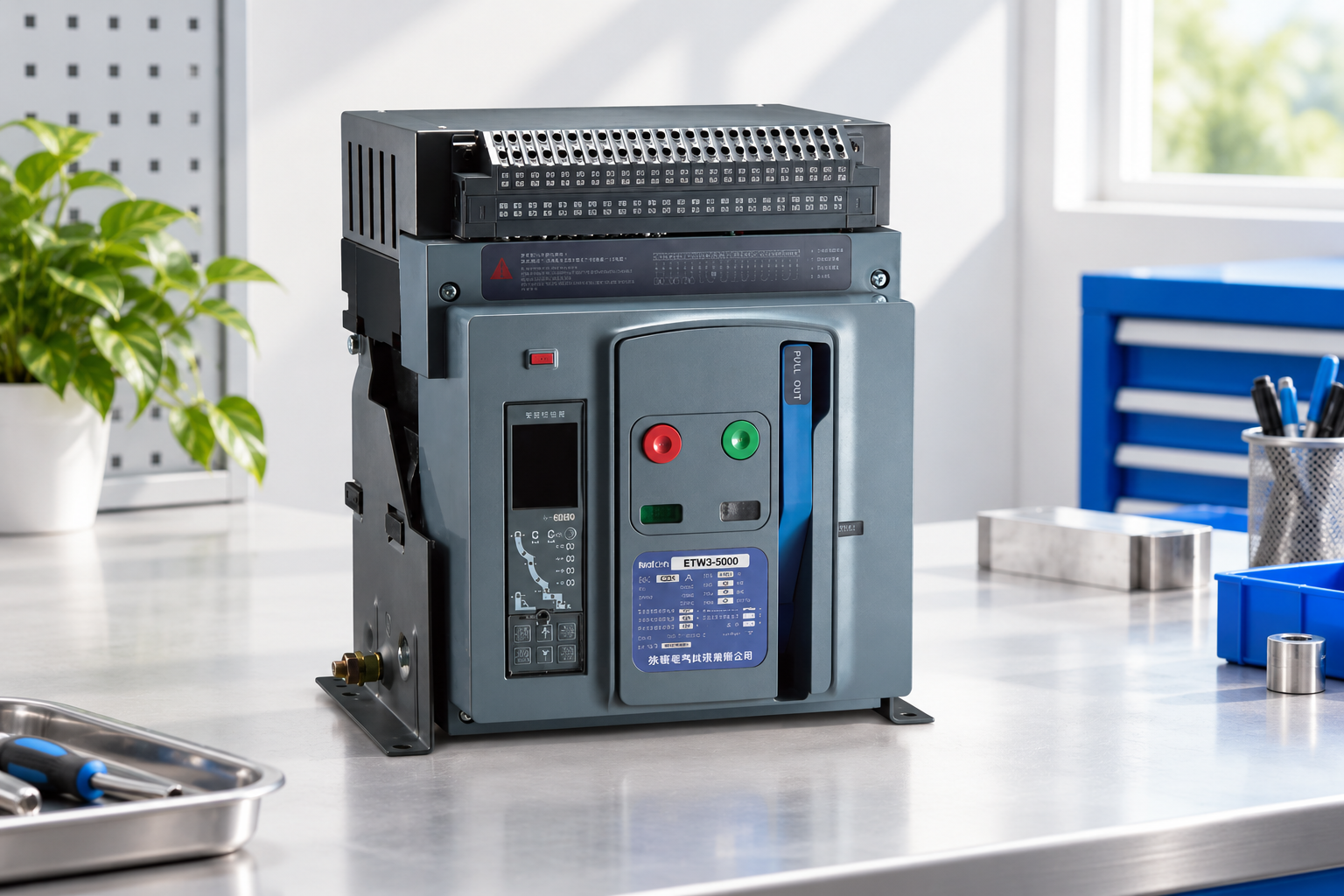
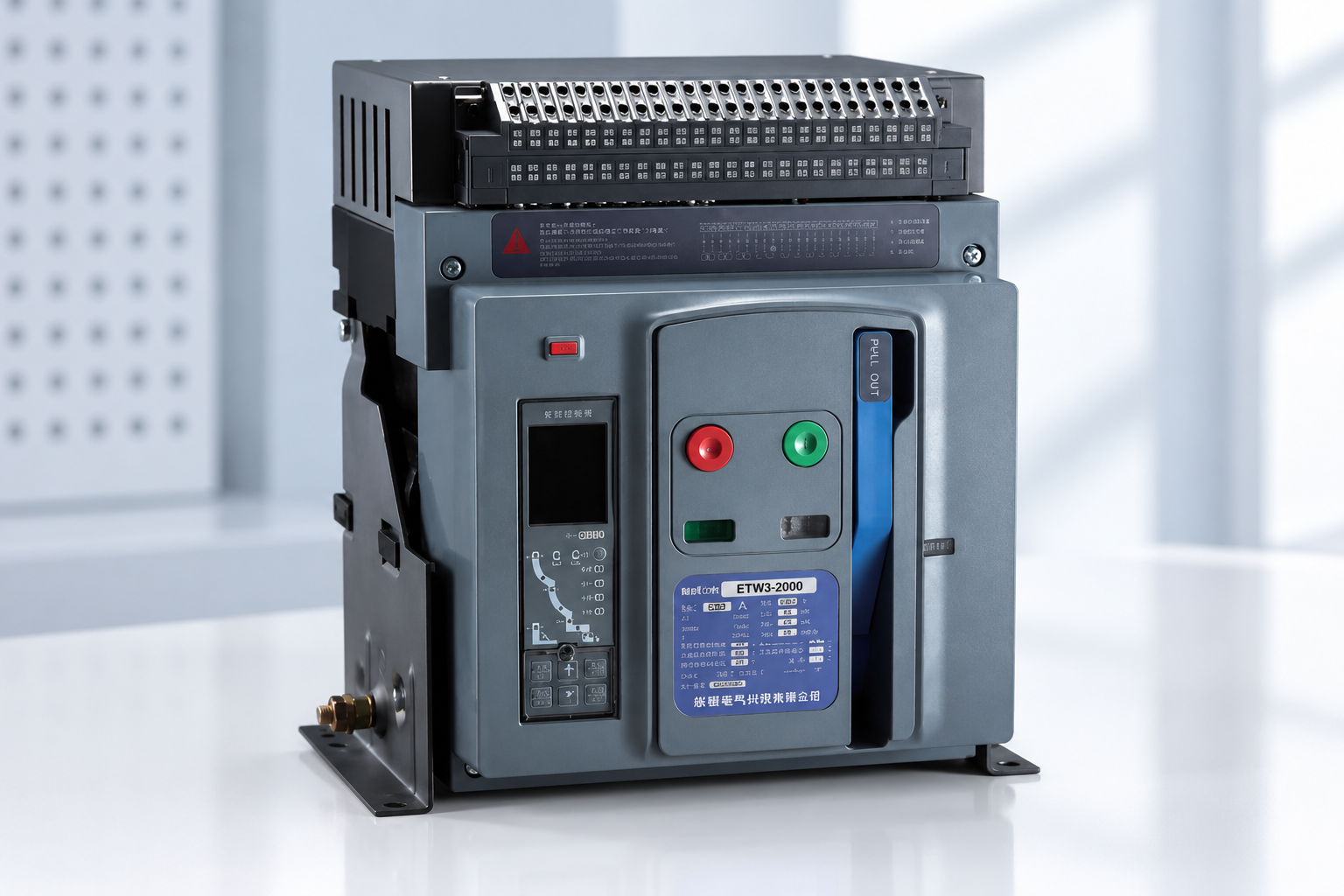
Photograph or record the complete ACB code, pole count, voltage, rated current or frame designation, interrupting rating, trip-unit type, sensor or module identifier and accessories. Check the wiring diagram and manufacturer instructions for the offered revision. A family photo cannot reveal every configuration. If one document says one sensor value and the as-built panel contains another module, stop and resolve the discrepancy before energization.
The SUTON ETW3 air circuit-breaker product page provides real product references for this review. Ask for the exact ETW3 model’s nameplate and trip-unit documents. This article does not assert that a sensor can be replaced or that one ETW3 frame has any particular setting range. Those claims require the model-specific instructions and approval.
Separate continuous-current duty from trip pickup
The current path, busbars, terminals and enclosure determine the continuous duty available under stated conditions. The electronic trip unit’s long-time pickup is a protection setting. If that setting is below a frame’s maximum class, the breaker still needs to be installed in a switchboard that meets its physical and thermal requirements. If the pickup is raised, verify conductor capacity, transformer and source conditions, selective coordination and permitted trip-unit range before approving it.
Do not treat a nominal sensor value as a shortcut for cable sizing. The protection study should show expected continuous load, overload boundary, fault current, trip curves and source modes. It should also state whether the neutral has a separate sensor or protection arrangement. A three-pole ACB with a distributed neutral needs careful documentation of any external neutral sensor, but the exact solution is manufacturer-specific.
Check breaking capacity and coordination separately
Frame, sensor and pickup values are not the same as short-circuit interruption capability. Compare the prospective maximum and minimum fault current at the ACB with the device’s declared breaking data at the system voltage. If the board relies on backup protection, zone selectivity or interlocking, request the tested or declared combination for the exact upstream and downstream devices. The IEC 60947-2 publication provides low-voltage circuit-breaker product-standard context; project calculations and model documents still control selection.
The MCCB frame-versus-trip guide introduces the related distinction for molded-case products. The breaking-capacity guide covers the separate interruption question. Do not transfer an MCCB adjustment range to an ACB trip unit merely because the labels look similar.
Use an approved settings sheet
List the frame code, sensor or module identification, programmed or plug rating if present, and every active long-time, short-time, instantaneous and ground-fault function. Record enabled/disabled state, pickup, delay, source mode and the study revision. If the product uses a menu rather than dials, save the as-left configuration or readback. The settings sheet should be signed by the responsible engineer and checked at commissioning.
When a replacement trip unit, sensor or rating module is proposed, ask whether the manufacturer permits that change for the frame and what new tests are required. A device may have hardware constraints that software settings cannot override. Do not infer that moving a module between similar-looking frames is safe or supported. Procurement should obtain the complete offered code and any factory configuration record.
Consider the whole switchboard
Verify busbar size, connection orientation, enclosure temperature, ventilation, clearances, arc-management design, door interlocks and the physical mounting arrangement. These may limit the practical continuous current even when the ACB nameplate lists a larger class. A drawout cradle or fixed mounting changes the connection and maintenance interface, but it does not automatically change the sensor or the protection study. The fixed versus drawout ACB guide covers that mechanical choice.
Include generator, utility, bus-tie and backup modes. The available fault current and desired coordination can differ by source. Record which mode sets the maximum interruption duty and which mode is most difficult for protective pickup. A single rated-current number on a quote cannot answer both questions.
Commission without relying on a front label alone
Before energization, compare the installed ACB and trip unit with the approved schedule. Confirm mechanical condition, terminations, control wiring, auxiliary contacts, interlocks, indication and settings under the adopted safe-work procedure. Use manufacturer-approved primary or secondary testing where required by the project; record instrument, method, result and as-left configuration. A test button or display self-check does not by itself prove every current sensor and power path.
The HSE electrical-safety guidance reinforces competent work and isolation. The IET protective-device guidance distinguishes a circuit breaker’s protection role from frequent load switching. Apply local rules and the exact ETW3 manual for the panel being commissioned.
Questions for the RFQ and replacement order
For a replacement order, create a three-column comparison: the installed assembly, the proposed assembly, and the evidence that establishes equivalence. Enter the frame identity separately from the sensor and trip-unit identities. A matching enclosure or front label is only one observation. Ask the supplier to identify which documents connect the proposed sensing arrangement to the setting scales and approved protection study. If that connection is missing, keep the alternative unresolved rather than converting a displayed percentage into amperes by assumption. Retain the rejected alternative and reason as well as the approved configuration so a later spare-parts purchase does not repeat the same ambiguity.
Ask bidders for the frame code, poles, rated voltage, continuous-current duty, sensor or reference rating, trip-unit model, any plug/module code, breaking capacity, accessories, mounting style, current transformers, neutral treatment, communication options and documents. Request a completed compliance schedule beside the fault and coordination studies. Do not accept “same frame” as proof of equivalent protection or interchangeable spares.
At handover, retain the nameplate photo, approved study, model-specific manuals, trip settings, test results, as-built drawing and maintenance limits. If the load, transformer, source, cables or trip unit changes later, repeat the affected calculation and test. The circuit-breaker types guide gives wider context, while this comparison remains tied to the installed ACB architecture.
Ask how the trip unit obtains power and what happens to protection and display during low-current, control-supply loss and testing conditions. The answer depends on its architecture. Record any external current-transformer ratios, polarity and wiring separately from the main frame number. An unexplained display or sensor mismatch should be resolved from the manufacturer drawings before the system is accepted.
For each proposed setting, note the study calculation that justifies it and the person authorized to change it. Read back the installed values after commissioning and compare them with the approved sheet. Put a dated label or digital record at the panel so that a later technician does not rely on an old quotation. A well-defined audit trail is more valuable than a single nominal current label when loads or sources change.
Frequently asked questions
Is ACB frame rating the same as the long-time pickup?
No. The frame class and protective pickup are different values; confirm the installed trip-unit architecture.
Can a sensor or rating plug be swapped between ACBs?
Only if the manufacturer permits the exact combination and the project study and tests are updated.
Does a larger frame automatically increase short-circuit capacity?
No. Check the declared interruption rating at the system voltage for the exact model.
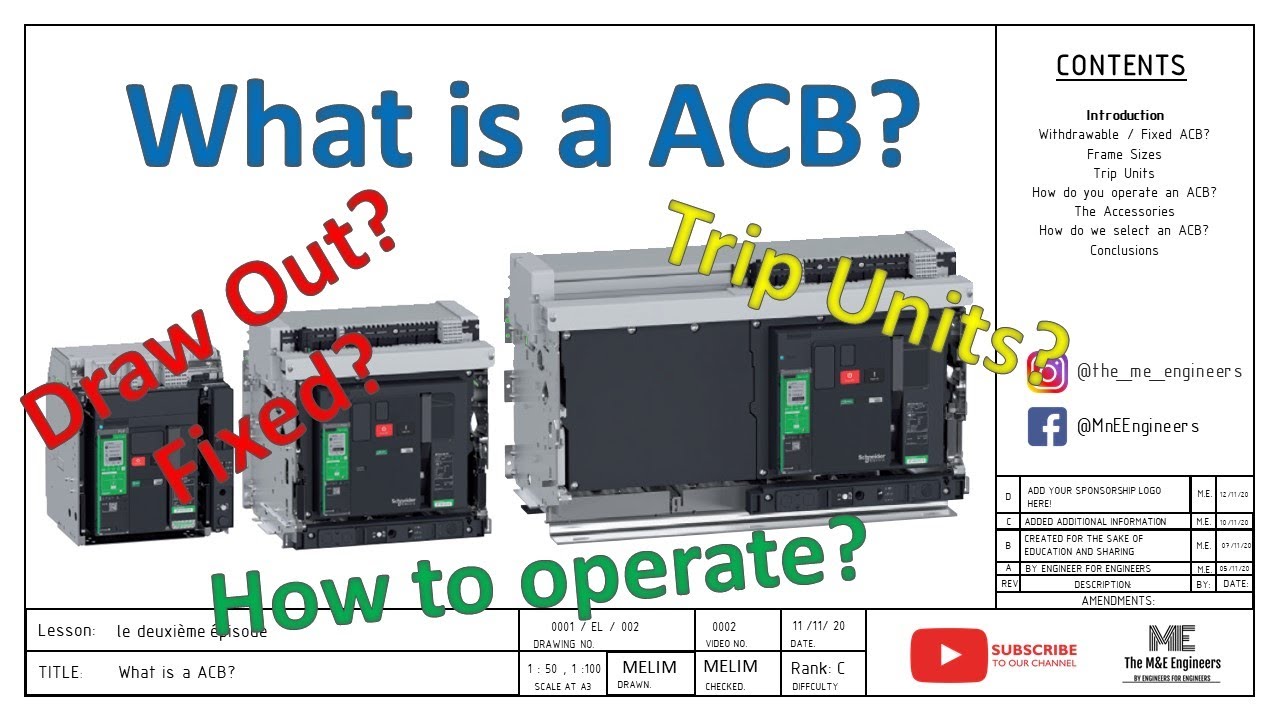
Video explanation
Watch Episode 2 – What is a ACB, Air Circuit Breaker, Trip Units, draw-out explained by a M&E engineer! by The M&E Engineers for visual context. Product configuration and safety steps must still follow the exact SUTON model documents.