


At the same time, B2B buyers are becoming more cautious. They are no longer evaluating MCB products only by price. Instead, they increasingly review breaking capacity, tripping curve accuracy, IEC standard references, OEM support, wiring compatibility, documentation, and long-term supply stability. In international procurement, these factors directly affect product selection, project safety, distributor reputation, and after-sales service.
This article explains how miniature circuit breakers are used, manufactured, tested, and sourced, helping buyers make more informed decisions when comparing an MCB manufacturer or low-voltage circuit breaker supplier.
Note: In low-voltage distribution systems, MCB selection should be based on load type, rated current, prospective short-circuit current, installation environment, cable size, and applicable local electrical regulations.
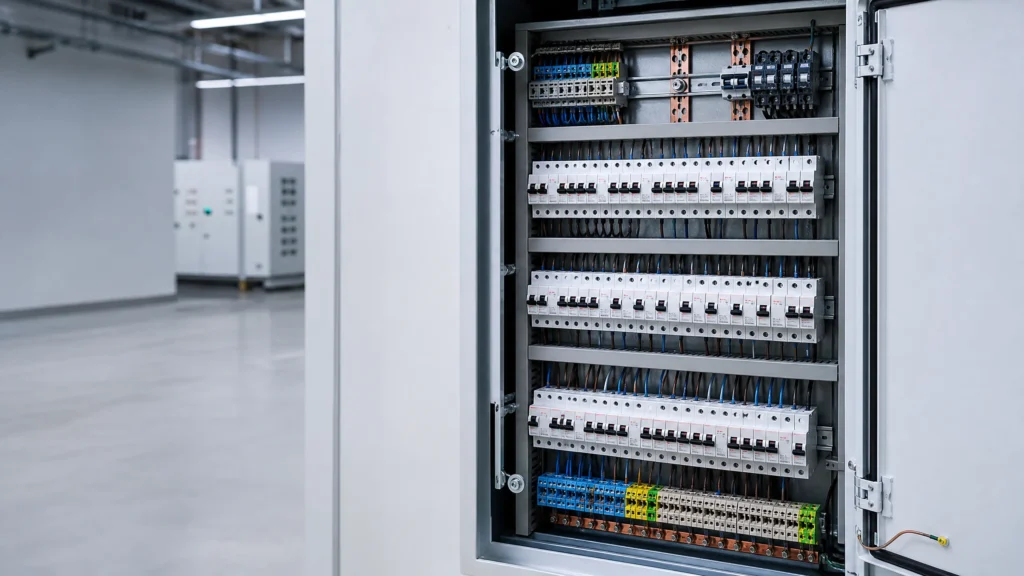
Understanding Miniature Circuit Breaker Demand in Low-Voltage Distribution
The demand for miniature circuit breakers is closely connected to the expansion of low-voltage electrical distribution. Residential buildings require safe distribution boards. Commercial facilities need compact electrical panels. Industrial control cabinets and low-voltage switchgear systems require stable circuit protection for machinery, lighting, control circuits, and auxiliary equipment.
According to the International Energy Agency, IEA, global electricity demand has continued to increase as electrification expands across buildings, industry, transport, and emerging energy systems. This broader electrification trend indirectly increases the importance of reliable downstream protection devices, including MCBs, in electrical distribution networks.
For B2B buyers, the need for MCBs is usually shaped by application environment, electrical risk level, and supply continuity. A distributor serving residential projects may focus on standard DIN rail installation, clear product marking, and stable packaging. A panel builder may care more about pole configuration, terminal capacity, and wiring convenience. OEM equipment manufacturers often pay closer attention to product consistency, documentation support, and repeatable supply across different batches.
In this context, a miniature circuit breaker supplier is not only expected to provide a product. Buyers also expect technical clarity, stable quality control, and reasonable support for market-specific requirements such as CE, CB, RoHS, CCC, or other local compliance documents.
In practical export projects, distributors often confirm model coding, carton labeling, barcode rules, and instruction sheet format before mass production. These details may seem small, but they help reduce warehouse confusion, after-sales disputes, and installation errors in the target market.
What Is a Miniature Circuit Breaker and How It Works
A miniature circuit breaker, often abbreviated as MCB, is an automatic electrical protection device used in low-voltage circuits. Its main function is to disconnect the circuit when abnormal current is detected. The two most common protection conditions are overload and short circuit.
In a typical MCB miniature circuit breaker, overload protection is handled by a thermal mechanism, usually a bimetal strip. When current exceeds the rated level for a certain period, heat causes the bimetal strip to bend and trigger the operating mechanism. Short-circuit protection is handled by a magnetic coil, which reacts quickly to a high fault current and trips the breaker.
Miniature circuit breakers are commonly installed in residential distribution boards, commercial electrical panels, industrial control cabinets, low-voltage switchgear, and OEM machinery control systems. Most models are designed for DIN rail installation and use screw terminals or similar terminal structures for wiring connection.
For buyers researching miniature circuit breaker wiring, the key point is not only whether the product can be connected easily, but whether the terminal capacity, tightening torque, wire size range, and wiring direction match the target application. These details should be confirmed through product datasheets, installation instructions, and local electrical requirements.
Note: Different countries and projects may have different requirements for MCB installation, wiring, and certification. Buyers should always confirm product suitability with local electrical standards and engineering specifications.
Key Materials and Components Used in Miniature Circuit Breaker Construction
Understanding miniature circuit breaker construction helps buyers evaluate product quality beyond external appearance. Although different manufacturers may use different designs, most MCBs include several core components: flame-retardant housing, copper conductors, silver alloy contacts, a thermal-magnetic trip unit, an arc extinguishing chamber, an operating mechanism, and a terminal system.
The housing is not only a protective shell. It provides insulation, mechanical protection, heat resistance, and space for product marking. Conductive parts such as copper conductors and silver alloy contacts directly affect current carrying performance and contact resistance. The thermal-magnetic trip unit determines how the breaker responds to overload and short-circuit conditions. The arc extinguishing chamber helps control the arc generated during switching or fault interruption.
| Component | Function | Buyer Evaluation Point |
|---|---|---|
| Flame-retardant housing | Provides insulation and mechanical protection | Material grade, heat resistance, marking clarity |
| Copper conductors | Carry operating current | Conductivity, thickness, dimensional consistency |
| Silver alloy contacts | Support switching performance | Contact welding quality, contact resistance |
| Bimetal strip | Responds to overload current | Calibration stability and thermal response |
| Magnetic coil | Responds to short-circuit current | Instantaneous trip accuracy |
| Arc extinguishing chamber | Helps extinguish electrical arc | Plate alignment and structural consistency |
| Terminal block | Connects external wiring | Terminal capacity, screw strength, wiring reliability |
| Operating mechanism | Opens and closes the circuit | Mechanical life and operation consistency |
For electrical distributors and panel builders, these details matter because poor material consistency can lead to overheating, unstable tripping, difficult wiring, or inconsistent performance across batches. A well-organized manufacturer should be able to explain how key components are selected, inspected, assembled, and tested.
Step-by-Step Manufacturing Process of a Miniature Circuit Breaker
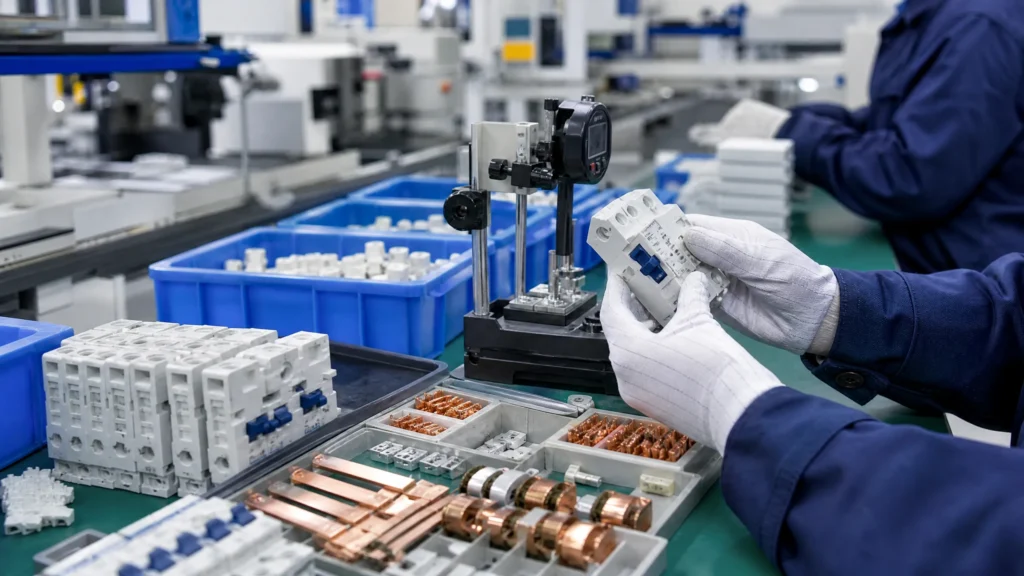
A reliable MCB manufacturer usually controls production from raw material inspection to final testing. Although different product series may use different production line arrangements, the basic manufacturing logic is similar.
The process begins with incoming material inspection. Plastic housing parts, copper conductors, silver alloy contacts, springs, screws, bimetal strips, magnetic coils, and terminal components are checked before entering production. This step helps reduce quality risks caused by unstable materials or dimensional deviation.
After material inspection, metal parts are stamped or formed according to the product design. Copper conductors, terminal parts, and mechanism components must maintain stable dimensions because even small deviations may affect assembly accuracy, contact pressure, and mechanical movement. Silver alloy contacts are then welded to conductive parts. Contact welding is a critical process because it can influence heat generation, electrical resistance, and switching durability.
The next stage is assembly of the thermal-magnetic trip unit. The bimetal strip, magnetic coil, and linkage structure are installed and adjusted so that the MCB can respond correctly to overload and short-circuit conditions. For B curve, C curve, and D curve MCBs, trip response must align with the intended load type and product specification.
The arc extinguishing chamber is then installed near the contact system. Its internal metal plates help divide, cool, and extinguish the arc during circuit interruption. After that, the handle, spring system, operating mechanism, trip linkage, internal conductive parts, and housing are assembled into the final product structure.
Before packaging, the product is calibrated and tested. Calibration helps ensure that the breaker trips according to its rated current and tripping curve. Functional inspection usually includes manual operation, continuity testing, marking inspection, and final visual review. Product information such as rated current, voltage, breaking capacity, curve type, model number, certification marks, and wiring symbols is then printed or marked before packaging.
Several manufacturing points are especially important for buyers to understand:
- Contact welding consistency affects temperature rise, contact resistance, and long-term switching performance.
- Trip calibration accuracy influences whether the MCB responds correctly under overload or short-circuit conditions.
- Assembly tolerance control supports stable mechanical operation and product consistency across batches.
- Final inspection traceability helps distributors manage batch records, documentation, and after-sales communication.
During sample approval, many distributors also compare terminal screw strength, printing clarity, handle operation feel, packaging protection, and datasheet consistency. These practical checks can reveal whether the product is suitable for repeated orders, not only for a single sample.
Technical Specifications Buyers Should Review Before Sourcing
Before purchasing from a miniature circuit breaker manufacturer, buyers should review technical parameters carefully. These specifications determine whether the product is suitable for the target market and application.
| Specification | Common Options | Buyer Notes |
|---|---|---|
| Rated current | 1A–63A, sometimes up to 125A depending on series | Select according to load and cable capacity |
| Rated voltage | 230/400V AC | Confirm grid and application requirements |
| Frequency | 50/60Hz | Match local electrical systems |
| Breaking capacity | 4.5kA, 6kA, 10kA | Match prospective short-circuit current |
| Pole configuration | 1P, 1P+N, 2P, 3P, 3P+N, 4P | Depends on distribution system design |
| Tripping curve | B, C, D | Select based on load type and inrush current |
| Installation | DIN rail | Check panel layout compatibility |
| Terminal capacity | Varies by model | Confirm wire size and tightening method |
| Applicable standards | IEC 60898-1, IEC 60947-2 | Confirm intended use and certification scope |
For most distributors, 6kA miniature circuit breaker and 10kA miniature circuit breaker models are common search and sourcing targets. However, the correct breaking capacity should be selected according to the available fault current at the installation point, not only based on market preference.
B curve MCBs are typically used for resistive or low-inrush loads. C curve MCBs are commonly used in commercial and general industrial applications. D curve MCBs are more suitable for loads with higher inrush current, such as motors, transformers, and some equipment circuits.
Rated current ranges, breaking capacities, and certification scope may vary by product series. Buyers should avoid assuming that one certificate or one test report automatically covers all models, poles, curves, and ratings. The safer approach is to match the exact product model with the corresponding technical document.
OEM Options for Electrical Distributors, Panel Builders, and OEM Projects
For electrical distributors and OEM equipment manufacturers, product customization is often part of long-term sourcing. OEM options help align the product with local market requirements, brand identity, packaging standards, and documentation needs.
Typical OEM cooperation may involve private label printing, logo and model marking, housing color selection, packaging design, product series customization, rated current configuration, terminal type selection, barcode or QR code labeling, datasheet support, instruction sheet preparation, and export carton design. However, these options should not be treated only as visual customization. In the low-voltage electrical equipment industry, OEM work must remain consistent with product ratings, technical parameters, certification scope, and local market requirements.
For example, product marking should clearly show rated current, rated voltage, breaking capacity, tripping curve, pole configuration, and model information. Packaging should protect the product during international transportation while also supporting warehouse management and distributor sales. Documentation such as datasheets, installation instructions, and wiring diagrams should be accurate enough for installers, engineers, and after-sales teams.
Yidun Electrical Technology Co., Ltd., as a manufacturer integrating scientific research, manufacturing, and sales, supplies complete-set high and low voltage electrical equipment, including circuit breakers, dual power supplies, disconnectors, instruments, meters, and power capacitors. In an OEM discussion, this product background can help buyers review compatibility, documentation, packaging, and supply coordination across related low-voltage electrical products.
For B2B buyers, useful OEM support should connect branding, specifications, technical documentation, and batch consistency instead of focusing only on appearance.
Quality Assurance Process for Stable Electrical Performance
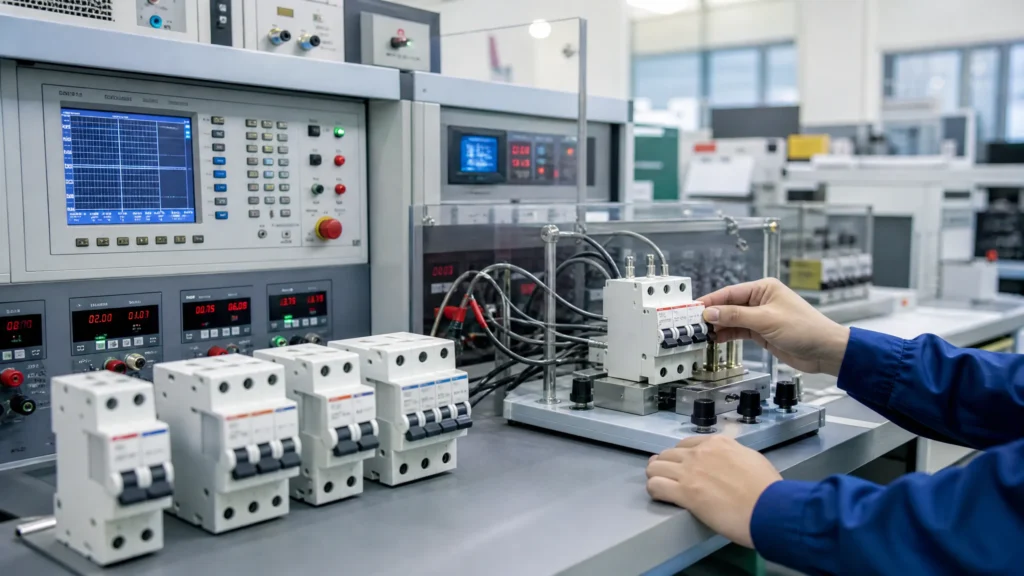
Quality assurance is one of the most important factors when evaluating an MCB supplier. A miniature circuit breaker is a safety-related electrical protection device, so testing should cover both mechanical and electrical performance.
For many international markets, miniature circuit breakers are evaluated with reference to IEC 60898-1 for household and similar installations or IEC 60947-2 for low-voltage switchgear and controlgear applications. These standards provide a technical basis for product classification, safety requirements, and performance testing.
A structured quality assurance process usually begins with incoming material inspection and dimensional inspection. Housing materials, conductive parts, contacts, springs, screws, coils, and bimetal strips need to meet design requirements before assembly. During production, component testing and assembly control help reduce variation between products.
After assembly, electrical and mechanical tests become more important. Contact resistance testing can help identify possible overheating risks. Trip calibration verifies whether overload and instantaneous trip performance meet the required curve. Temperature rise testing evaluates heat performance under rated current conditions, while dielectric strength testing checks insulation performance and electrical safety. Mechanical endurance testing reviews repeated opening and closing performance, and breaking capacity verification confirms interruption capability under specified fault current conditions.
Final inspection should not be limited to appearance. It should also confirm marking accuracy, functional operation, packaging information, and batch traceability. A manufacturer does not need to overstate its capability to demonstrate reliability. Consistent testing procedures, clear inspection records, controlled materials, and transparent communication often provide stronger evidence for B2B buyers.
For example, buyers may review whether a supplier has a documented quality management system, such as ISO 9001, and market-related certifications such as CCC, CE, or CB, depending on the destination market. Yidun Electrical Technology Co., Ltd. presents its low-voltage electrical equipment background, quality management approach, and export market experience on its website, which buyers can review as part of supplier due diligence.
Buyer Checklist for Evaluating an MCB Manufacturer
A structured checklist can help buyers compare different miniature circuit breaker suppliers more objectively. Instead of relying only on catalog photos or quoted prices, buyers can review documents, samples, testing information, and communication quality together.
| Review Item | Why It Matters |
|---|---|
| Certificate and test report | Confirms product compliance scope |
| Rated current and breaking capacity | Ensures correct application matching |
| Trip curve | Matches load type and inrush current |
| OEM marking and packaging | Supports distributor market needs |
| Batch traceability | Helps after-sales and quality tracking |
| Sample testing | Reduces procurement uncertainty |
| Datasheet accuracy | Supports engineering and installation review |
| Lead time stability | Helps distributors manage inventory planning |
This checklist is especially useful for electrical distributors, panel builders, and OEM buyers who need repeatable quality across multiple orders. A supplier with clear documentation and stable communication is often easier to evaluate for long-term cooperation.
How B2B Buyers Can Evaluate a Reliable Miniature Circuit Breaker Manufacturer
When searching for a miniature circuit breaker manufacturer, buyers should evaluate more than unit price. A low initial price may not reduce total procurement risk if product documentation, testing consistency, packaging, or communication is weak.
Electrical distributors, panel builders, and OEM buyers should first review whether the supplier can provide clear certification documents, test reports, datasheets, and product specifications. These documents should match the exact model, rated current, breaking capacity, and tripping curve being purchased. Buyers should also confirm whether the supplier can explain key quality control steps, including trip calibration, temperature rise testing, dielectric testing, and final inspection.
Sample evaluation is another important step before bulk purchasing. By checking samples, buyers can review marking clarity, terminal structure, switching feel, packaging quality, and datasheet accuracy. For OEM projects, it is also useful to confirm logo marking, model coding, carton layout, barcode rules, and documentation format before mass production.
Long-term supply capability should also be considered. A supplier that can maintain stable production scheduling, export packaging, batch traceability, and technical communication is usually easier to work with in international B2B procurement. For buyers comparing different MCB manufacturers, reviewing samples, datasheets, test records, and packaging details before placing large-volume orders can reduce sourcing uncertainty.
Yidun Electrical Technology Co., Ltd. may be evaluated through this type of practical review process, especially for buyers who require low-voltage electrical equipment, circuit protection products, OEM discussion support, and export supply coordination. Buyers can also review company information and product categories at https://cnsuton.com/ as part of supplier background research.
Frequently Asked Questions
1. What is a miniature circuit breaker used for?
A miniature circuit breaker is used to protect electrical circuits from overload and short-circuit conditions. It is commonly installed in residential distribution boards, commercial electrical panels, industrial control cabinets, low-voltage switchgear, and OEM equipment.
2. What are the common miniature circuit breaker types?
Common miniature circuit breaker types include B curve, C curve, and D curve models. They may also be configured as 1P, 1P+N, 2P, 3P, 3P+N, or 4P depending on the electrical system design.
3. How do buyers choose the correct breaking capacity?
Buyers should select breaking capacity according to the prospective short-circuit current at the installation point. Common options include 4.5kA, 6kA, and 10kA, but the final choice should follow project design and local electrical requirements.
4. What is the difference between B curve, C curve, and D curve MCBs?
B curve MCBs are usually used for resistive or low-inrush loads. C curve MCBs are suitable for general commercial and industrial loads. D curve MCBs are used for equipment with higher inrush current, such as motors and transformers.
5. Can miniature circuit breakers be customized for OEM projects?
Yes. OEM options may include product marking, private-label packaging, housing color selection, model coding, rated current configuration, terminal type adjustment, barcode labeling, and documentation support. Buyers should confirm that all customized elements remain consistent with technical ratings and certification requirements.
6. What quality tests are commonly used in MCB production?
Common quality tests include incoming material inspection, contact resistance testing, trip calibration, temperature rise testing, dielectric strength testing, mechanical endurance testing, breaking capacity verification, and final functional inspection.
7. Which standards are commonly related to miniature circuit breakers?
IEC 60898-1 is commonly related to circuit breakers for household and similar installations. IEC 60947-2 applies to low-voltage switchgear and controlgear circuit breakers. CE, CB, CCC, RoHS, or local certifications may also be required depending on the target market.
8. How can electrical distributors compare different MCB suppliers?
Distributors can compare suppliers by reviewing certification documents, sample consistency, testing capability, OEM support, packaging quality, technical communication, lead time stability, batch traceability, and long-term supply capability.
Conclusion
Choosing a miniature circuit breaker manufacturer requires a balanced review of technical parameters, manufacturing process, quality assurance, certification documentation, OEM options, and supply reliability. For electrical distributors and panel builders, the right sourcing decision can support safer electrical distribution, easier installation, clearer product management, and more stable long-term cooperation.
Rather than relying only on product appearance or price, buyers should examine rated current, breaking capacity, tripping curve, pole configuration, IEC-related documentation, sample performance, and factory testing procedures. A manufacturer that can explain its materials, production process, inspection steps, and OEM support in a transparent way is generally easier to evaluate for international B2B procurement.
For buyers sourcing low-voltage electrical equipment, Yidun Electrical Technology Co., Ltd. can be considered as part of a structured supplier comparison process through sample review, technical discussion, specification confirmation, documentation evaluation, and website background research.
Disclaimer
This article is for general technical and sourcing reference only. Final product selection should follow local electrical codes, project specifications, applicable standards, and qualified engineering review.
References
- International Electrotechnical Commission. IEC 60898-1
Electrical accessories — Circuit-breakers for overcurrent protection for household and similar installations — Part 1: Circuit-breakers for a.c. operation.
Official standard page:
https://webstore.iec.ch/publication/27944 - International Electrotechnical Commission. IEC 60947-2
Low-voltage switchgear and controlgear — Part 2: Circuit-breakers.
Official standard page:
https://webstore.iec.ch/publication/6794 - International Energy Agency, IEA. Electricity 2024
Analysis and forecast to 2026.
Official report page:
https://www.iea.org/reports/electricity-2024