

3P+N vs 4P surge protector selection depends on the protection circuit inside the device, the supply earthing arrangement and the manufacturer's approved connection diagram. Four modules do not establish four identical protective paths. A product described as 3P+N may use three line-to-neutral elements plus a distinct neutral-to-earth element, while a product marketed as 4P may describe a different circuit or simply its physical construction. Confirm the exact topology before comparing ratings or ordering. This guide helps three-phase panel buyers distinguish the descriptions, request meaningful evidence and avoid treating a catalog name as an installation instruction.
Start with the protection paths, not the module count
A three-phase four-wire supply has three line conductors and a neutral. The protective conductor provides a different function and must not be treated as another phase. An SPD connects to selected points in this system to limit transient differences in potential. Which points it connects, and what happens between them during normal operation and a disturbance, matter more than the number of visible cartridges.
In a common 3+1 arrangement, three protective elements connect the lines to neutral, and another element connects neutral to protective earth. That description identifies electrical paths. It does not guarantee that every product marked 3P+N uses that arrangement. In a common 4+0 arrangement, paths connect each line and neutral individually toward protective earth. Again, verify the drawing for the ordered part number. These are useful comparison concepts, not permission to build a circuit from a generic sketch.
Ask for a schematic that names L1, L2, L3, N and PE and identifies each internal element. A terminal drawing alone can show where conductors land without explaining the internal protective circuit. Keep both documents in the purchase file.
Why the neutral element needs separate attention
The neutral-to-earth element in a 3+1 design may use a voltage-switching component, such as a spark gap, rather than the same voltage-limiting technology used on the phase paths. Its behavior affects normal leakage, transient performance and the requirements applied to the complete assembly. A statement that the device has four poles cannot answer these questions.
The neutral element may also have a different current duty because of how surge currents from the phase paths combine. Do not assume its rating equals one phase cartridge's rating. Request the manufacturer's declared values and the test conditions for the complete arrangement. A rating written on the front of one module may not describe every path in the assembly.
Neutral and PE are not interchangeable simply because they appear close together in a panel. Moving their connection point changes the system being assessed. Where a proposed drawing is ambiguous, stop the selection review and obtain clarification from the panel designer and SPD supplier.
Compare the complete device on equal terms
| Tinjau item | 3P+N candidate | 4P candidate |
|---|---|---|
| Protective paths | Request the exact 3+1 schematic; do not assume from notation | Request all paths; a 4P label alone is insufficient |
| Neutral element | Identify N-PE component and its declared duty | Confirm whether the neutral path differs from phase paths |
| Earthing compatibility | Check approved diagram for the actual TT or TN system | Check approved diagram for the same installation |
| Surge classification | Verify Type 1, Type 2 or combined evidence separately | Apply the same test-duty requirement |
| Perlindungan cadangan | Use exact permitted protective-device conditions | Compare under equivalent short-circuit conditions |
| Final comparison | Approve only documented supported configuration | Compare price and dimensions after suitability is resolved |
The comparison should begin with the actual system and end with a documented, supported device. If one quotation describes a module and another describes a complete four-module assembly, make the distinction explicit. Price and width comparisons are meaningful only after both candidates meet the same electrical requirements.
Use Uc to assess continuous operating voltage on the relevant paths, and Up to assess the declared voltage protection level under the stated test conditions. Compare In, Imax or Iimp only where their waveform and test classification match. A higher number under one test does not automatically replace a lower number under another. The companion guide to SPD Uc, Up, In and Imax ratings explains that separate rating review.
Match the topology to TT, TN-S or TN-C-S
The approved connection depends on the earthing system at the installation point. In TT systems, the relationship between neutral, local protective earth and residual-current protection needs specific attention. In TN-S systems, neutral and PE remain separate. In TN-C-S systems, confirm where the combined conductor divides into separate conductors before applying a diagram intended for a downstream panel.
These system labels are inputs to a design decision, not universal answers about a particular SPD. The location relative to an RCD, the treatment of an SPD failure and the manufacturer's supported circuit all need review. The Panduan perlindungan lonjakan BEAMA explains why connection arrangements and overcurrent protection must be assessed together. Its UK context must be checked against the rules adopted by the project.
Record the confirmed system on the single-line diagram. If the building's supply arrangement is uncertain, ask the responsible electrical designer or supply operator to verify it. Replacing uncertainty with a guessed terminal arrangement can invalidate the entire comparison.
Specify the protection class separately
3P+N and 4P describe an arrangement; Type 1, Type 2 and Type 3 describe different protection classifications and test duties. A three-phase topology can exist in more than one class. A combined device may have more than one declared classification, but that must be supported by its exact documentation.
The need for lightning-current protection, protection against induced or switching surges and downstream equipment protection comes from the installation assessment. Do not upgrade or downgrade the protection class because a candidate has more modules. The IET's explanation of SPDs describes different installation roles and the need to coordinate multiple devices.
For an existing panel, identify the upstream protection before choosing a replacement. A unit that fits the same space may provide a different function. Capture the old part number, actual ratings and circuit, then ask whether the proposed replacement preserves the intended protection strategy.
Check backup protection and the assembly conditions
An SPD is not a load-circuit breaker. Its external short-circuit protection, where required, must follow the manufacturer's conditions. Confirm the prospective fault current at the panel and the acceptable fuse or breaker specification. A maximum backup fuse value must not be interpreted as an unconditional instruction to install that fuse.
Compare terminal capacity, conductor requirements, permissible orientation, environmental limits and the intended enclosure. A mechanically convenient product can still be unsuitable for the available fault duty or internal panel arrangement. For a replacement, the assembly manufacturer should confirm the proposed device and any connection changes.
Document the effect of an SPD branch failure. Depending on the selected protective arrangement, a failed SPD may be disconnected while the loads remain energized, or operation of shared protection may interrupt them. That consequence should be understood before the quotation is approved.
Plan wiring before accepting the quotation
The installation can add voltage to the protection level at the equipment because of the impedance of the connecting conductors during a fast surge. A catalog Up value is not the complete installed result. Check the proposed route to the supply connection and protective-earth connection, including any external backup protective device.
A suitable topology in the wrong position can create unnecessarily long conductors. Place the design on a scaled panel layout and review access, separation and the actual cable path. Do not reduce required clearances or conductor sizes to shorten a route. The guide to Panjang kabel SPD addresses that layout review.
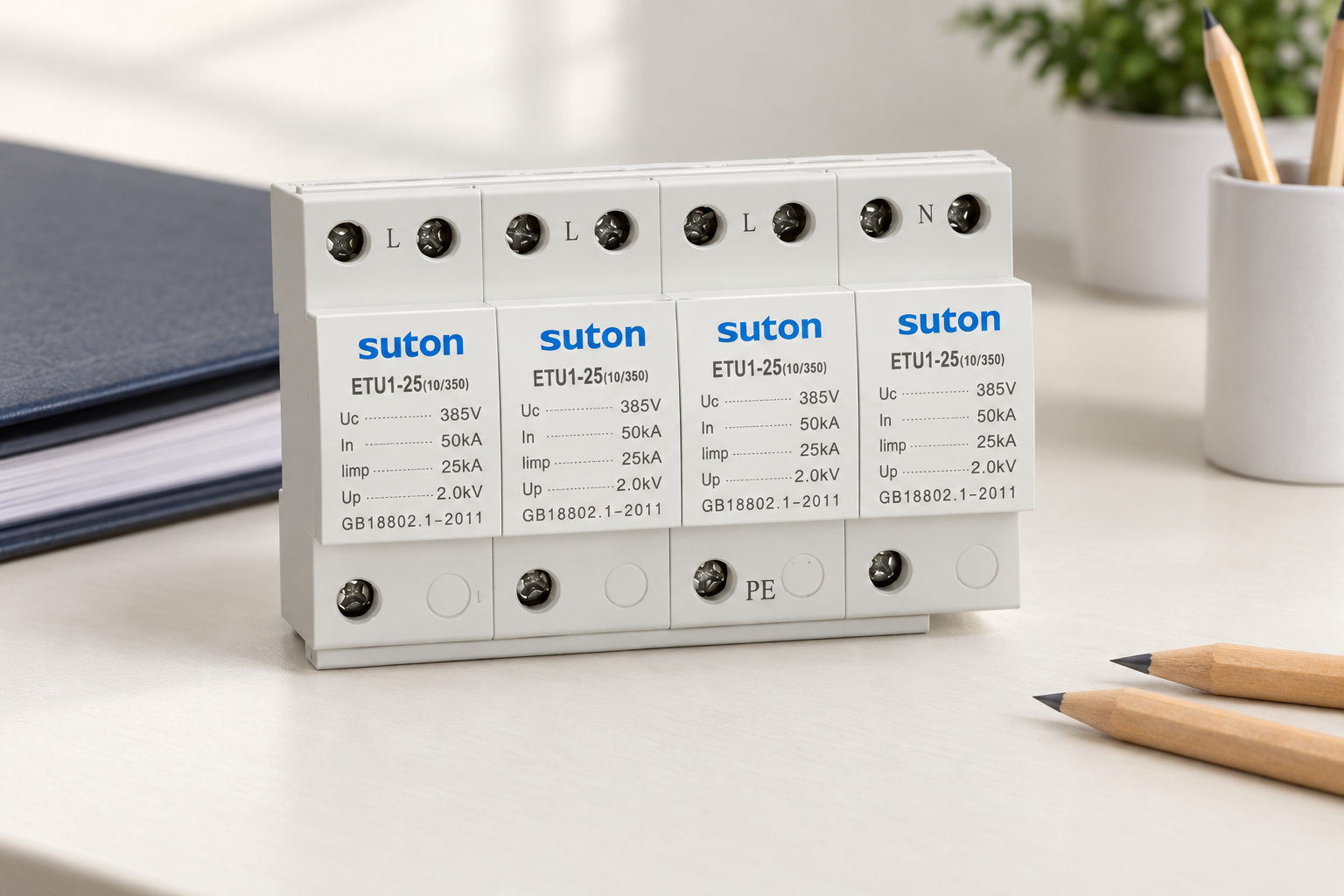
Final connection work belongs to competent personnel using the approved instructions. Product photography in this article illustrates the SUTON ETU1 family only; it is not a verified 3+1 or 4+0 circuit diagram and does not show a recommended installation.
A practical quotation review
Consider two suppliers offering four-module devices for the same three-phase board. One quote states 3P+N and includes a neutral-to-earth switching element. The other says 4P but includes no internal schematic. The first question is not which is cheaper. Ask the second supplier to identify all protective paths and supply the relevant earthing-system diagram.
Next, compare continuous voltage, protection level, surge test duty and backup protection under matching conditions. Check whether the neutral element is included in the quoted assembly and whether the part numbers in the test evidence match the delivered cartridges and base. Record each unresolved item beside the quotation rather than accepting a generic declaration of equivalence.
If both candidates are supported for the installation, the designer can then evaluate space, maintainability, available monitoring and cost. If the evidence differs, describe the difference precisely. Avoid saying that every 3P+N product is better or that every 4P product is interchangeable.
Request a traceable SUTON configuration
Gunakan SUTON ETU1 surge protective device page as a starting point for a model inquiry. Send the supply voltage, conductor arrangement, confirmed earthing system, panel location, required SPD class, prospective fault current and upstream protective device details. Request the exact order code, internal schematic, ratings and backup protection conditions.
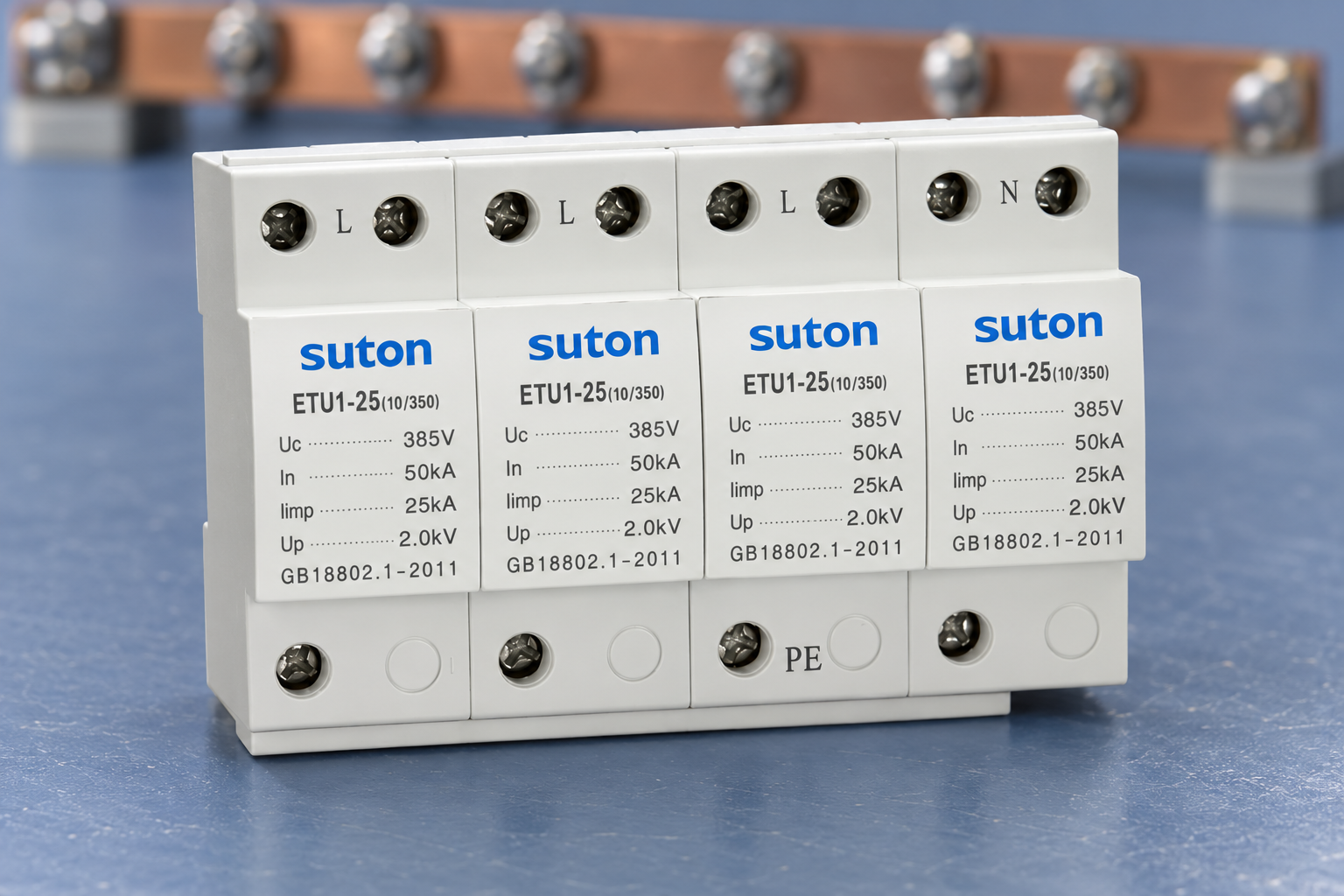
Do not infer an unlisted variant from the family photograph. The reference image shows a specific exterior; different configurations require their own documentation. For broader context, read Pilihan SPD tipe 2 and the comparison of single-phase and three-phase arrangements.
At delivery, match the base and cartridges against the approved bill of materials. Record the visible part numbers, terminal designations and supplied instructions. A purchase file that links the design decision to the actual delivered unit is more useful than a folder containing unrelated certificates.
Pertanyaan yang sering diajukan
Is 3P+N always the same as 3+1?
No. It is a common interpretation, but catalog notation is not sufficiently consistent to establish the internal circuit. Confirm the exact schematic and neutral-to-earth element for the ordered model.
Can a 4P SPD replace a 3P+N device without redesign?
Only after the designer and manufacturer confirm compatible protective paths, earthing-system suitability, ratings, backup protection and installation conditions. Equal module count and enclosure width are insufficient evidence.
Does four-pole construction establish Type 1 protection?
No. The pole arrangement does not establish surge test classification. Type 1 duty must be supported by the declared classification and applicable test evidence for the exact device.
Referensi dan lingkup
Latar belakang teknis: Panduan perlindungan lonjakan BEAMA, Penjelasan perlindungan lonjakan listrik IET, Petunjuk keselamatan listrik dari HSE. Berlaku sesuai dengan standar yang ditetapkan oleh proyek dan petunjuk produk yang tepat. Ilustrasi produk menampilkan keluarga SUTON yang difoto dan tidak menetapkan peringkat atau persetujuan pemasangan yang tidak tercantum.
Video edukasi
Surge Protection – Fundamentals, oleh IAEI – The Electrical Enforcement Authority, memberikan latar belakang pendidikan umum tentang perlindungan transient. Hal ini tidak menetapkan rating khusus untuk model maupun menggantikan desain proyek. Pembahasan mengenai kerangka instalasi harus dipastikan sesuai dengan peraturan yang telah ditetapkan oleh proyek.