

SPD backup fuse sizing starts with the exact surge protective device manufacturer's short-circuit protection requirements, then checks the available fault current, the upstream protective device and the complete panel arrangement. Do not derive a fuse amperage from the SPD's kA surge rating or assume any miniature circuit breaker can replace an approved fuse. A maximum permitted backup fuse is a limit within stated conditions, not a universal design value. This guide explains how buyers and panel engineers assemble the evidence needed to select an external fuse or breaker without inventing a model-specific rating.
Understand what the backup device protects
An SPD normally carries little current in its protective paths until a transient causes it to conduct. Its components can deteriorate, and an abnormal condition may create a fault requiring disconnection. External short-circuit protection, where specified, must deal with that duty. It has a different purpose from the SPD's surge-limiting function.
A thermal disconnector inside an SPD addresses certain thermal conditions. Its presence does not establish that all possible short-circuit duties are safely handled without external protection. Some assemblies include a specifically designed integrated protective function; others rely on stated upstream or branch devices. Read the documentation instead of making assumptions from the enclosure.
Likewise, a load-circuit breaker protects its circuit according to its own characteristics. It does not replace an SPD merely by being installed upstream. The two functions need coordination. The BEAMA guide discusses protection of SPDs, including the consequences of device end of life; use it as background alongside the exact manufacturer instructions.
Collect the inputs before choosing an amperage
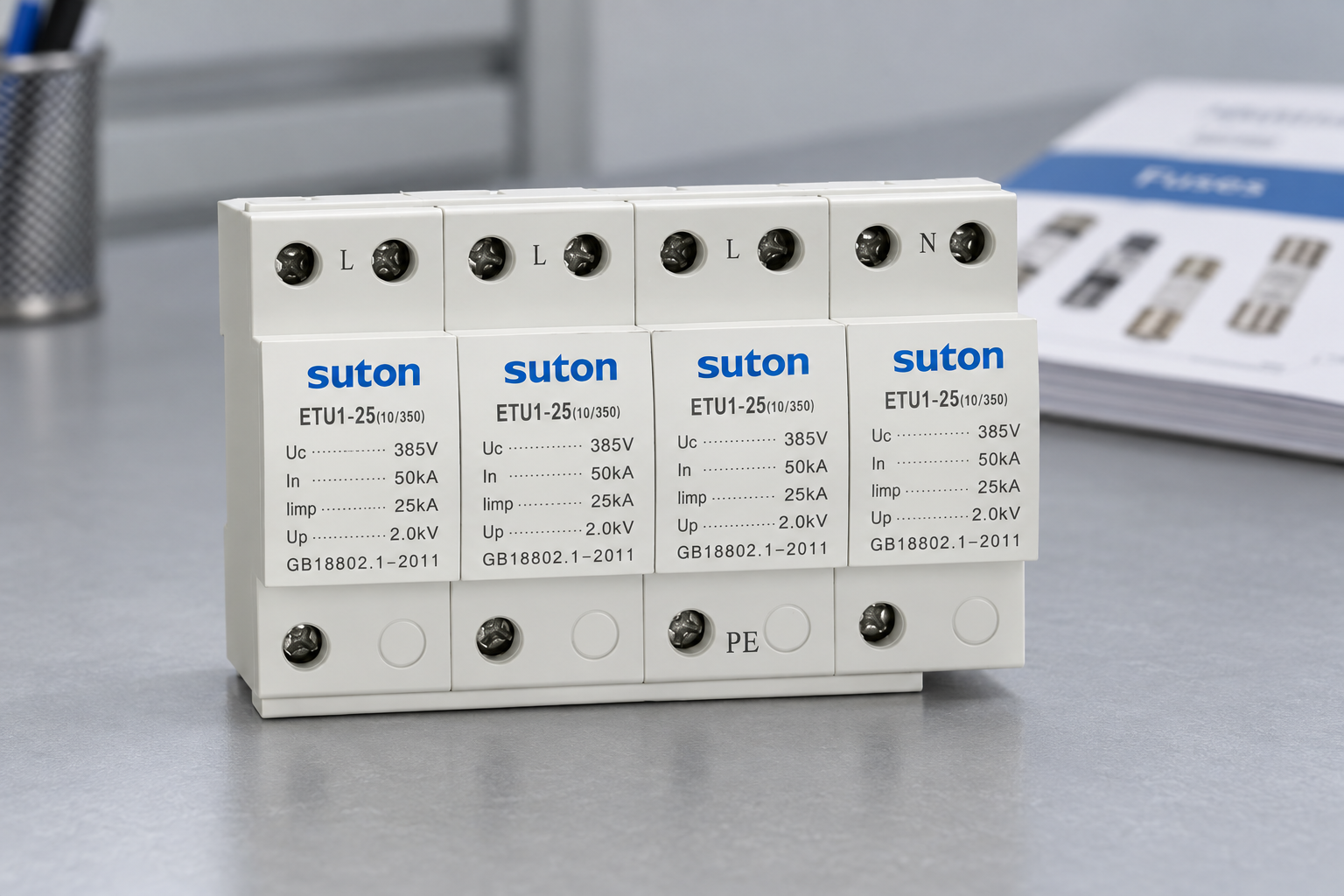
Start with the SPD order code, voltage, protection paths, class and declared short-circuit conditions. Add the prospective fault current at the proposed connection point, the upstream fuse or breaker details and the panel manufacturer's requirements. A photo showing only the device front is useful for identification but cannot provide the whole specification.
The fault-current value must apply to the location and operating configurations being reviewed. A panel fed from different sources or with changed transformers can have a different available fault duty. Do not reuse an old calculation without checking that the assumptions remain valid. Where no verified value is available, the design record should say so and request one.
Identify the actual upstream protective device: manufacturer, model, fuse category or breaker characteristics, rated current, breaking capacity and any relevant settings. Recording only an ampere value discards information that may determine compatibility with the SPD.
Distinguish a maximum backup rating from a recommendation
A datasheet may list a maximum upstream fuse under defined test conditions. That statement establishes the boundary of the declared arrangement. It does not mean that a fuse of that size is required in every installation, or that any protective device below that number is necessarily acceptable.
The existing supply fuse may satisfy the manufacturer's conditions, allowing an arrangement without an additional dedicated device. In another panel it may exceed the permitted limit, requiring separate branch protection. The correct conclusion depends on the complete documentation, including device technology, prospective current, wiring and any minimum surge-withstand requirements for the backup device.
Too small a branch device may operate during a surge that the SPD was intended to handle. Too large or incorrectly characterized a device may not provide the required fault disconnection. The decision needs both sides of that assessment. Do not solve one problem by ignoring the other.
Use this evidence table for quotation review
| Barang bukti | What to obtain | Keputusan tersebut mendapat dukungan |
|---|---|---|
| SPD identity | Exact base and cartridge codes; applicable document revision | Identify the complete protected assembly |
| Arus gangguan | Verified prospective fault current at the connection point | Check declared short-circuit conditions |
| Existing protection | Exact fuse category or breaker model, rating and settings | Assess whether upstream protection qualifies |
| Manufacturer limits | Maximum values with all stated conditions | Avoid treating a limit as an unconditional recommendation |
| Proposed substitute | Written supported coordination for the alternative device | Approve or reject substitution |
| Branch wiring | Conductor and terminal requirements; physical route | Review complete electrical and panel arrangement |
The table is a purchasing and design review aid, not a fuse schedule. Every numeric entry in the final schedule should come from the approved design and exact device evidence. Keep conditional ratings attached to their conditions when copying them into a bill of materials.
Itu IET's SPD question-and-answer document directs users to equipment manufacturers for protective-device ratings. That is particularly relevant when the literature is unclear about whether a published limit applies to an upstream supply device, a dedicated branch fuse or an integrated assembly.
When a breaker can be considered
A breaker may be used where the SPD manufacturer supports the exact arrangement and the breaker meets the stated requirements. Do not treat a breaker with the same ampere marking as equivalent to a fuse. Their time-current behavior, energy let-through and response during short-duration surge currents can differ.
Request a tested coordination table or a written approval naming the permitted device and conditions. If a table lists a specific breaker range, check the exact model, poles, rating and relevant settings. A generic phrase such as suitable MCB is insufficient for a design that depends on conditional short-circuit performance.
If the proposed breaker differs from the documented device, obtain a confirmed alternative before procurement. This is also important when substitutes are introduced because of stock shortages. Changing the backup device can change the declared protection arrangement even when the SPD remains identical.
Check the conductor and the complete branch
The backup device is part of a circuit, not an isolated item. Conductor size, material, installation conditions, terminal capacity and connection route must all be suitable. The branch wiring needs protection appropriate to the design. Do not assume the SPD's terminal capacity is itself a conductor-sizing instruction.
Review the connection path from the supply takeoff through any external protective device to the SPD and protective-earth connection. Additional devices can increase the route length. The voltage experienced by protected equipment depends partly on that layout during a surge, so electrical coordination and physical arrangement should be reviewed together.
The companion article on SPD lead length and protection level explains why drawing a short route is useful before the panel is built. Physical convenience cannot justify reducing required conductor size, spacing or access.
Decide what happens when the SPD branch opens
With a dedicated SPD branch, protective operation may remove the surge protection while leaving the load energized. That can be useful for continuity but creates a monitoring and maintenance requirement. A green status indicator yesterday does not establish that protection remains available after the branch opens today.
With shared upstream protection, some faults or operations can interrupt a larger part of the installation. The significance depends on the connected loads. Discuss the intended failure response with the owner, especially where controls, communications or production equipment must remain available.
If remote indication is part of the specification, confirm what it monitors. An SPD contact may report cartridge status without reporting loss of the external supply path. The monitoring design should distinguish device condition from branch availability rather than presenting both as one unqualified healthy signal.
Apply the method to an existing panel
Suppose a buyer wants to add an SPD to a board with an existing upstream protective device. First, identify the board, available fault current and exact SPD candidate. Then compare the upstream device with the permitted protection conditions. If it qualifies, record the reference supporting that conclusion and check the conductor arrangement.
If it does not qualify, obtain a permitted dedicated protective device and update the layout. Check whether the additional component changes enclosure space, conductor routing, monitoring or maintenance access. Submit that arrangement to the responsible assembly designer before accepting the procurement package.
Do not invent a worked numeric rating when the underlying device data is missing. A useful review can identify the evidence required and the decision sequence without pretending that every Type 2 SPD needs the same fuse. The guide to Pilihan SPD tipe 2 covers the earlier product-selection stage.
Control replacement and maintenance changes
An installed SPD can be replaced with a cartridge that appears mechanically compatible but has different voltage or protection characteristics. Record the approved base and replacement cartridge codes together. Check that the backup protective arrangement remains supported for the complete assembly.
During maintenance, inspect indicators and monitoring in accordance with the instructions. A change to the upstream fuse, breaker settings, supply source or panel fault-current assumptions should trigger a review of the SPD branch. Keep the coordination record accessible to the personnel who order spares.
HSE's electrical safety guidance emphasizes suitable equipment and competent working practices. Examination of live panels, isolation and electrical testing require the applicable safe system of work. This article provides a review method rather than a live-work procedure or permission to bypass a protective device.
Prepare a SUTON inquiry with the missing evidence
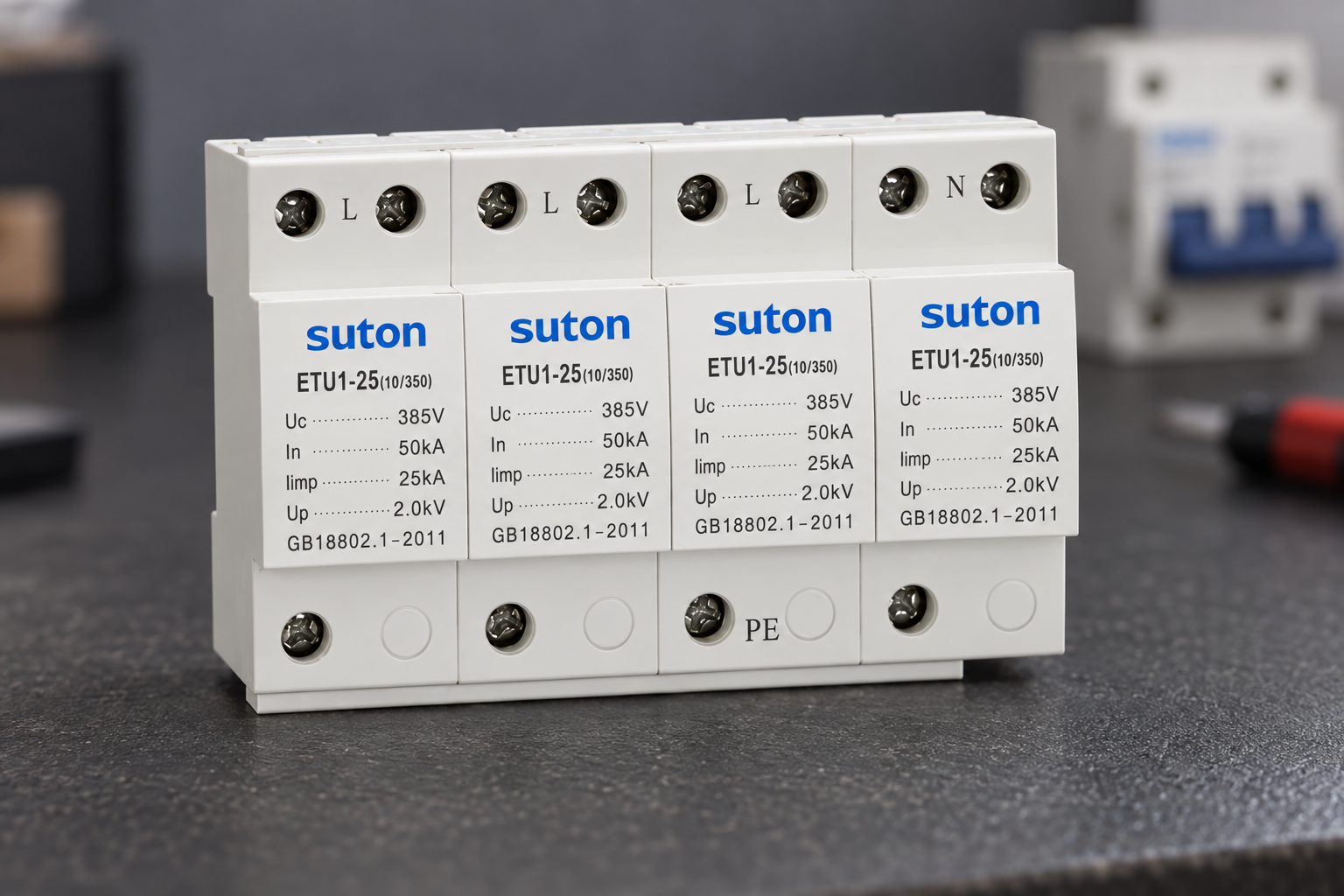
Untuk SUTON ETU1 surge protective device family, request the exact model's external short-circuit protective device requirements and conditional ratings. Include the supply voltage, earthing system, available fault current, upstream protection and intended panel layout. Ask the supplier to name permitted fuse categories or breaker models where applicable.
Compare SPD rating symbols separately from backup protection. In and Imax are surge-current parameters; they do not provide an ampere value for an external fuse. The SPD earthing-system selection guide covers another input that must be resolved before the complete branch is approved.
The final purchase order should identify the SPD, backup device, applicable document revision and any installation conditions. At delivery, verify the part numbers against that record. If an alternative is offered, return to the coordination evidence rather than accepting an equivalent label without support.
Pertanyaan yang sering diajukan
Can the SPD's Imax rating determine its backup fuse size?
No. Imax describes surge performance under stated test conditions. The external short-circuit protective device must be selected using the exact manufacturer's conditions and the installation fault duty.
Does an internal thermal disconnector eliminate every external fuse requirement?
No. Follow the declared complete arrangement. A thermal disconnector does not by itself establish all short-circuit protection or conductor-protection requirements.
Can a breaker replace a specified fuse with the same ampere rating?
Only when the SPD manufacturer supports the proposed breaker arrangement and all relevant conditions are satisfied. Equal current markings do not establish equivalent protective behavior.
Referensi dan lingkup
Latar belakang teknis: Panduan perlindungan lonjakan BEAMA, IET SPD technical Q&A, Petunjuk keselamatan listrik dari HSE. Berlaku sesuai dengan standar yang ditetapkan oleh proyek dan petunjuk produk yang tepat. Ilustrasi produk menampilkan keluarga SUTON yang difoto dan tidak menetapkan peringkat atau persetujuan pemasangan yang tidak tercantum.
Video edukasi
Surge Protection – Fundamentals, oleh IAEI – The Electrical Enforcement Authority, memberikan latar belakang pendidikan umum tentang perlindungan transient. Hal ini tidak menetapkan rating khusus untuk model maupun menggantikan desain proyek. Pembahasan mengenai kerangka instalasi harus dipastikan sesuai dengan peraturan yang telah ditetapkan oleh proyek.