

Switch disconnector altitude derating requires the exact manufacturer's assessment of the installation height and electrical duty. It is not a universal percentage that can be copied from a circuit breaker chart. Reduced air density can affect insulation and cooling conditions, and the complete assembly must be reviewed. SUTON's HGL/ETGL product page states a normal installation altitude not exceeding 2000 metres. For a site above that declared boundary, obtain written approval for the exact configuration and its applicable ratings before purchase. A larger current frame or a higher insulation-voltage number alone does not establish suitability.
Begin with the actual installation height
Record the altitude of the equipment location, not the company's address or the nearest city. A project may contain several buildings at different elevations, and an equipment room can have a different environmental arrangement from outdoor equipment. State the location used for the design, the intended enclosure and the responsible designer's environmental assumptions. These details give the supplier something concrete to evaluate rather than an informal description such as mountain service.
Distinguish normal service from exceptional transport or storage conditions. Equipment may travel through a high pass without operating there; that is a different question from continuous energized service at the final site. Include relevant storage and transport conditions in their own fields. Do not treat an approved shipping route as evidence of electrical operating suitability, or treat an operating-altitude declaration as approval for every storage environment.
Separate insulation and thermal effects
Air is part of the insulation environment around many electrical components. A change in air density can change relevant dielectric conditions, while cooling by air also requires attention. These are related environmental concerns but separate review questions. Lowering the current does not automatically resolve an insulation issue, and a higher voltage label does not automatically resolve a thermal issue. Ask the supplier to address each characteristic that the exact application requires.
The IEC 60947-1 publication provides the general low-voltage switchgear framework, while the IEC 60947-3 publication addresses the relevant switch and disconnector product scope. Public catalogue descriptions identify that framework but do not supply a complete project approval. The IEC 60664-1 insulation coordination scope also explicitly addresses altitude guidance. The applicable edition, manufacturer's declaration and assembly requirements must be established by the responsible engineer using the actual project documents.
Use the SUTON normal-service boundary correctly
The HGL/ETGL load disconnector page lists an installation altitude not exceeding 2000 metres under normal operating and installation conditions. It also lists temperature, humidity and exposure conditions. Treat those as a set of declared boundaries. Meeting the altitude condition alone does not approve a location with unsuitable temperature, contamination, rain exposure or enclosure conditions. Equally, indoor installation does not remove the altitude question.
Above the stated altitude, the public product page does not provide a model-specific correction curve in the material reviewed for this guide. It would therefore be misleading to publish a derived HGL current or voltage factor. Request a supported configuration and written conditions from SUTON. The response should identify the precise device code, voltage, operational duty, enclosure assumptions and any changes required. A family name followed by an unexplained approval statement is insufficient for a traceable order.
Do not transfer a breaker correction chart
Circuit breakers and switch disconnectors have different functions and declarations. Even products within one category can use different construction and validated conditions. A factor provided for one range is evidence for that range under its stated limits, not a universal law for every electrical device. The MCB altitude guide concerns a neighboring product question; it should not be used as the source of an HGL correction factor.
Also avoid combining unrelated factors by intuition. Multiplying a temperature percentage from one source by an altitude percentage from another can produce a precise-looking answer with no validated basis. Ask the manufacturer to address the combined conditions or provide the approved method for the exact product. If that information cannot be supplied, retain the selection as unresolved or evaluate another documented configuration with the responsible engineer.
Keep each voltage characteristic in its role
Operational voltage, insulation voltage and impulse withstand voltage have different meanings. None should be chosen simply because it is the largest number on a page. At altitude, ask which declared characteristics remain applicable, what conditions change and how the manufacturer supports that conclusion. The Ue, Ui and Uimp discussion explains the distinctions needed to ask those questions clearly.
A component label is also not a full assembly assessment. External clearances, conductor routing, adjacent apparatus and the enclosure arrangement require their applicable review. Do not shorten spacing or modify insulating parts to make a larger device fit. Any proposed installation change must follow approved drawings and the appropriate design process. This article intentionally does not provide insulation distances or test voltages because those require exact conditions and authoritative design evidence.
Use an altitude approval checklist
| Review input | Bằng chứng để thu thập | Câu hỏi chấp nhận |
|---|---|---|
| Site altitude | Actual equipment location | Is it within declared normal service? |
| Danh tính thiết bị | Complete code and pole arrangement | Is approval specific to this configuration? |
| Insulation | Applicable declarations at site conditions | Which characteristics and conditions remain valid? |
| Thermal duty | Manufacturer-supported current and enclosure conditions | Are combined environmental effects addressed? |
| Switching function | Operational duty or isolation restriction | Does environmental approval preserve function limits? |
| Hội đồng | Approved layout and verification | Are component and assembly assumptions consistent? |
| Delivery | Dated approval and matching documents | Does the delivered configuration match approval? |
This checklist organizes the manufacturer's response and assembly review. It contains no numerical correction factors. Its product-specific starting point is the HGL normal-service declaration; the IEC links above identify the relevant standards framework. Complete every open field with the exact configuration and applicable conditions. An unresolved entry is a procurement action, not permission to assume normal sea-level performance.
Example: a site outside normal service
Consider a hypothetical panel planned for a location at 2800 metres. The selected product's public declaration allows normal installation only up to 2000 metres. The immediate conclusion is that this site is outside that declared condition. It is not that the device automatically loses a particular percentage of current capacity. The project should request a supported selection and retain the supplier's response with the design review before placing an order.
Suppose the supplier responds only with a larger nominal current model. The designer still needs to know whether that configuration addresses the altitude-related insulation conditions and the required switching or isolation duty. A size change may be part of an approved solution, but it is not evidence by itself. Keep the hypothetical heights separate from product ratings and do not present this example as a calculation of suitable HGL performance.
Review the enclosure and load together
Identify internal temperature, nearby heat-producing equipment, ventilation strategy and the intended conductor system. High-altitude service may coincide with large day-night changes, condensation concerns or dust, but these conditions must be established from the actual site rather than assumed. Record the combination the supplier is being asked to approve. Avoid a sequence in which altitude is checked against one arrangement and temperature against a different arrangement.
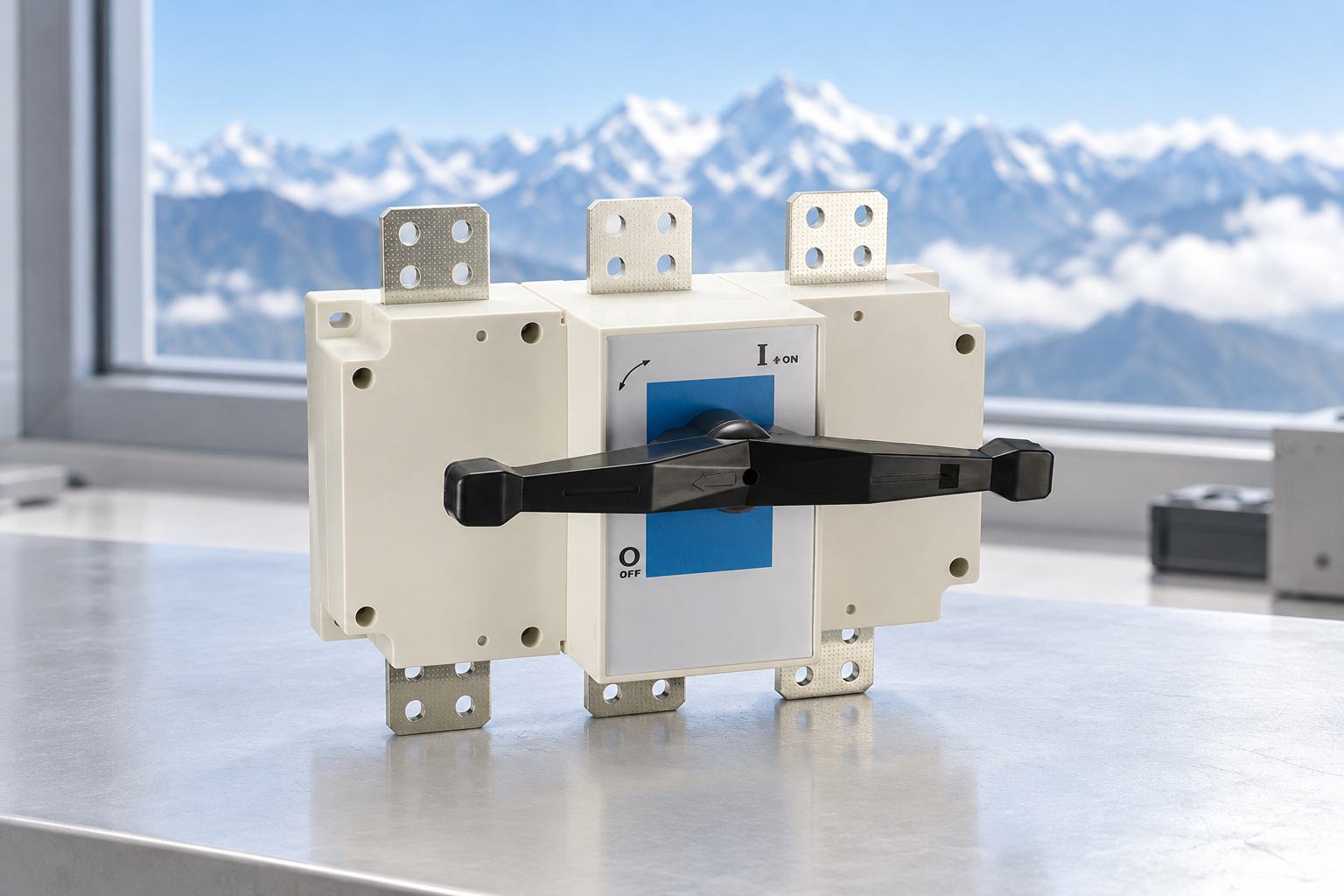
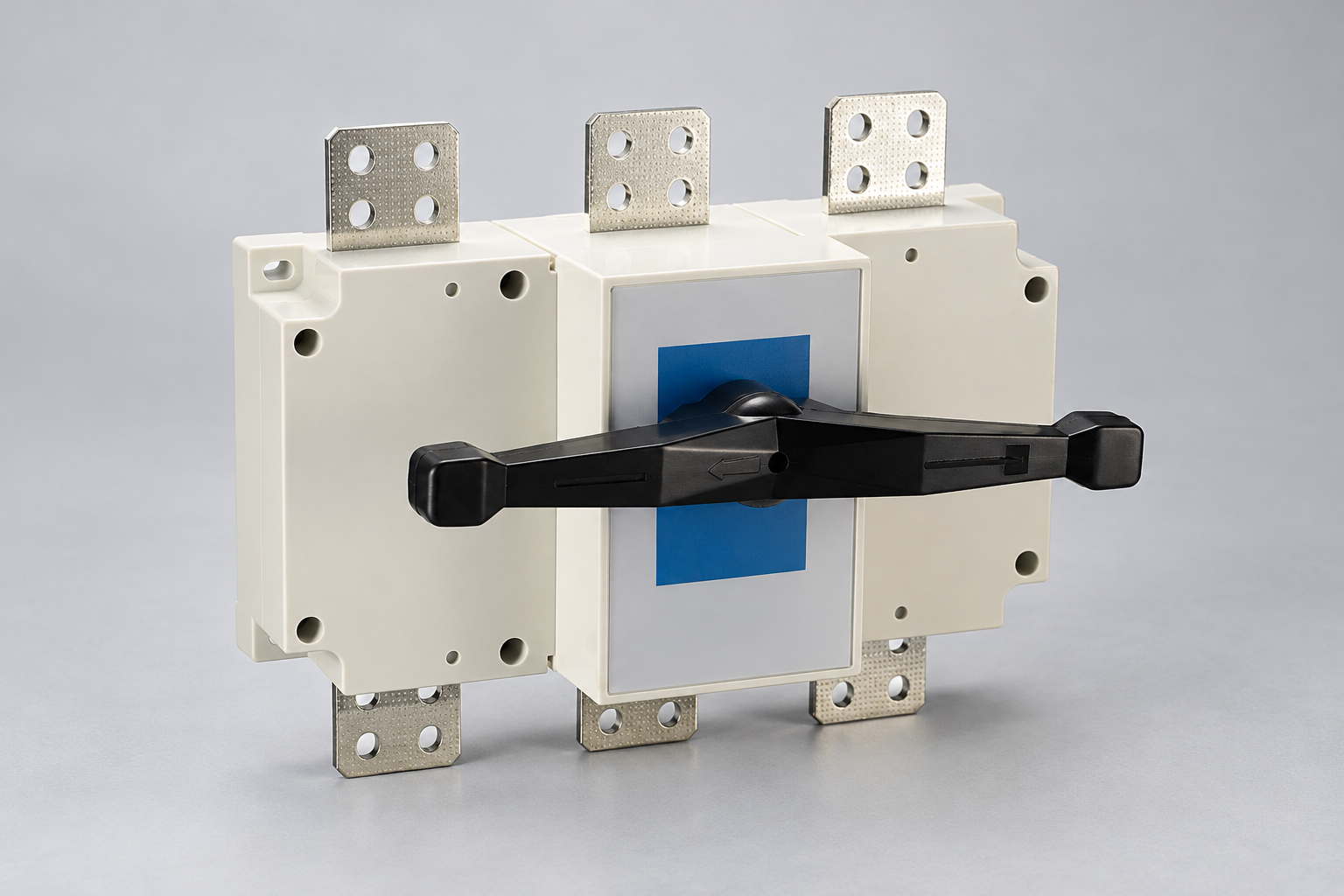
Ventilation changes can affect ingress protection and maintenance needs, so adding a fan is not an automatic cure for an unsupported rating. The assembly designer should coordinate the full solution. Product photographs in this guide show the reference device exterior for identification; they do not depict an approved mountain installation. Neither a studio image nor a catalogue diagram establishes field suitability, enclosure verification or a safe operating state.
Preserve duty restrictions at the new location
Environmental approval does not automatically expand the device's function. The HGL description identifies infrequent switching and isolation, and specifically limits models rated 1000 A and above to electrical isolation. Retain such restrictions in the high-altitude enquiry and resulting order. If the installation requires normal loaded switching, the supplier must confirm an appropriate exact configuration and operational declaration rather than allowing an environmental response to obscure the original duty limit.
Short-circuit conditions and protective coordination also remain separate requirements. The Icw and conditional rating guide helps organize those questions. Ask whether the proposed altitude conditions affect any relevant declarations, and obtain the applicable supporting evidence. Do not interpret an accepted thermal characteristic as blanket approval for fault withstand, switching capacity or coordination with a different protective device.
Make the approval usable at delivery
The purchase record should identify the approved model, pole arrangement, operating accessories, application voltage, duty, site altitude and enclosure assumptions. Attach the dated manufacturer's response and any revised data sheet. Record exclusions and conditions in a way that the assembly builder and site team can use. A vague email saying suitable for altitude is hard to verify when the delivered product code or enclosure later changes.
At receipt, match the device identity and supplied documents to that record. Refer differences back to the responsible engineer and supplier instead of treating a higher current label as an acceptable substitution. Keep operation, maintenance and electrical testing within the authorized site process. High-altitude review is a design and procurement task; it does not authorize improvised live testing or an undocumented experiment to see whether the chosen switch works.
Sử dụng isolator switch selection guide as the parent checklist for the complete purchase. Keep the altitude assessment with the same model and assembly records, so environmental approval remains connected to the original application and isolation requirements.
Các câu hỏi thường gặp
Is 2000 metres a universal limit for every switch disconnector?
No. This guide cites the normal-service condition stated on the SUTON HGL/ETGL page. Other products may have different declarations. Obtain the exact device documentation and applicable conditions rather than transferring that boundary to an unrelated range.
Can I solve altitude concerns by increasing current size?
Not without supporting evidence. A larger frame does not automatically establish the required insulation, switching and assembly performance at the site altitude. Request a manufacturer-supported configuration and have the responsible engineer review all relevant conditions together.
What should happen if no altitude correction data is available?
Keep the application outside the existing declaration unresolved and request written manufacturer assessment or another supported configuration. Do not invent a factor or borrow one from a different product. The final selection should remain traceable to actual approval evidence.
Video giáo dục
Mod-01 Lec-16 Dielectric (Insulating) Solids by nptelhrd. University teaching on solid dielectric materials supports the insulation discussion. It is not an altitude correction method or approval of the illustrated product.