


The difference between a fuse-switch and a switch-fuse concerns how the switching function and fuse-links are combined. In a fuse-switch arrangement the fuse-link, or a carrier holding it, participates in the moving switching assembly; a switch-fuse combines a switch with fuses in a different construction. Trade names are not always used consistently, so a buyer should confirm the actual mechanism, isolation function and approved fuse combination. The important purchasing outcome is not choosing a preferred word: it is obtaining a documented assembly that suits the circuit. This guide uses the SUTON HR6 fuse-switch disconnector as a real construction reference.
Ask what moves when the device operates
Begin with an identified drawing of the proposed device. Locate the fixed terminals, switching contacts, fuse-links, carrier, handle and barriers. Ask the supplier which parts move during normal operation and which remain connected to the incoming circuit. The answer helps the panel builder understand the operating envelope and the later inspection requirements. It also prevents a misleading comparison between products that share a catalogue term but use different mechanisms.
Do not infer a universal load-breaking capability from a removable fuse carrier. That capability depends on the complete product's declared duty. Likewise, a separate switching mechanism does not by itself establish an isolation function or a particular fault rating. Request the product's designation, applicable standard, utilization category and configuration-specific documentation. The construction description and electrical rating need to describe the same delivered assembly.
Keep the disconnector function in the comparison
The word disconnector adds an isolation requirement that should be supported by the exact product evidence. It is not simply another spelling of switch. The Hướng dẫn của IET về các thiết bị bảo vệ, cách ly và chuyển mạch explains why broad terminology can obscure the difference between isolation and load switching. Use that distinction when translating an inquiry into a technical schedule.
For each proposal, state whether it must carry normal current, switch the intended load, provide isolation and operate with a specified fuse-link. If one of those functions is not declared, do not assume the name fills the gap. The fuse-switch disconnector procurement guide provides the broader inquiry framework. This comparison adds the mechanical-construction question rather than replacing that framework.
Examine the actual HR6 construction
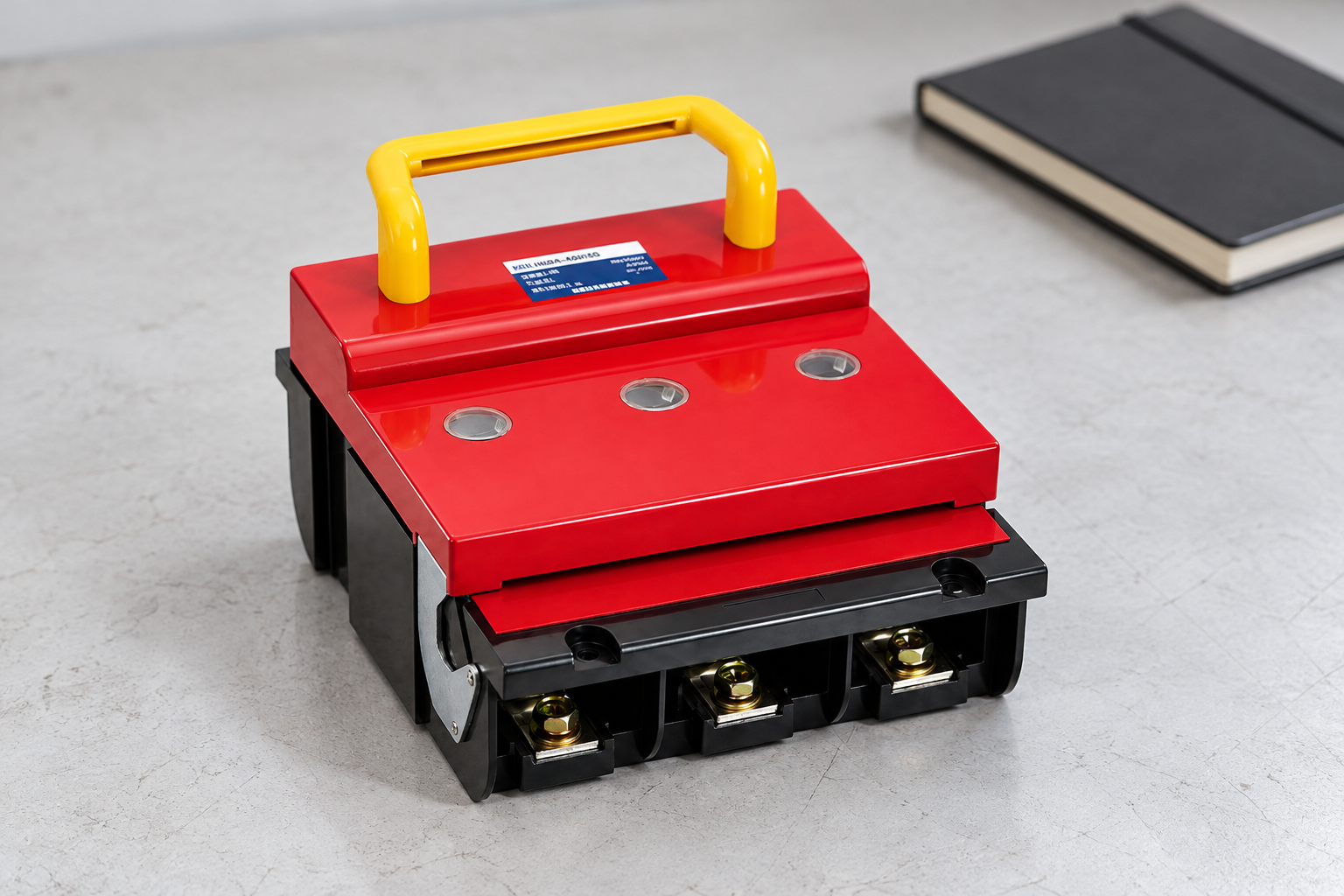
The SUTON HR6 series fuse-switch disconnector is described with a base, cover and arc chutes. The fixed contacts are mounted on the base, and NT-type fuse-links are installed in the cover. The cover moves in a fan-shaped path and can be removed from the base. This provides a concrete example of why the moving assembly and its available clearance matter during a layout review.
The public page describes applications in distribution and motor circuits but says that the device is generally not used for direct making and breaking of a single motor. Do not reduce that information to the statement “suitable for motors.” Ask for the intended circuit role and the applicable utilization category at the required voltage. A feeder switching function and repeated operation of one motor are different duties.
The page also describes optional auxiliary contacts. Their presence must be confirmed in the offered configuration, including contact duty and wiring. A main-switch status output does not automatically report whether a fuse-link has operated. If fuse monitoring is required, specify it as a separate function and request the appropriate evidence.
Compare construction and electrical evidence together
| Comparison | What to identify | Why it affects selection |
|---|---|---|
| Moving assembly | Switch contacts and fuse carrier | Determines operating and service envelope |
| Cách ly | Declared function for exact code | Trade name alone is insufficient |
| Fuse compatibility | Complete fuse type and rating | Physical fit does not establish approval |
| Chuyển đổi tải | Voltage and utilization category | Construction does not imply every duty |
| Fault evidence | Specified protective combination | Conditional ratings need their conditions |
| Signals | Switch status and fuse monitoring | These are different information functions |
| Bảo trì | Approved carrier and spare parts | Preserves the accepted combination |
The table deliberately avoids ranking one construction as universally better. Different panel layouts and service arrangements can favor different products, provided their functions and ratings are suitable. Keep the comparison tied to the actual assembly and fuse-link. An unqualified “equivalent” substitution can change carrier movement, spare parts, installation clearance and protection evidence even when the nominal current looks unchanged.
For switching-duty selection, use the fuse-switch utilization category guide. It addresses a related electrical decision. The construction comparison here should not be used to bypass that decision or to turn a thermal-current figure into an approved operational rating.
Match the fuse-link beyond its physical size
A fuse-link that fits inside a carrier is not necessarily approved for the proposed duty. Identify its type, size, voltage, current rating, utilization characteristics and the manufacturer's specified compatibility. The carrier's current capability and the fuse's protective behavior are separate parts of the selection. Record both codes in the bill of materials rather than keeping the fuse description as an informal purchasing note.
The HR6 product page includes a matching table with different combinations of fuse size, current, voltage and utilization category. Preserve the conditions in that table. A combination shown at one voltage or category should not be extended to a different condition by guesswork. The NH fuse size selection guide covers the physical and protection inputs that complement this construction review.
Understand conditional short-circuit information
A conditional short-circuit rating depends on the specified protective arrangement and test conditions. It should not be read as a standalone promise that a switch can interrupt any fault of the same numerical magnitude. Ask which fuse-link and upstream conditions support the rating, and whether they match the proposed circuit. Retain the document that identifies the approved combination.
Compare the prospective fault duty at the installation point with the appropriate equipment evidence. Normal load current, short-time withstand, making duty and fault interruption are different quantities. The IEC 60947-3 standard overview identifies the relevant product family and notes conditional short-circuit rating requirements in the standard's scope of development. The full applicable documents and manufacturer evidence govern the actual engineering assessment.
Allow space for the complete carrier movement
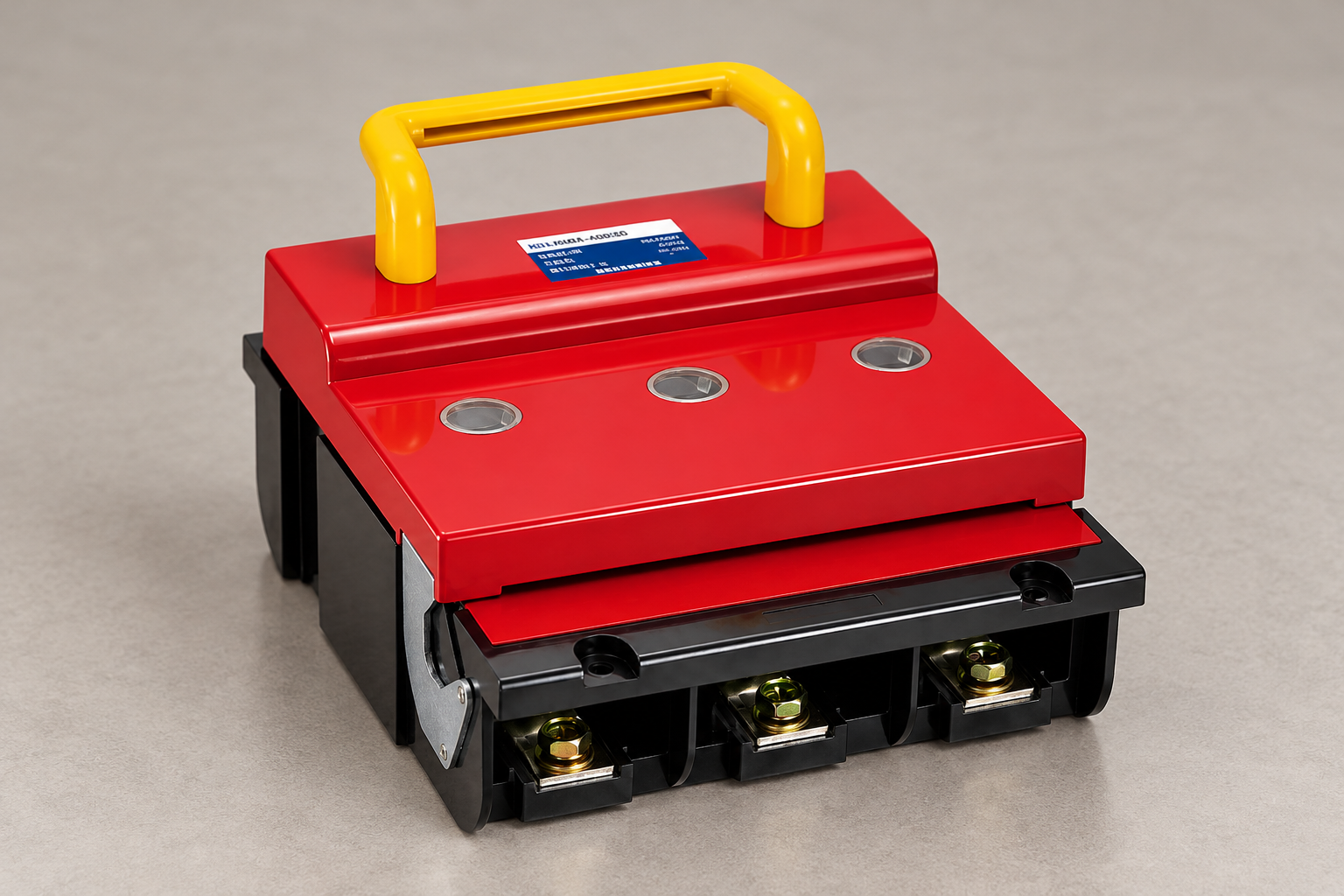
A carrier can require a different operating and removal envelope from a switch with a separate contact mechanism. Put the exact outline drawing into the panel layout and show door travel, handle access, cable bends, barriers and the intended fuse-maintenance approach. Check the mounted product rather than assuming that its closed dimensions describe every service condition.
The HR6 cover's described movement is particularly relevant when adjacent devices or wiring ducts are close. Do not solve an interference by trimming a barrier or altering a carrier. Request an approved layout change or a suitable alternative device. Spare fuse storage and access to authorized replacement parts should also be considered before the panel is handed over.
Distinguish switching from fuse replacement
Normal operation of an approved switching device and replacement of a fuse-link are different activities. A carrier in an open position may still leave incoming parts energized. The work procedure must identify the relevant sources, access boundaries and verification requirements. This article does not authorize removing a fuse carrier under load or servicing exposed equipment.
The fuse-switch inspection and replacement guide addresses the maintenance planning questions. Keep the exact manual available with that plan. If the original fuse type is unavailable, obtain a reviewed substitution rather than relying on dimensions or a higher nominal current. A replacement can change the protective coordination on which the approved assembly depends.
Write a quotation comparison that survives substitutions
Include the exact switch or fuse-switch designation, pole count, operational duty, voltage, current, fuse-link code, short-circuit evidence, mounting arrangement and accessories. Ask suppliers to identify exceptions individually. A quotation that only says “400 A fused isolator” leaves too many decisions open for a meaningful comparison.
At receipt, compare the delivered product and fuses with the approved schedule. Record the mechanism type, carrier clearance, labels and accessory codes. Keep the technical approval distinct from the commercial order so that a later price-driven substitution cannot silently change the construction or fuse combination. If an alternative is proposed, reopen the affected technical rows before installation.
The useful decision is a verified combination that the panel builder can install and the maintenance team can identify. A precise construction description helps, but it only becomes valuable when it remains connected to the ratings, approved fuse-link and service documentation throughout the equipment's life.
Keep construction and spare-parts records together
Photograph the accepted assembly under the permitted inspection conditions and link the image to its equipment tag, order code and document revision. Record the approved carrier and fuse-link separately so a future technician does not have to identify them from a worn label or a distant catalogue illustration. If a spare carrier is supplied, check its identity against the same schedule.
After a fuse operation, preserve the event information needed by the responsible engineer: affected circuit, operating condition, fuse identification and any relevant protective-device indications. Replacing the fuse without investigating an unexplained operation can hide a system problem. The necessary investigation and safe access method belong to the approved maintenance process. They cannot be inferred from whether the device is described as a fuse-switch or a switch-fuse. Keeping the records together supports a controlled repair while avoiding unnecessary changes to a previously approved protection combination.
Các câu hỏi thường gặp
Are fuse-switch and switch-fuse always interchangeable names?
No. They can describe different constructions, and trade usage varies. Confirm the mechanism and exact product designation instead of assuming the words establish equivalence.
Does an auxiliary contact prove that every fuse is intact?
No. A switch-position contact generally reports its defined mechanism state. Fuse operation monitoring must be specified and verified separately if the project requires it.
Can any fuse of the correct physical size be installed?
No. Confirm the approved fuse type, rating and combination evidence. Physical fit does not establish protection coordination or the conditional short-circuit performance of the assembly.
Video giáo dục
Lecture 35 Arc Interruption Theory in Circuit Breaker II by IIT Roorkee July 2018. This university lecture supports the arc-interruption principles relevant to load switching and arc chutes. It does not establish the internal design or rating of the illustrated HR6 product.