


DC arc interruption in a PV circuit breaker is the process of controlling and extinguishing the arc that can form when energized contacts separate. A breaker must interrupt under its declared DC conditions without depending on the regular current zero crossings available in an AC circuit. For a buyer or panel engineer, the practical task is to verify the complete device's operational voltage, breaking capacity, polarity and approved pole arrangement. An AC marking, a large handle or an attractive enclosure cannot establish that capability. Select from documented performance for the actual PV circuit.
How an arc forms during contact separation
When contacts carrying current begin to separate, the electrical path does not necessarily stop at the instant a visible gap appears. An ionized path can continue conducting between the separating surfaces. The resulting arc releases heat and can damage contacts or nearby materials unless the switching device manages it as designed. In a circuit breaker, the internal system must move the interruption process toward successful extinction under specified conditions. External appearance tells the buyer very little about that internal performance.
This explanation is intentionally functional. It does not describe an unverified cutaway of a particular SUTON model. Arc-control methods vary among designs, and a photograph of one product cannot establish the construction of another. Procurement documents should identify what the complete breaker has been declared or tested to do, with applicable conditions. Do not replace that evidence with a generic diagram showing components that may not exist in the selected unit or an animation that omits important limitations.
Why DC requires its own rating
An AC circuit has periodic current zero crossings. A DC circuit does not provide the same regular opportunity for interruption, so a device intended for DC service needs a suitable, documented interruption arrangement. This is why an AC operational rating cannot simply be transferred to a PV application. The fact that a closed breaker conducts DC current without immediately heating or tripping does not demonstrate that it can safely clear a DC fault at the project's voltage.
The correct comparison uses the operational DC rating and applicable breaking capacity for the exact arrangement. The solar PV DC breaker selection guide places interruption evidence alongside current, thermal and installation checks. Check the manufacturer's definitions and conditions, including direction, time constants where specified and pole connections. If the documentation includes both AC and DC tables, ensure the purchase review cites the DC entry. A broad statement that a product is a “circuit breaker” is too general to resolve these questions. The rating must match the proposed circuit and its credible fault contribution.
Distinguish a switching arc from an installation arc fault
A switching arc occurs during the intended opening action inside a device designed to manage it. An unwanted arc fault can occur elsewhere, for example at a damaged connection or conductor. These are different protection questions. A conventional overcurrent breaker is not automatically a detector for every series arc fault. The current through a series fault may not create the overcurrent condition required for that breaker to operate, so the overall PV protection design must address the applicable arc-fault requirements separately.
The national laboratory arc-fault research record is useful context for the separate detection problem. Its findings do not certify a selected breaker or prescribe a universal installation arrangement. When a project requires dedicated arc-fault detection or interruption, ask for equipment expressly providing that function and evidence of coordination with the rest of the system. Do not claim that an ordinary DC breaker eliminates all PV arc hazards merely because it contains an arc-control mechanism.
Voltage, source and fault contribution define the duty
The maximum design voltage must be established using the actual PV module data, string count and accepted design method. A nominal voltage label does not capture the highest relevant open-circuit condition. The guide to PV string voltage and breaker voltage rating provides a separate worksheet. Once that value is known, compare it with the selected device's declared operational capability for the approved configuration. Do not substitute insulation voltage or a rating from another configuration.
Fault contribution also depends on the circuit. Parallel strings, batteries, converters and other sources can change the duty at a given location. Obtain the responsible designer's fault assessment and compare it with the applicable DC breaking-capacity declaration. A string's normal operating current is not a complete statement of every fault the equipment may face. If a supplier cannot link its claim to the exact voltage and arrangement, the review remains open even if the quoted current rating looks generous.
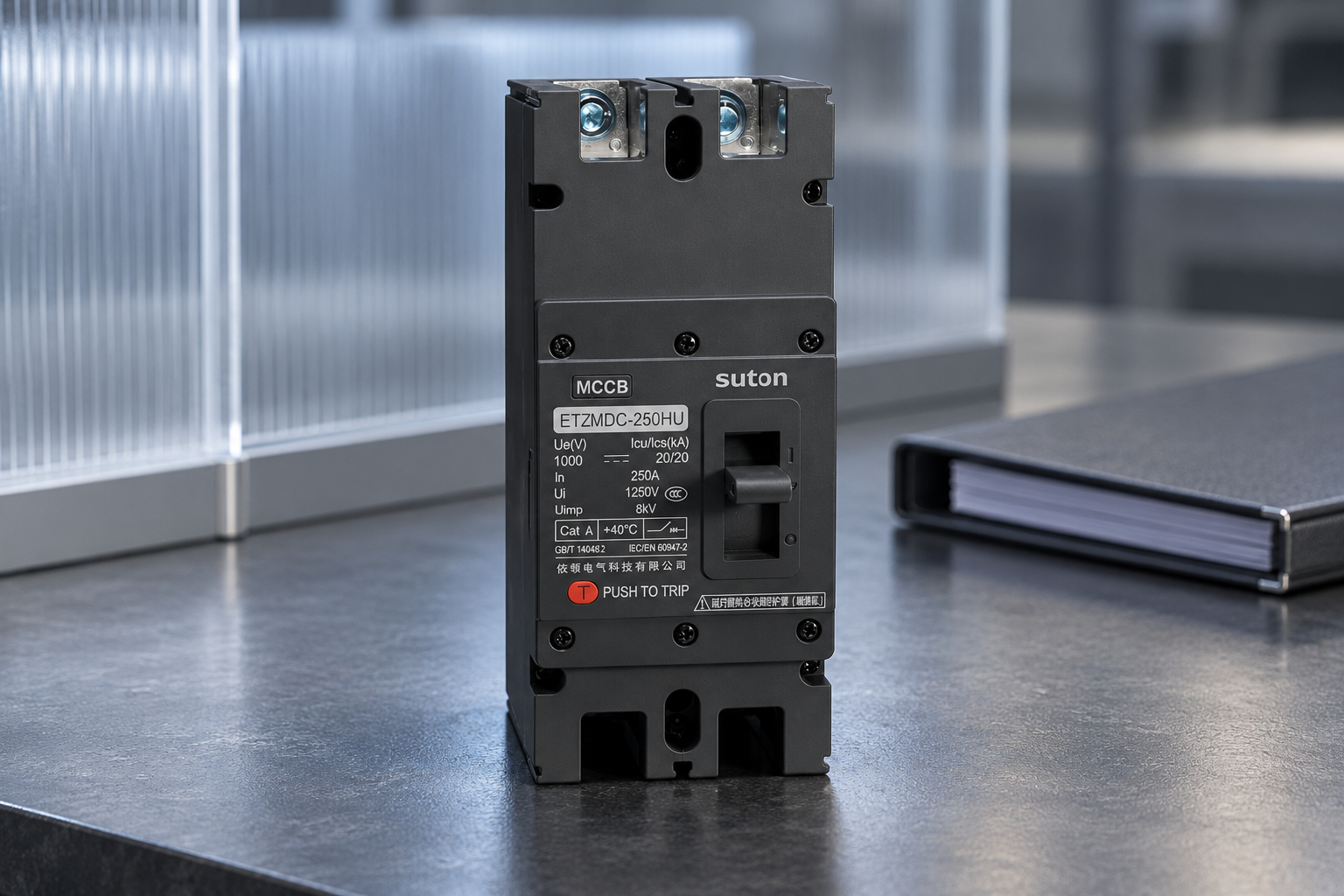
Review interruption evidence systematically
| Xem lại mặt hàng | Yêu cầu cung cấp bằng chứng | Misleading substitute to reject |
|---|---|---|
| Operational voltage | DC rating for exact configuration | AC rating or insulation voltage alone |
| Khả năng cắt | Applicable declared DC interruption capability | Normal current carried without visible trouble |
| Direction | Documented polarity and source/load conditions | Unverified assumption from appearance |
| Sự sắp xếp cực | Approved complete terminal diagram | Arithmetic addition of individual pole ratings |
| Arc-fault function | Explicit function and coordination where required | Assuming every arc fault causes overcurrent |
| Product identity | Exact order code and revision | Generic cutaway of another product |
The table separates several claims that are often combined in a short catalogue sentence. Each requires an answer referring to the same model and configuration. A test document for one arrangement should not be combined with a drawing for another to create an imaginary approval. Keep the document revisions together and ask the supplier to resolve inconsistencies in writing. This disciplined review is more useful than comparing unexplained headline figures across several unrelated offers.
Polarity and pole arrangements belong in the review
Some DC breaker designs have direction restrictions associated with their arc-control arrangement. Others have documented suitability for additional directions within stated conditions. Neither case can be inferred from the housing. Check the terminal diagram and any source/load limitations. The separate guide to polarized and non-polarized DC breakers explains how to ask that question without confusing conductor polarity with interruption direction. A correctly identified positive conductor does not independently prove the breaker is installed within its rating.
Where several poles are used together, follow the exact approved arrangement. Do not multiply a pole voltage by a visible pole count or improvise series links. The two-pole versus four-pole selection guide addresses the configuration evidence in more detail. Arc interruption is a property of the complete accepted arrangement, including its connections and conditions. A physically possible wiring layout is not necessarily one for which the manufacturer has declared performance.
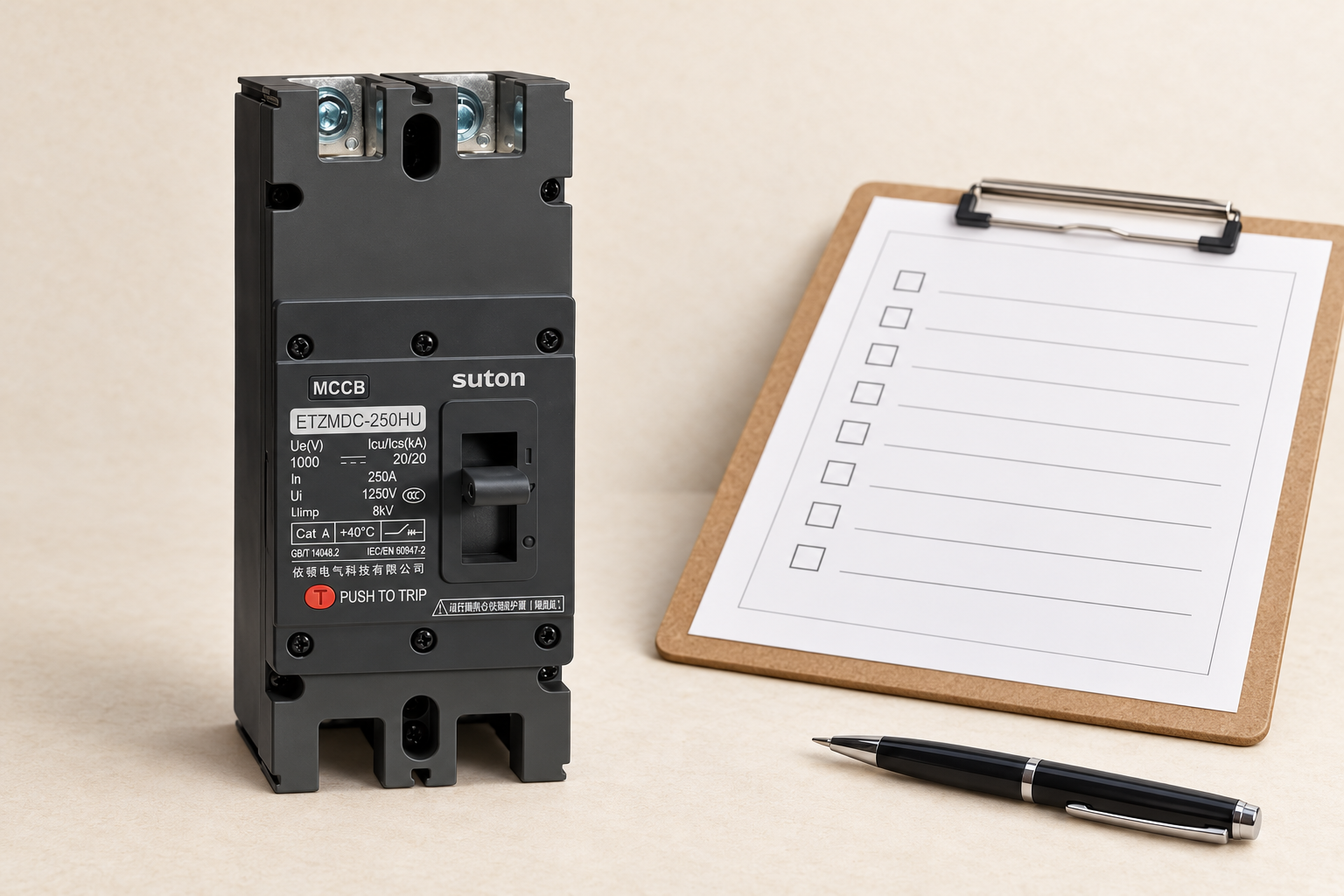
Đánh giá các bằng chứng về sản phẩm SUTON thực tế
The SUTON ETZM PV molded-case DC circuit breaker is a relevant product family for PV equipment enquiries. The illustrations here retain its actual exterior. They deliberately do not invent a cutaway, internal arc chute or magnetic mechanism. Ask for the exact order code, DC operational rating, applicable breaking capacity and approved diagram. Any claims about internal construction should come from the selected model's verified technical documents rather than an illustrative article image.
For an enquiry, provide the single-line diagram, source description, design voltage, current duty and enclosure conditions. Identify whether the device is expected to provide overcurrent protection, a declared isolation function or another specified duty. Ask how the proposal coordinates with other protective devices. A clear enquiry helps distinguish an equipment capability from a system requirement and prevents the breaker from being assigned a function that the submitted evidence does not support.
Installation quality remains part of the system
A correctly rated breaker does not compensate for loose connections, damaged conductors, incompatible connectors or an unsuitable enclosure layout. Follow the product's terminal requirements, conductor specifications and tightening instructions. Installation and inspection should be performed through the project's qualified procedures. Never disconnect a PV connector under load or create an arc to demonstrate a problem. Such experiments expose people and equipment without providing a valid type test or a defensible acceptance result.
The national laboratory overview of PV DC systems and safety provides useful system context. Use it alongside applicable local requirements and manufacturer instructions. If there are signs of arcing, heat damage, odor or abnormal noise, follow the site's safe response procedure and have qualified personnel investigate. An article cannot determine whether a particular installation is safe to operate. Record observations and equipment identity so that the investigation can address the actual failure mode.
Plan maintenance around evidence, not demonstrations
Maintenance records should identify the installed model, settings, wiring arrangement and relevant inspection findings. Where a breaker has interrupted a fault, follow manufacturer guidance and the site's review process before returning equipment to service. Do not assume that resetting the handle proves the complete device is undamaged. Likewise, do not open a sealed case to inspect an imagined arc-control component. Unauthorized disassembly can compromise the equipment and does not establish continued interruption performance.
For replacement, compare the complete configuration rather than selecting a unit with a similar handle and current number. Recheck voltage, direction, pole arrangement, breaking capacity, terminals and accessories. Retain the approval record with the maintenance history. This is particularly valuable in PV systems that evolve over time, where a replacement ordered from an old photograph might otherwise miss a change in string design, inverter arrangement or fault contribution introduced after the original installation.
Các câu hỏi thường gặp
Can an AC breaker interrupt the same DC voltage?
Do not transfer the AC rating to DC. Use a product with a declared DC operational rating and breaking capacity for the exact proposed arrangement. Contact opening during a no-load test or normal current conduction does not prove adequate DC fault interruption capability.
Does a DC breaker protect against every PV arc fault?
No such assumption is justified. Arc interruption inside a breaker and detection of an unwanted installation arc are different functions. Determine the project's arc-fault protection requirements separately and obtain equipment explicitly suitable for those functions, coordinated with the rest of the PV protection design.
Can a product photograph prove the arc-chute design?
An exterior photograph cannot establish internal construction or interruption performance. Obtain the selected model's technical documents and applicable evidence. The reference images in this article identify the actual product exterior and should not be used as engineering drawings or proof of an internal mechanism.
Video giáo dục
Lecture 35 Arc Interruption Theory in Circuit Breaker II by IIT Roorkee July 2018. This independent university lecture supports the arc-interruption principles discussed here; it is not a type test or approval of the pictured SUTON product.