


Surge protector testing begins by defining what the test must prove. Routine field inspection can verify identification, indication, connections and a supported alarm function. It cannot automatically establish the device's voltage-limiting performance or remaining service life. A continuity meter, insulation tester or improvised mains test is not a universal SPD health test. Use the exact manufacturer's procedure and keep field checks separate from laboratory surge-performance testing.
For industrial panel SPDs, a useful report states the device reference, test method, conditions, observed result and accepted limits. It also identifies what remains untested. This guide helps engineers and maintenance teams make that distinction, select safe checks and avoid damaging the protective device or overstating the evidence.
Define the purpose before selecting an instrument
A commissioning check asks whether the correct assembly has been installed according to its documents. A periodic inspection asks whether observable conditions require action. A remote-contact test asks whether the monitored signal reaches the controller. A laboratory evaluation asks how the device performs under specified electrical stresses. These are different questions and require different evidence.
Write the intended question at the top of the test record. For example, “verify remote alarm transfer to building monitoring” is more accurate than “prove surge protection.” The first can be supported by a documented signal-chain check; the second requires a much broader assessment and may involve tests unsuitable for the installed equipment.
Itu UL Solutions overview of SPD testing describes a certification-testing context. Use it to understand why evaluated surge performance depends on defined test conditions. It does not provide permission to repeat those stresses on an installed panel or to invent a field pass threshold.
Confirm the device and installation documents
Record the complete SPD reference, base and module codes, application, protective arrangement and document revision. Read the label carefully and compare it with the accepted design. A similar-looking device with a different continuous operating voltage or configuration can invalidate the selection even if its indicator appears normal.
Obtain the exact inspection and testing instructions. Check whether the manufacturer permits a particular test with the SPD connected, requires module removal, or uses a dedicated device tester. Identify the approved acceptance criteria and any handling limitations. If the instructions do not support the proposed measurement, do not assume that a general electrical meter makes it valid.
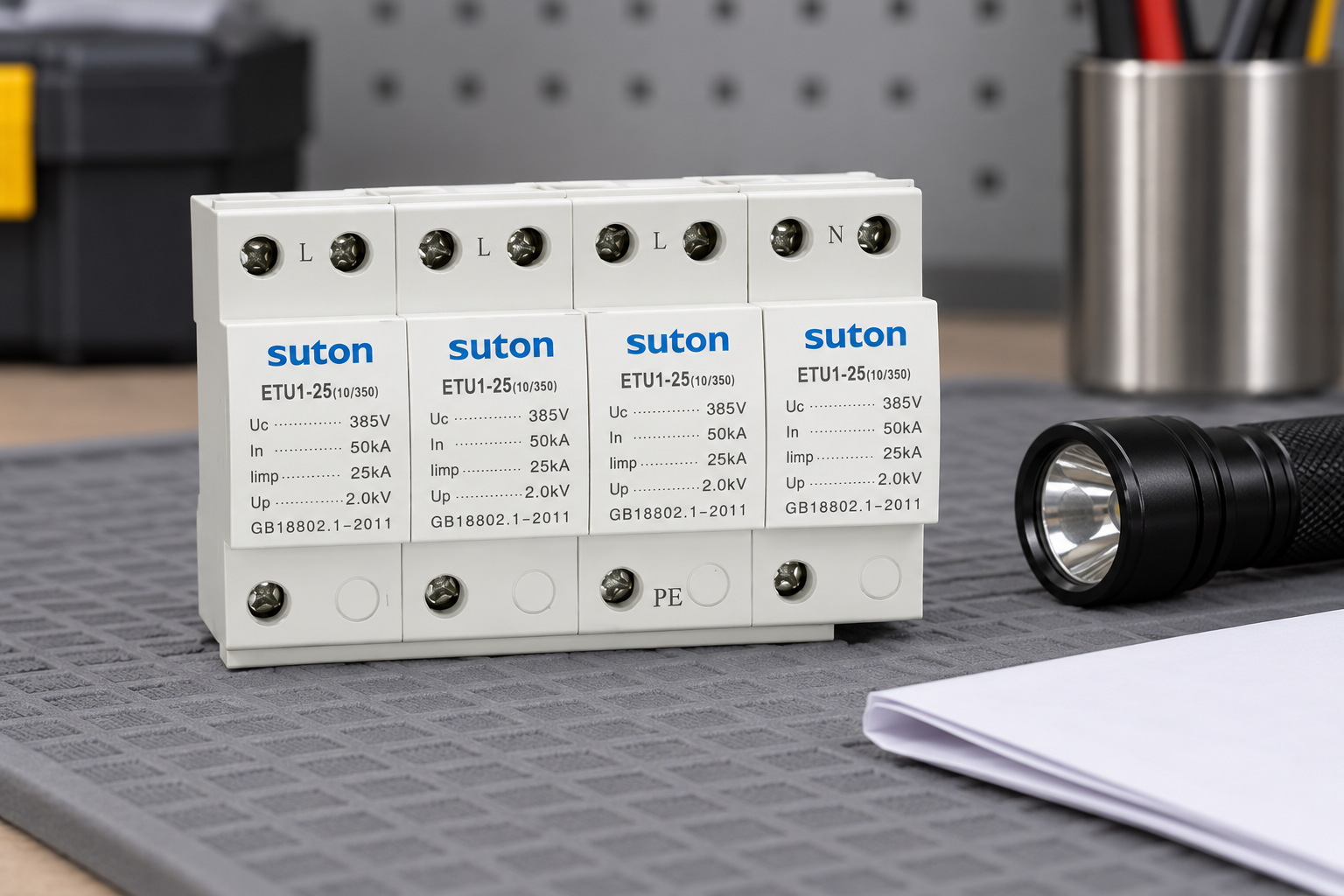
Gunakan SUTON ETU1 product information as the starting point for a model-specific request. Ask for the actual supplied version's inspection requirements and any approved tester. External appearance alone cannot establish the permitted test method or internal construction.
Make the inspection safe and controlled
The test plan should identify all relevant sources and the cabinet's electrical hazards. Follow the site's isolation, verification and access procedure with competent personnel. An SPD may connect between active conductors and the protective-earth system, and other nearby equipment can remain energized even when one protective branch is opened.
Itu HSE guidance on work near electrical equipment provides the safety framework for planning such work. Select instruments suitable for the actual measurement environment and task. A test button or pluggable module does not eliminate the need to understand adjacent live parts and the approved operating conditions.
Before changing anything, photograph the labels and observed indication. Save the existing arrangement and monitor state. This prevents the final successful state from erasing evidence of the original fault. Where an indication is ambiguous, preserve the observation rather than interpreting it through another manufacturer's color convention.
Check the local condition and protective branch
Inspect the visible housing, indicators, module seating where applicable, terminals and surrounding enclosure through the permitted safe method. Look for damage, abnormal discoloration, contamination or other conditions covered by the product instructions. The absence of visible damage does not prove that all internal elements retain their original performance.
Review the branch protective device and connection arrangement against the approved drawing. A blown backup fuse or an open protective branch can affect protection while the load remains powered through its normal supply. Record the condition of the protective branch separately from whether the cabinet's equipment operates.
Compare actual wiring, bonding and route with the accepted installation. The SPD lead-length guide explains why routing influences installed protection. A test of a disconnected module cannot independently verify that system-level route or the resulting protection at the equipment terminals.
Interpret electrical measurements cautiously
A multimeter reading depends on the instrument's applied voltage, current and measurement mode, as well as the SPD's internal circuit. A healthy surge-limiting component may appear open under one low-voltage test, and another path may affect the reading. There is no universal resistance value that proves an unknown SPD is healthy.
A continuity test can be appropriate for a documented signaling contact, but it only checks the contact under the specified condition. It does not establish the characteristics of the main protective element. Record the terminals measured and the exact state used during the test, rather than writing a generic “SPD continuity passed.”
Where a manufacturer provides a dedicated tester, confirm the supported models, procedure, instrument status and acceptance criteria. Save the actual result and limitations. A threshold copied from another product, or an instrument used outside its instructions, cannot produce a defensible acceptance decision.
Plan insulation testing around the connected SPD
An insulation test applies a defined electrical stress to the installation. Connected SPDs and other electronic equipment can influence the result or require special treatment. Determine the method from the rules adopted by the project and the instructions for every affected device. Do not apply a generic test voltage to an unknown SPD arrangement.
Where disconnection is required, identify all relevant paths and use an approved safe procedure. Preserve the connection record, restore the correct assembly afterward and verify that the protective branch and indication are normal. A successful insulation measurement is incomplete if the SPD remains disconnected after the test.
Avoid interpreting a low insulation reading as an SPD failure without considering the connected circuit and test method. Equally, do not dismiss a genuine installation defect simply because an SPD is present. Separate the installation measurement, device handling and final restoration in the test report so that each result has a clear meaning.
Use a test-scope decision table
The following table distinguishes practical inspection tasks from performance claims. It contains no invented universal limits. Each accepted field test needs the exact manufacturer's method or the applicable installation-testing procedure, along with an explicit statement of what the result supports.
| Periksa | Evidence obtained | Limit |
|---|---|---|
| Visual inspection | Label, indication and observable assembly condition | Does not establish impulse performance |
| Remote alarm test | Defined signal transfer and controller behavior | Does not test surge-limiting elements |
| Installation review | Connections and routing against accepted documents | Requires actual installation evidence |
| Insulation test | Result under the approved procedure | SPD treatment and restoration follow exact instructions |
| Laboratory evaluation | Performance under specified test conditions | Not an improvised installed-panel test |
This distinction is useful when receiving a contractor's report. If the document says “surge test passed,” ask which test, which waveform or method, which terminals, which device and which criterion were used. A vague label should not be accepted as evidence of all SPD functions.
Verify remote indication independently
For an SPD with a supported remote contact, check the terminal identity, normal state and contact rating. Verify the controller's input configuration and alarm text. Use the manufacturer's permitted method to create the expected change, or a separate approved signal-circuit simulation when the aim is to test the monitoring chain.
Keep these results separate. A simulated open cable can prove that the controller detects a loop change, but it does not prove that the SPD's internal indication mechanism operates. A contact measurement at the SPD can prove a local state while leaving the controller route untested. Complete the chain required by the commissioning plan.
Itu remote-contact monitoring guide describes how cable failures and monitoring-power loss affect interpretation. Include those scenarios where the accepted monitoring design requires them. A dashboard displaying an old healthy value is not a current inspection result.
Keep impulse-performance tests in the right setting
Specified surge-performance tests use controlled equipment, defined electrical stresses and appropriate protective measures. They can stress or damage a device and require interpretation against the relevant product standard and exact configuration. Do not reproduce such tests with improvised equipment in an operating cabinet.
Itu Panduan perlindungan lonjakan BEAMA explains the broader selection and installation context. Certification or manufacturer test evidence applies to the declared product conditions; it does not make every installed arrangement equivalent. Field acceptance should combine that evidence with verified installation and maintenance checks.
If performance assessment is required after a severe event or unexplained repeated failure, discuss the scope with the manufacturer or a qualified test laboratory. Provide the device identity, installation history and observed symptoms. Establish whether replacement, laboratory analysis or a system investigation is the most useful next step before attempting an unsupported test.
Document the result and close the maintenance loop
A complete record includes date, location, equipment reference, product codes, method, instruments where relevant, observed indication, measurements and acceptance basis. State any access restrictions or untested functions. Record restoration of disconnected devices and the final protective-branch condition.
When replacement is required, follow the module replacement guide and exact product instructions. Retain the failed-state record and update the asset history with the replacement code and final checks. Repeated failures should trigger a review of selection and installation conditions.
Ask SUTON support for the exact inspection instructions and supported test criteria when the documents are incomplete. A useful test report tells the next engineer what was established, what was restored and what still requires assessment. It does not convert a narrow observation into an unsupported promise of full protection.
Pertanyaan yang sering diajukan
Can a multimeter prove that an SPD is healthy?
Not universally. A low-voltage resistance or continuity measurement depends on the instrument and internal circuit. Use only a supported model-specific method, and distinguish a signaling-contact test from testing the surge-limiting function.
Should an SPD be disconnected before an insulation test?
Determine this from the applicable installation-testing procedure and exact device instructions. Connected SPDs and electronic equipment can affect the test or require particular treatment. Any disconnected protective device must be restored and checked afterward.
Does a normal indicator prove the installed protection level?
No. It reports the condition defined by the device's indication mechanism. Installed protection also depends on selection, wiring, bonding, backup protection and coordination. Routine indication checks do not independently establish all those factors.
Video edukasi
Surge Protection – Fundamentals, by IAEI – The Electrical Enforcement Authority, explains the general protective arrangement. It does not provide a model-specific contact, replacement or field-testing procedure.