

The choice between a polarized vs non polarized DC breaker depends on the current directions the complete device is approved to interrupt, the circuit's voltage and grounding arrangement, and the manufacturer's wiring instructions. A polarized design can require a specific source, load and terminal arrangement. A non-polarized label does not remove voltage, pole, fault-duty or installation limits. For a PV procurement review, obtain the exact model's diagram and declared DC ratings before comparing price. Never infer polarity suitability from the handle, housing color, a supplier photograph or an AC rating printed on a similar product.
Separate three meanings of polarity
The first meaning is the electrical polarity of the circuit conductors. A PV string has positive and negative terminals, and those identities matter throughout the installation. The second meaning is terminal marking on a particular breaker. Symbols, arrows and source/load labels must be interpreted using that device's documentation rather than a diagram copied from another model. The third meaning is the direction in which the device is approved to interrupt current. These questions overlap, but treating them as interchangeable creates specification errors.
A breaker does not become suitable for reverse interruption because a multimeter shows the expected open-circuit voltage. That measurement cannot establish arc-control behavior inside a switching device. Likewise, successfully opening an unloaded circuit says little about interruption under a fault. Ask for documentation identifying the complete product, operating voltage, approved wiring and relevant interruption conditions. A test report for another pole arrangement or a family name without model identification does not answer the procurement question.
Why interruption direction can matter
Opening contacts in a DC circuit can create an arc. In some breaker designs, magnetic arrangements influence how that arc moves into the intended extinguishing region. A current direction outside the approved arrangement can therefore matter even when the breaker carries normal load current without an obvious symptom. The engineering issue is interruption performance, not simply whether current can pass through a closed contact. Do not use normal operation as proof that a directional installation is acceptable.
Other designs may be declared suitable for more than one current direction within stated conditions. That approval is a product-specific claim requiring evidence. It must still be checked at the project's DC operating voltage, available fault duty and required pole configuration. Avoid statements such as “all DC breakers need polarity” or “non-polarized breakers work anywhere.” Both remove the very boundaries that a designer needs to review. The correct answer belongs to an identified device and an identified circuit.
Identify every possible source
A simple PV string feeding an inverter is different from a circuit connected to batteries, bidirectional converters or several parallel sources. Draw the normal energy path and then identify credible fault contributions. Consider how the system behaves during charging, discharging, maintenance and equipment failure. An arrow showing ordinary power delivery is not a complete fault-current study. Where more than one source can energize the protected section, obtain a design review covering the resulting directions and magnitudes.
Record the assumptions explicitly. A purchase request that says only “solar DC breaker” leaves the supplier guessing whether the device belongs in a string combiner, a battery circuit or an inverter input. Include the circuit location, grounding method, maximum design voltage and all contributing sources. If the installation later changes, revisit the breaker selection. Adding storage to an existing PV installation can invalidate assumptions made when the original protection was selected, even if the enclosure and cables remain physically unchanged.
Read markings with the approved diagram
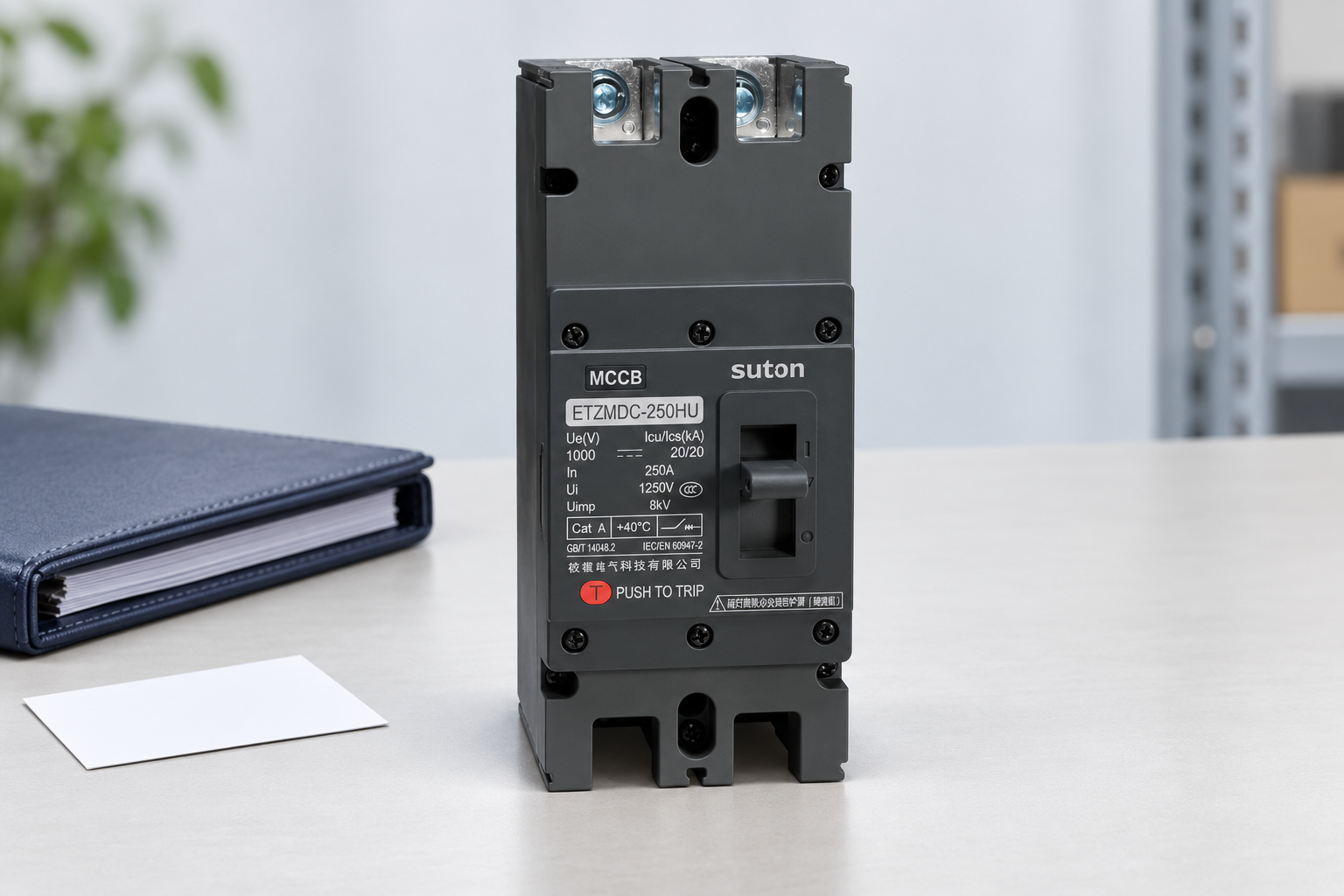
Before approving a drawing, compare the product's visible terminal labels with its model-specific instructions. Confirm which side is intended for each connection and whether the instructions permit reverse feeding. Check whether series links are required and whether the declared rating applies to the complete arrangement. Do not supply a generic wiring diagram as an installation instruction. A four-terminal case, for example, does not by itself explain how the manufacturer has tested the internal interruption paths.
Photographs can support identity checks, but they cannot replace a readable drawing. Request the full document revision and retain it with the purchase record. If a label on the delivered unit differs from the submitted drawing, hold acceptance until the discrepancy is resolved. A useful receiving inspection compares model code, terminal layout, markings, accessories and documentation together. It should identify mismatches before the equipment reaches a live panel, where correction becomes slower and more disruptive.
Use a polarity evidence checklist
| Barang bukti | Soalan yang perlu diselesaikan | Document to retain |
|---|---|---|
| Circuit sources | Can current or fault contribution come from either direction? | Current single-line diagram and source assessment |
| Identitas perangkat | Which exact order code is proposed? | Model and document revision |
| Direction | What current directions are approved? | Manufacturer declaration for actual DC duty |
| Terminals | What do source/load and polarity marks mean? | Approved terminal diagram |
| Konfigurasi | Are links and grounding assumptions matched? | Configuration-specific rating and accessory list |
| Perubahan kontrol | Does an alternative preserve these conditions? | Reviewed substitution record |
Use this checklist to organize the evidence, not to create an approval by ticking boxes. A satisfactory answer must refer to the actual order code and configuration. If the supplier cannot establish whether a proposed current direction is within the rating, the gap remains unresolved. Escalate it to the responsible designer and manufacturer. Do not accept an informal message that contradicts a published wiring diagram without a controlled clarification tied to the product.
Compare polarized and non-polarized proposals fairly
Compare proposals using the same operating conditions. One offer might quote a rating for several poles connected in series, while another quotes a different voltage or interruption duty. Those are not equivalent offers merely because the current rating and enclosure width look similar. Ask each supplier to identify the tested arrangement, direction limitations, relevant breaking capacity and conditions of use. Then compare accessories, terminal requirements, documentation and lifecycle support alongside the initial price.
A declared non-polarized design may simplify certain reviews, but it does not eliminate the need for a circuit study. Confirm that its approval covers the required direction, voltage and fault conditions. Conversely, a correctly selected directional product should not be dismissed solely because it has polarity markings. What matters is whether the installed arrangement matches the design and all credible operating conditions. The specification should explain that match in language another engineer can verify from the retained documents.
Keep voltage and pole selection separate
Polarity approval is only one part of DC breaker selection. Calculate the maximum PV voltage using the accepted design method and actual module data. Then check the operational DC rating for the approved arrangement. Do not multiply a single-pole voltage by the number of visible poles unless the manufacturer expressly permits that configuration. Clear conductor identification and correct direction cannot compensate for inadequate voltage capability. These checks must pass independently before the assembly is accepted.
For a broader review, use the guide to solar PV DC breaker selection and the worksheet for PV string voltage and breaker rating. The separate discussion of two-pole and four-pole PV breakers addresses configuration rather than direction. Keeping these topics separate makes purchase decisions easier to audit and helps prevent a correct answer to one question from being misused as evidence for another.
Periksa bukti produk SUTON yang sebenarnya
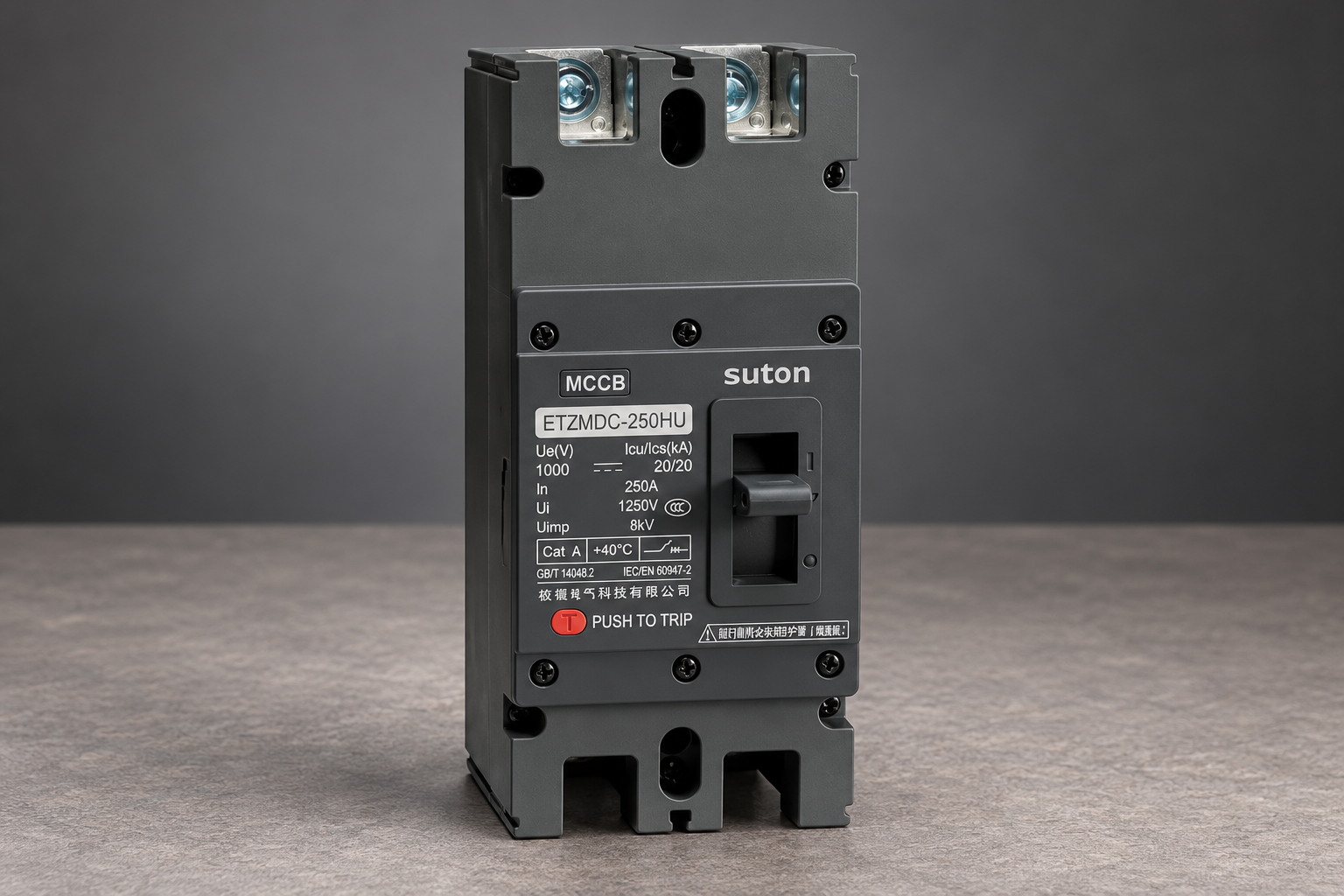
Itu SUTON ETZM PV molded-case DC circuit breaker provides a relevant starting point for a supplier enquiry. The reference illustrations show its exterior so that the buyer can identify the product family. They do not establish that every model is polarized or non-polarized, nor do they certify a particular wiring arrangement. Request the exact order code, current documentation and configuration-specific rating before choosing a unit for a real installation.
Include a single-line diagram and a short list of unanswered questions in the enquiry. Ask the supplier to mark the approved connections and state any source/load or current-direction restrictions. Keep the answer linked to the submitted model and document revision. If an alternative is proposed, repeat the relevant checks rather than copying the first product's acceptance record. This turns a vague comparison into a controlled procurement decision and reduces ambiguity when the goods arrive.
Commissioning cannot replace selection evidence
Commissioning should confirm the installed arrangement against the approved design using appropriate procedures and qualified personnel. It is not an opportunity to experimentally discover whether a breaker can interrupt an unknown DC fault. Never deliberately create a fault, reverse a live circuit or disconnect PV connectors under load to test a claim. The safe sequence is to resolve the specification, install according to approved instructions and verify the work under the project's established safety process.
Itu IET discussion of PV DC switching configuration is useful background on why the declared arrangement matters; switch-disconnector guidance must not be treated as a breaker rating. The national laboratory overview of PV DC systems and safety provides wider system context. Neither source independently approves a SUTON model. Product acceptance still requires its own evidence and the applicable project requirements.
Pertanyaan yang sering diajukan
Does non-polarized mean the breaker can be installed either way?
Only within the conditions declared for the exact product. Check source/load restrictions, terminal arrangement, voltage, current direction and fault duty in the manufacturer's instructions. A general marketing label is insufficient to approve a particular installation, especially where multiple sources or energy storage are involved.
Can I identify a polarized breaker from its appearance?
Appearance can help identify a model but cannot establish interruption capability. Read the terminal markings together with the current model-specific diagram and rating documentation. Do not transfer a wiring rule from another breaker because the housing or number of terminals looks similar.
Is a polarized PV breaker suitable for a battery circuit?
Do not assume so. A battery circuit can have different current directions and fault contributions from the PV application for which a device was considered. Obtain explicit documentation covering the proposed battery circuit and have the complete protection arrangement reviewed before procurement or installation.
Video edukasi
How do solar panels work? – Richard Komp by TED-Ed. This independent TED-Ed lesson explains how photovoltaic cells generate electricity. It supports the PV-source context; it does not approve breaker wiring, sizing, thermal limits or a maintenance isolation procedure.