


A 1P+N vs 2P surge protector comparison cannot be resolved by counting two modules. Manufacturers can use those labels for different internal protection arrangements, and SPD terminology should not be assumed to match circuit-breaker pole terminology. Obtain the exact internal diagram, supported grounding system, voltage ratings for each path and backup-protection instructions. In common single-phase arrangements, one design may combine a phase-related element with a distinct neutral-to-earth element, while another uses a different set of protective paths. The correct choice is the documented arrangement that suits the installation, not whichever two-module product looks familiar.
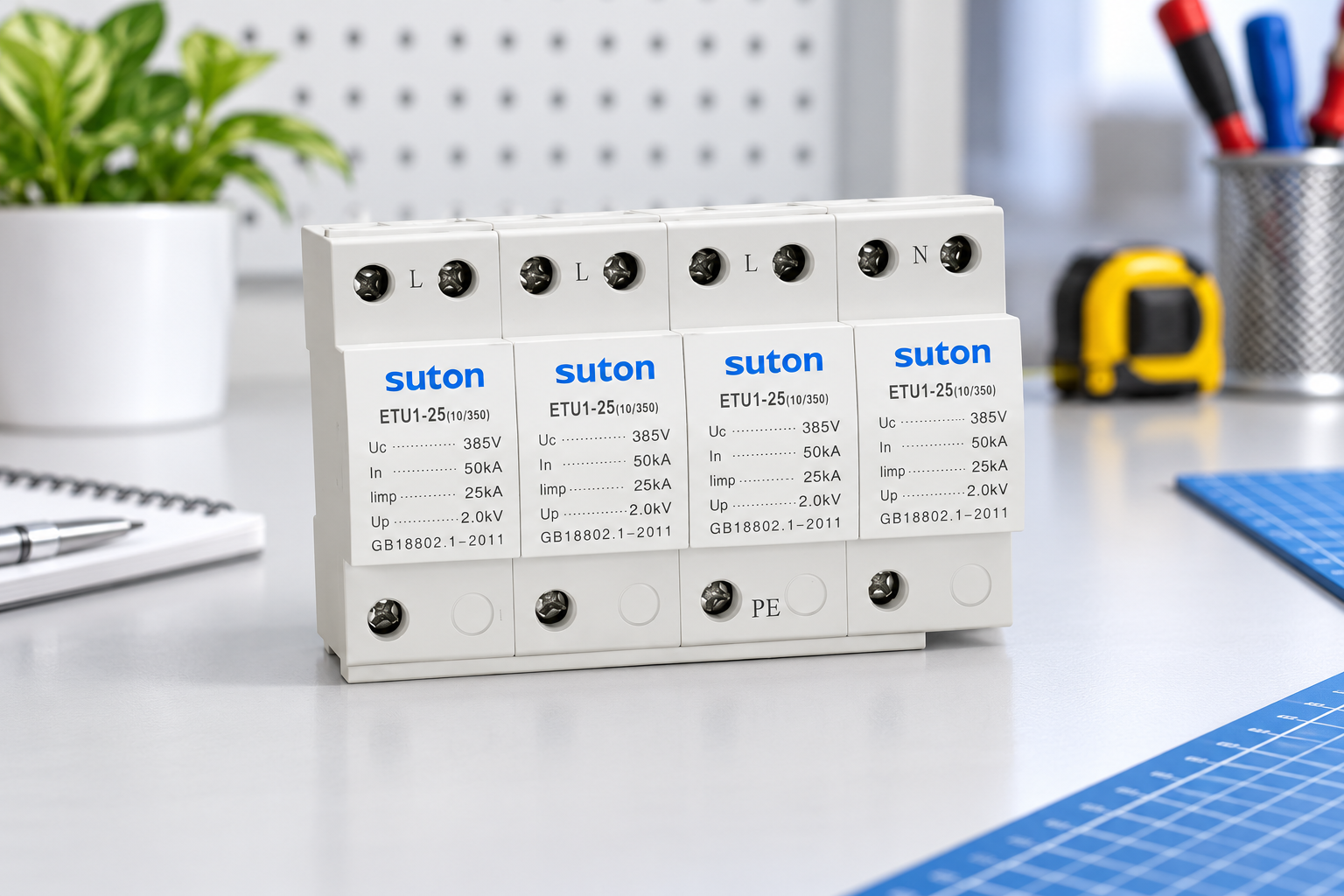
Separate an SPD label from a breaker pole label
A miniature circuit breaker’s pole label describes its switching and protective construction within its own framework. An SPD limits transient overvoltages through its defined protection paths. It does not carry out the same function merely because it has two modules or terminals marked L and N. Treat the product’s own circuit diagram as the source of meaning.
For each proposed unit, ask what “1P+N” or “2P” means in that manufacturer’s documentation. Does the neutral-related part contain a distinct technology or rating? Which paths are connected internally? Which supply arrangements are supported? A short catalogue name can help identify a version, but it cannot answer every question needed for safe selection.
Identify the paths in the exact internal diagram
Write the terminals and protected modes explicitly. Phase-to-neutral, phase-to-earth and neutral-to-earth are different paths. A device arrangement may provide its overall protection through more than one element, and the elements need not have identical behavior. Do not infer a complete mode list from the visible number of cartridges.
The single-phase and three-phase SPD guide addresses the wider conductor arrangement. Here the narrower task is to compare two candidates intended for the same circuit. Keep the circuit fixed while comparing their documented topologies, so a label difference does not hide an actual change in protection paths.
Review the grounding system as part of the comparison
The suitability of an internal arrangement depends on the earthing system and the conditions at the installation point. Record whether the project uses TT, TN or IT, and identify the relevant neutral and protective-earth relationships. A single-phase nominal voltage alone does not establish that both candidates are permitted in that system.
The Tổng quan về SPD của IET supplies installation background. Apply the project’s actual local rules and manufacturer instructions. Ask the supplier to state the supported system and diagram in writing. Do not connect neutral and protective earth at an improvised point merely to reproduce a generic drawing found online.
Confirm the neutral-related element’s function
In some documented arrangements, the neutral-to-earth element differs from the phase-related element. Its voltage behavior, current duty and failure characteristics must be evaluated from the exact device information. Do not assume that an N mark means the module is identical to the phase module, or that it is merely a terminal with no protective role.
Ask which element technology is used, how the complete arrangement operates, and what indications or replacement rules apply. Where follow-current behavior is relevant, obtain the specified limits and conditions. Do not transfer those properties from another supplier’s 1P+N design. This article intentionally avoids declaring all 1P+N products equivalent or assigning a universal internal schematic to every 2P product.
Compare voltage ratings path by path
Uc describes maximum continuous operating voltage for its specified path, while Up concerns a declared protective characteristic under defined tests. A candidate can list different data for different elements or for the complete arrangement. Record what each value represents rather than putting every voltage number into one column.
The Hướng dẫn về biểu tượng xếp hạng của SPD explains the distinction. Check the applicable normal voltage conditions and temporary-overvoltage behavior. Do not choose the lowest Uc as if it were always the best protection level, and do not choose the highest Uc without checking the resulting protective performance.
Keep the test category independent of the pole name
The labels 1P+N and 2P do not establish Type 1, Type 2 or combined tested duty. Obtain the exact declared category, standard, edition and certification required by the target market. Similar type names in different standards systems should not be converted casually.
The Trang tiêu chuẩn IEC 61643-11 về thiết bị bảo vệ chống sét AC identifies the relevant product-test context. The Type 2 selection guide addresses the broader duty decision. A two-module device with an attractive current marking still needs the correct category and documented protection arrangement.
Use a topology comparison sheet rather than a visual ranking
| Comparison field | Evidence for the 1P+N candidate | Evidence for the 2P candidate |
|---|---|---|
| Meaning of label | Manufacturer’s definition and exact model | Manufacturer’s definition and exact model |
| Internal paths | Diagram naming each element and mode | Diagram naming each element and mode |
| Grounding compatibility | Supported system and installation conditions | Supported system and installation conditions |
| Voltage characteristics | Path-specific Uc, Up and abnormal-voltage behavior | Path-specific Uc, Up and abnormal-voltage behavior |
| Current duty | Named ratings with waveform and test category | Named ratings with waveform and test category |
| Bảo vệ dự phòng | Sự kết hợp của thiết bị bảo vệ đã được phê duyệt | Sự kết hợp của thiết bị bảo vệ đã được phê duyệt |
| Service parts | Verified replacement codes and indication behavior | Verified replacement codes and indication behavior |
Until those fields are populated, the comparison remains incomplete. The table does not imply that both candidates are suitable or that one label is inherently superior.
Verify backup protection and fault-current conditions
Determine whether dedicated backup protection is required and which fuse or breaker combinations are approved. Check the prospective short-circuit conditions at the intended installation point. A permitted upstream rating in a family table should be tied to the exact device and arrangement, including any stated limits.
Do not use discharge-current ratings as a replacement for short-circuit suitability. Surge current and power-frequency fault current describe different duties. The Hướng dẫn về bộ ngắt điện và bộ bảo vệ quá dòng explains their separate roles. Preserve the approved combination in the parts list so a later service change does not unintentionally alter the protection scheme.
Check installation details that the label cannot show
Confirm terminal identification, permitted conductor sizes, tightening requirements, mounting, connection route and environmental conditions. The exact instructions determine those details. A unit that fits the DIN rail and occupies the expected width may still require a different layout or protective combination from the replaced device.
Keep surge paths consistent with the approved arrangement and manufacturer guidance. Do not create a universal wiring sequence from a product photograph. Intervention requires the approved isolated work condition and authorized personnel. An SPD is not an isolation device, and a healthy indication does not prove the entire circuit is safe to work on.
Do not mix cartridges by appearance
Replaceable cartridges must match the approved base and function. A visually similar module can have a different continuous-voltage rating, protective characteristic or internal technology. A neutral-related cartridge may have a distinct code and purpose. Preserve the complete model identification when ordering spares.
After replacement, verify the intended configuration and status indication under the manufacturer’s procedure. Record what failed, which code was fitted and which checks were completed. Do not substitute a phase cartridge for a neutral-related element simply because it locks into the same-looking space. Mechanical fit is not evidence of electrical equivalence.
Evaluate the complete surge-protection scheme
Both candidates need appropriate coordination with other SPDs in the installation. Their individual labels do not establish how upstream and downstream devices share duties. Obtain the supported combinations and any required installation conditions, especially when changing an existing device’s topology or protective voltage characteristic.
Lịch sử NIST-hosted coordination research supplies background on the system question. Current manufacturer evidence remains necessary for the actual devices. For near-equipment protection, the Hướng dẫn SPD loại 3 provides complementary context rather than the same two-module comparison.
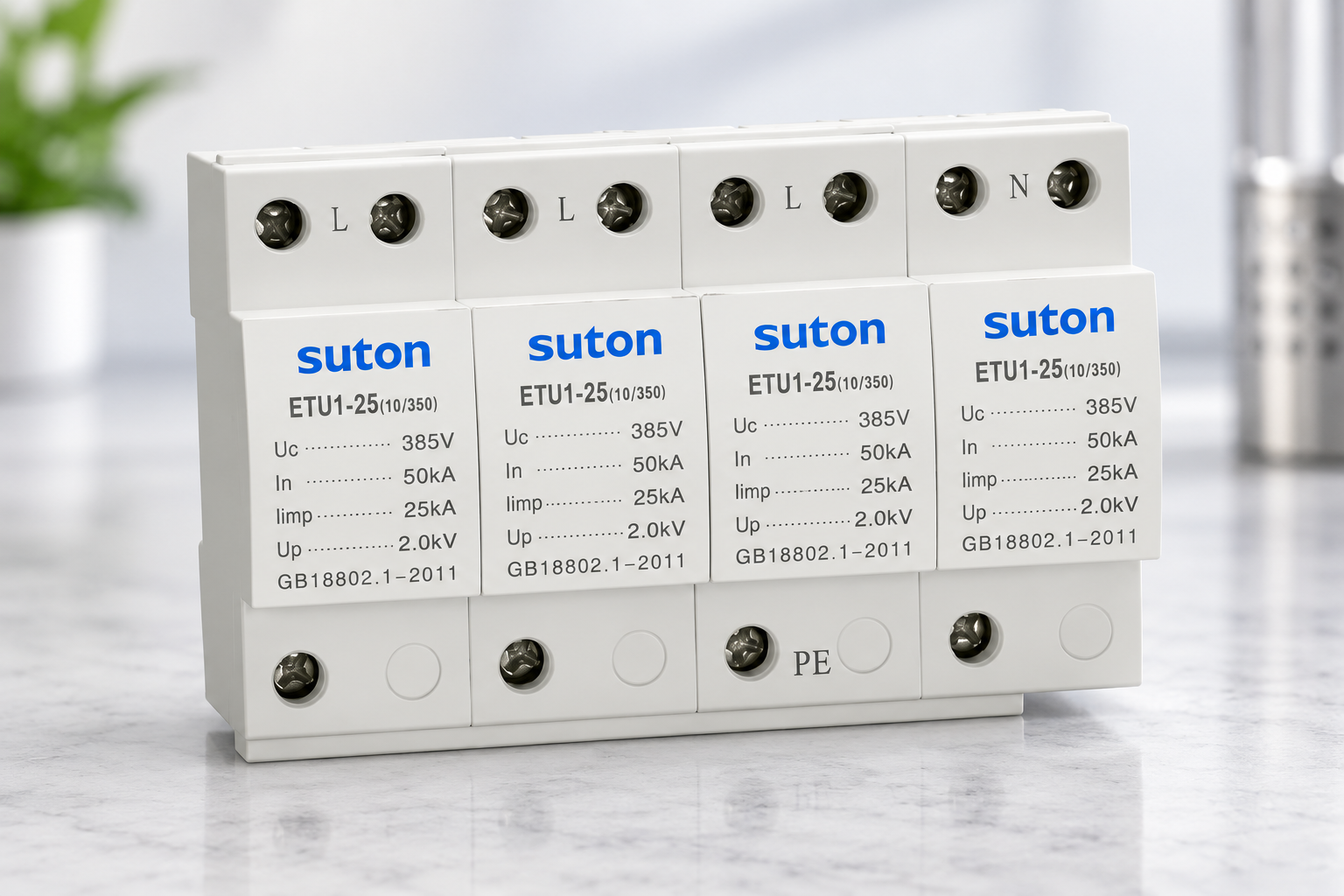
Request exact SUTON variants and written confirmation
The Trang thông tin về dòng sản phẩm bảo vệ quá dòng SUTON lists 2P and 1P+N among several arrangements. The multipole reference photograph is not a picture of every listed version and cannot establish their internal diagrams. Ask for photographs, drawings and datasheets for the exact candidates under consideration.
Provide the single-line diagram, grounding system, supply conditions, required standards category, prospective fault current, monitoring needs and existing upstream or downstream protection. Ask the supplier to complete the comparison fields and explain any difference from the requested circuit. A clear written response turns ambiguous labels into a model-specific procurement decision.
Các câu hỏi thường gặp
Are every 1P+N and 2P SPD interchangeable?
No. Compare exact internal paths, ratings and supported installation conditions.
Does the N module always have the same function as the phase module?
No. Confirm its technology, protective path and replacement code from the exact documentation.
Can module count prove standards category?
No. Type and tested duty require separate model-specific evidence.
Video giáo dục
Chống sét – Các nguyên tắc cơ bản do IAEI – Cơ quan thực thi pháp luật trong ngành điện. Buổi hội thảo về ngành công nghiệp và giáo dục này cung cấp thông tin cơ bản về các trường hợp sét và biện pháp phòng ngừa. Các thảo luận về khuôn khổ pháp lý cụ thể không nên được áp dụng như một quy tắc lắp đặt chung. Hãy sử dụng các tiêu chuẩn được áp dụng cho dự án của bạn và hướng dẫn của nhà sản xuất chính xác.