


A switch disconnector's rated short-time withstand current, Icw, describes its ability to carry a specified current for a stated short duration under declared conditions. It does not describe the same duty as interrupting that current. A conditional short-circuit rating refers to a specified protective combination, so the associated fuse or circuit breaker and its conditions matter. For a panel buyer, the essential task is to keep current magnitude, duration, peak duty and protective-device evidence connected. This guide explains a document-led review for low-voltage switch disconnectors and avoids using a single kA number as a complete approval.
Identify the fault duty at the installation point
Start with the approved system study and the switch's location on the single-line diagram. Record the available sources, prospective fault conditions and protective devices that affect that location. Utility, generator and other source arrangements can produce different conditions. A duty calculated for one operating mode should not automatically be carried into every alternative mode.
The responsible engineer must decide which characteristics the equipment needs to satisfy. The buyer's role is to obtain the correct evidence for the exact offered configuration. A catalogue statement such as “high short-circuit capacity” is insufficient because it can refer to different current duties. Ask the supplier to name the characteristic, its unit, its time basis where applicable and the protective arrangement to which it belongs.
Read Icw together with its duration
Icw is incomplete without the associated duration and conditions. A short-time withstand declaration expresses a carrying duty during a short-circuit condition; it is not a permission to leave a fault uncleared. The protective arrangement must act within the design's accepted limits. Record the stated time alongside the current in the schedule rather than placing it in a separate note that may be lost.
Do not convert a manufacturer's declaration to another duration using an assumed rule unless the manufacturer and applicable engineering method support that use. Nor should a higher current for a shorter time be treated as automatically superior to another declaration. The relevant question is whether the complete evidence matches the actual fault and clearing conditions of the installation.
Separate peak making duty from short-time carrying duty
Closing onto an existing fault can impose a peak duty that differs from the RMS current used in another rating. A short-circuit making characteristic, where declared, therefore answers a different question from Icw. Preserve the symbol and whether the value is peak or RMS when reading or copying a table.
O GSO preview of IEC 60947-1 lists Icw, making-current and conditional-current characteristics separately. Its terminology supports keeping those fields distinct. This article does not reproduce a test procedure or assign a making duty to a particular SUTON model. The exact product declaration and the applicable standards govern the proposed configuration.
Understand what a conditional rating requires
A conditional short-circuit rating depends on a specified protective arrangement and the conditions of its supporting evidence. If that evidence identifies a fuse-link or circuit breaker, its complete identity is part of the rating review. A different protective device cannot be assumed equivalent solely because it carries the same nominal current.
Ask for the manufacturer's approved combination information, including voltage and any other stated restrictions. Confirm whether the offered protection is actually included in the panel bill of materials. If a supplier quotes the switch and another party selects the protective device, assign responsibility for reconciling the combination before approval. Otherwise, two individually plausible quotations can leave the central coordination question unanswered.
Use a short-circuit evidence matrix
| Caraterística | Record with the value | O que não prova |
|---|---|---|
| Icw | RMS current, duration and applicable conditions | Fault interruption at the same current |
| Making duty | Peak or RMS basis and declaration | Equivalent short-time carrying capability |
| Conditional duty | Exact protective device and restrictions | Compatibility with any nominally similar fuse |
| Tensão | Circuit type and rated conditions | The same duty at every voltage |
| Operating mode | Source and fault-study revision | Suitability under an unreviewed source change |
| Configuração | Order code, poles and installation | Approval of every family member |
| Evidência | Manufacturer document and revision | Performance demonstrated by appearance |
This qualitative matrix is intended for procurement and document review. It does not calculate a permissible fault current or replace the protection study. For every accepted field, retain the applicable document and revision. If the source table uses an unfamiliar symbol or an unclear unit, request clarification rather than translating it from a similarly named characteristic on another product.
O Guia de capacidade de fabricação e ruptura de interruptores de comutação covers adjacent switching functions. The present review owns the short-time and conditional fault-evidence questions. Keeping these scopes separate prevents a normal load-breaking declaration from being mistaken for a fault-interruption declaration.
Read the HGL(ETGL) table without losing its headings
O SUTON HGL(ETGL) load-disconnector page publishes a short-time withstand row with a stated time basis, alongside other current and voltage characteristics across several sizes. It also describes different operating duties within the family. Preserve the entire relevant heading and configuration when requesting the offered model's datasheet.
Long range tables can be difficult to interpret after copying into a spreadsheet. Merged headings and differing numbers of size columns can create alignment mistakes. Ask the supplier to identify the exact row and column for the complete order code. This article deliberately does not select a current value from the web table as a project approval. The original table, model-specific document and engineering assessment belong together.
Keep voltage and utilization conditions attached
A fault-related declaration at one voltage does not automatically establish the same performance at another voltage. The AC or DC nature of the circuit and the connection arrangement also matter. Record these conditions in the comparison rather than assuming they are shared across every row of a brochure.
O IEC 60947-3 standard overview identifies switches, disconnectors, switch-disconnectors and fuse-combination units as the relevant product group. It also identifies conditional-rating developments in the standard. The full applicable documents and manufacturer's evidence must still be used for the actual design. A standard's scope is not a certificate for an individual product or a substitute for the offered configuration's declaration.
Review the upstream protective device as part of the assembly
Identify the exact fuse or breaker, settings where applicable and the configuration used in the supporting combination evidence. A nominal ampere value alone cannot describe its current-limiting or clearing behavior. If a protective-device setting changes, review whether the previously accepted switch arrangement remains within its conditions.
O circuit-breaker selectivity guide addresses another protection objective: which device operates for a fault. That objective is related to, but different from, protecting the switch against the applicable stresses. A system may need both objectives assessed. Do not assume that a statement about selectivity proves the conditional short-circuit suitability of the switching device.
Avoid using field appearance as fault-rating evidence
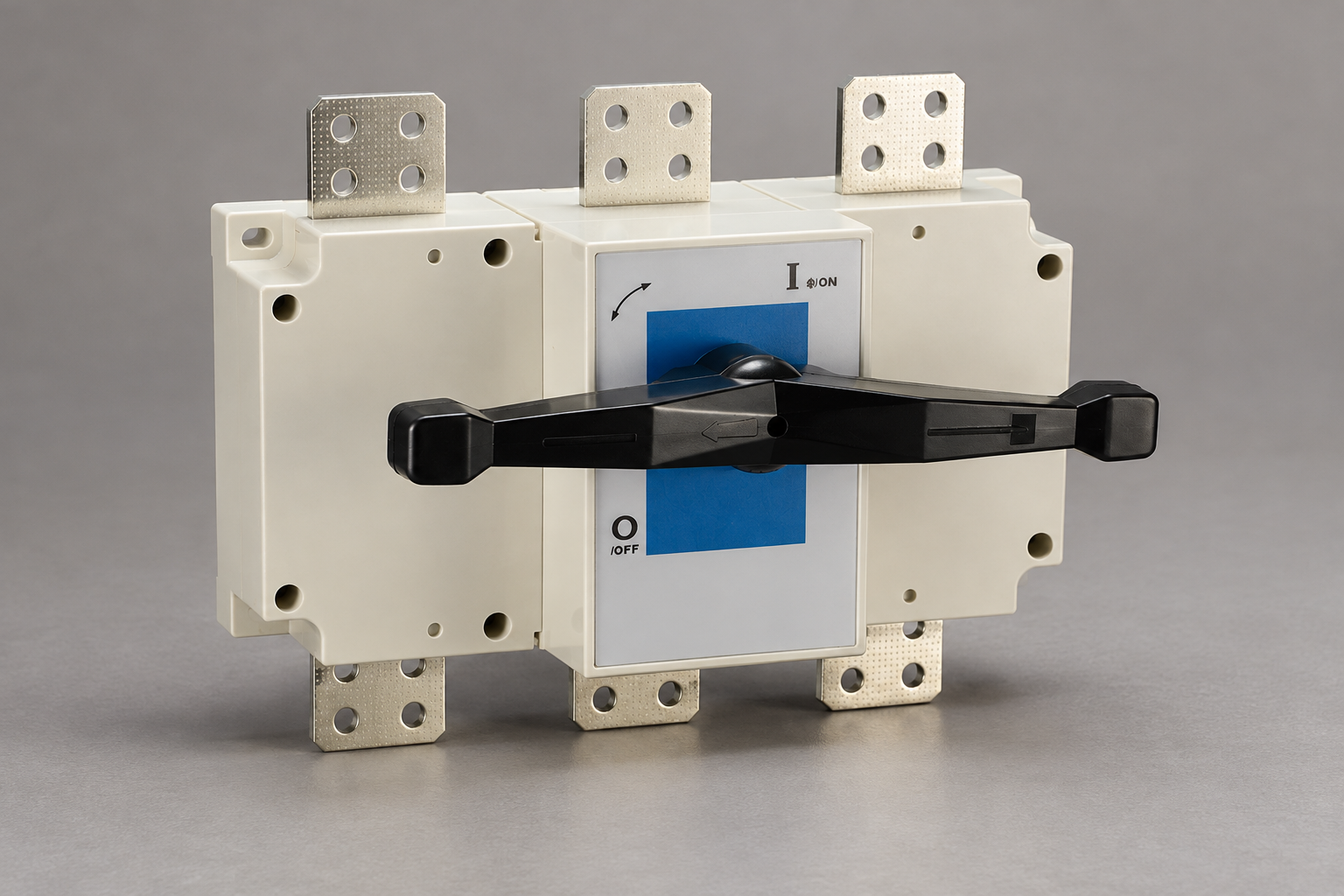
A large terminal, substantial handle or heavy enclosure does not establish a short-time withstand rating. Nor does a successful normal-load demonstration prove behavior during a fault. The required evidence is documentary and configuration-specific, supported by the applicable verification of the equipment and completed assembly.
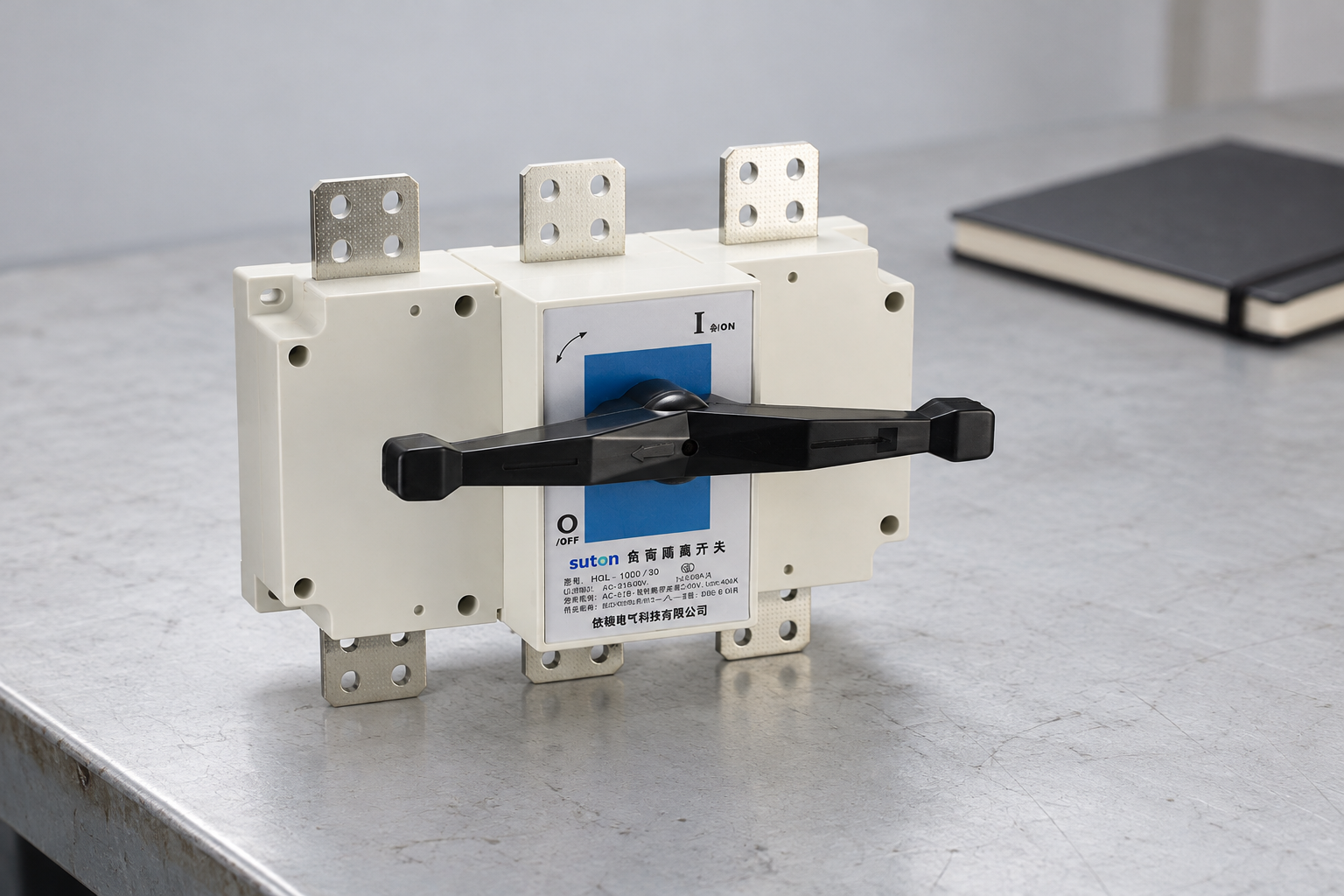
The reference illustrations in this article show the actual product family's exterior. They intentionally do not depict an internal fault test or claim a certified performance. Keep photographic identification separate from the rating review. If a supplier presents an attractive image without the relevant characteristic and conditions, leave that field unresolved rather than turning the image into a technical declaration.
Control substitutions and later source changes
A substitute switch should be compared against every relevant characteristic, not only normal current and mounting dimensions. Preserve the exact voltage, duration, peak duty, protective combination and installation restrictions from the approved schedule. If any characteristic differs, obtain the responsible engineer's decision before accepting the substitution.
Source changes can also matter. Adding a transformer, generator, parallel supply or different protective device may change the assumptions behind the original assessment. Keep the short-circuit evidence with the single-line revision so future changes trigger a meaningful review. An old approval should not be treated as permanent evidence for a materially different system.
O isolator switch planning guide provides the parent framework for defining the equipment role and installation boundary before comparing these fault characteristics.
Prepare a usable supplier request
Send the supplier the switch location, exact operating modes, voltage and circuit type, normal current, pole arrangement, prospective fault information and protective-device schedule. Ask for separate declarations of short-time withstand, relevant making duty and any conditional short-circuit combination relied upon. State which durations and documents the engineer needs to compare.
Retain unresolved questions and the final answers in the panel dossier. If the supplier cannot provide evidence for the proposed condition, request another supported configuration rather than filling the gap with a generic conversion or a competitor's value. The outcome should be a traceable relationship between the system study, offered switch and protective arrangement, with clear limits that remain visible during maintenance and future modification.
Perguntas frequentes
Does Icw mean the switch can interrupt that fault current?
No. It is a specified short-time carrying characteristic. Interruption and protection require their own declared functions and the appropriate protective arrangement.
Can the duration be omitted from an Icw comparison?
No. The time basis is part of the declaration. Keep it with the current and verify that the complete conditions match the design assessment.
Can a different fuse preserve a conditional rating automatically?
No. Confirm the exact approved combination and its conditions. Matching a nominal current or physical size alone does not establish equivalent fault performance.
Vídeo educativo
Lecture 35 Arc Interruption Theory in Circuit Breaker II by IIT Roorkee July 2018. This university lecture supports the arc-interruption principles relevant to load switching and arc chutes. It does not establish the internal design or rating of the illustrated SUTON product.