


If you engage in low-voltage power distribution, industrial cabinet assembly, commercial building electrical construction, or cross-border electrical component procurement, you must have seen robust shell-type switch devices inside power distribution cabinets. Such essential power protection hardware is officially named Molded Case Circuit Breakers, widely abbreviated as MCCB in global electrical industries. Countless overseas electrical engineers and procurement managers search for MCCB basic definitions, selection criteria and installation pitfalls every day, yet most online tutorials are overly technical or fragmented. Combining years of electrical manufacturing and cross-border delivery experience, this guide explains molded case circuit breakers in plain English, solves buyer pain points, and covers core industry knowledge to help you make reliable procurement decisions.
1. Basic Definition: What Is a Molded Case Circuit Breaker
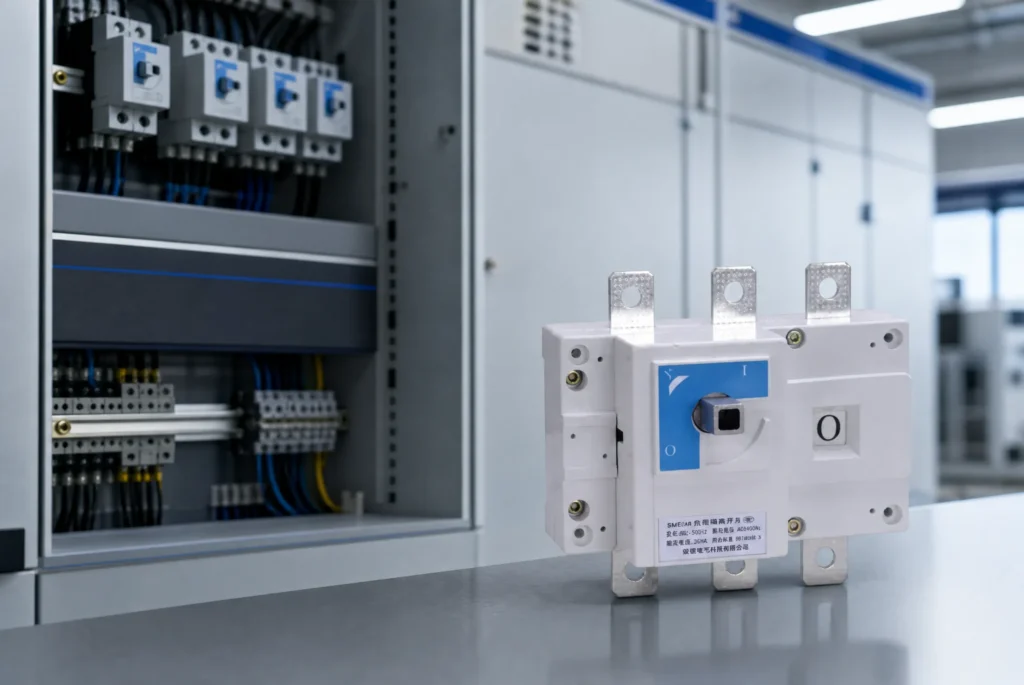
A molded case circuit breaker is a configurable low-voltage protection switch wrapped with insulated thermoplastic housing. Its internal parts including contactors, tripping mechanisms and arc extinguishing chambers are integrally encapsulated by high-temperature-resistant engineering plastic, which is the origin of the term “molded case”. Complying with IEC 60947-2 global electrical safety standards, it serves as core power distribution equipment to cut off abnormal current automatically and prevent electrical fires and equipment burnout.
Different from simple manual switches, it integrates three core protection functions: overload protection, short-circuit protection and phase loss protection. It can trigger automatic tripping within milliseconds once the circuit suffers sudden current surges or abnormal voltage. The insulated molded shell isolates internal charged components, effectively avoiding electric shock risks and arc leakage during equipment operation.
2. Core Working Principle of MCCB
The operating logic of molded case circuit breakers relies on two built-in induction components, matching mechanical linkage structures. For long-term circuit overload caused by excessive electrical loads, the thermal induction component heats up and deforms slowly, pushing the linkage to cut off the circuit to prevent wire aging. For instantaneous short-circuit faults with surging current, the magnetic induction component reacts instantly to release the locking structure and realize rapid power-off.
High-quality MCCBs add independent arc extinguishing grids inside the molded shell. When breaking heavy current, the grids can quickly cool and extinguish electric arcs, avoiding arc re-ignition that may damage distribution cabinets. This is also the key advantage distinguishing qualified industrial MCCBs from low-cost counterfeit products.
3. Main Classifications and Practical Application Scenarios
According to internal tripping modes and load grades, mainstream molded case circuit breakers on the global market are divided into three types, targeting differentiated engineering scenarios, which is the core reference for bulk procurement:
Thermal-magnetic MCCB: The most cost-effective mainstream model, equipped with dual thermal and magnetic tripping systems. It fits conventional factory power distribution, shopping mall electrical systems and warehouse low-voltage cabinets, occupying nearly 75% of global MCCB procurement volume.
Electronic MCCB: Adopts digital electronic sensing modules to replace traditional mechanical induction parts, featuring adjustable current precision. It matches smart power grids, data center power supply systems and new energy energy storage cabinets with strict power parameter requirements.
Motor-protection MCCB: Optimized anti-shock tripping program, avoiding false tripping caused by motor startup instant current. It is specially customized for water pumps, production line motors and industrial automation equipment.
Related long-tail keywords: industrial low voltage mccb, electronic molded case circuit breaker, motor protection circuit breaker for automation
4. MCCB VS MCB: Avoid Most Common Buyer Confusion
Most beginner electrical buyers mix up MCCB and MCB, both categorized as circuit breakers but with huge differences in load capacity and usage. MCB refers to miniature circuit breakers, with compact size and low breaking capacity, only suitable for household lighting, office socket wiring and other low-current scenarios below 125A.
In comparison, Molded Case Circuit Breakers bear higher rated current ranging from 125A to 1600A, with stronger short-circuit breaking capacity and environmental resistance. Their thick insulated shell can resist vibration, dust and high temperature, so they are exclusively applied to main power inlet protection of industrial and large commercial projects. Simply put: MCB protects terminal electrical appliances, while MCCB protects overall distribution circuits.
5. Key Selection Factors for Overseas Bulk Buyers
Improper MCCB selection will lead to frequent false tripping, cabinet burnout or even cross-border customs rejection. We sorted four must-check factors based on after-sales data of global electrical projects, conforming to Google E-E-A-T industry credibility standards:
Rated Current and Breaking Capacity: Do not blindly pursue high current parameters. Buyers need to confirm local grid voltage and peak load current first. Excessively large rated current will lose protection effects, while overlarge breaking capacity raises procurement costs unnecessarily.
Shell Insulation Material: Industrial-grade MCCBs adopt flame-retardant PA66 engineering plastic, with fireproof and anti-aging performance. Inferior recycled plastic shells are prone to cracking and ignition under high temperature, which is the biggest hidden danger of cheap non-standard breakers.
Auxiliary Function Matching: For remote monitoring projects, select MCCBs with shunt release and alarm contacts; for humid coastal areas, prioritize corrosion-resistant hardware accessories to extend service life.
International Compliance Certifications: Export-oriented orders must verify IEC, CE and UL certificates. Uncertified molded case circuit breakers will face customs seizure and cannot be put into official engineering use.
6. Frequently Asked Questions (FAQ) From Global MCCB Buyers
6.1 What is the difference between MCCB and MCB?
The biggest gap lies in load capacity and application scenarios. MCB, or miniature circuit breaker, is designed for low-current household and light commercial wiring with rated current below 125A. By contrast, molded case circuit breakers support 125A to 1600A high current, built for heavy-load industrial and commercial power distribution.
6.2 Are molded case circuit breakers reusable after tripping?
Yes, qualified molded case circuit breakers are reusable electrical protective devices. Unlike disposable fuses, they adopt mechanical tripping structures. After eliminating circuit faults such as overload and short circuit, engineers can manually reset the breaker for repeated use, greatly cutting operation and replacement costs.
6.3 What certifications do exported MCCBs need?
For cross-border electrical export, mainstream mandatory certifications include IEC 60947-2 international standard certification, CE certification for European markets, and UL certification for North American projects. Bulk buyers should ask suppliers for official test reports to avoid customs detention.
6.4 Can MCCBs be installed on DIN rail?
Most compact-size molded case circuit breakers support standard 35mm top-hat DIN rail mounting, while large-current heavy-duty models require fixed base installation. It is necessary to confirm installation dimensions before panel assembly.
7. Common Procurement Mistakes to Prevent
Many overseas purchasers fall into price traps when ordering low-voltage circuit breakers. The top mistake is purchasing non-certified low-cost MCCBs with recycled plastic shells. Such products suffer shell deformation and tripping failure under continuous heavy load, easily triggering industrial electrical accidents. The second mistake is ignoring terminal size matching; mismatched wiring terminals will cause poor contact and heat accumulation after long-term operation.
Besides, some buyers overlook shipping protection requirements. Molded case circuit breakers have precise internal mechanical structures, and collision damage during sea freight will damage tripping components. Reliable suppliers will adopt anti-collision foam packaging and provide factory inspection reports to reduce cross-border after-sales risks.
To sum up, a molded case circuit breaker is a standardized, reusable low-voltage protective switch with insulated molded housing, focusing on medium and high-current power distribution protection scenarios that miniature breakers cannot bear. Distinguished from MCB by load capacity and structural durability, qualified MCCBs need compliant certifications, flame-retardant shell materials and matched current parameters to guarantee engineering safety. For global electrical contractors and bulk procurement teams, distinguishing product specifications and avoiding low-quality counterfeits can stabilize power system operation and control long-term project costs. If you need customized parameters, bulk quotation or certification verification of industrial breakers, you can reach out to our electrical engineering team for professional one-stop support.